

CURVE SKETCHING (GRAPHS) D 113
Fig. 15-38
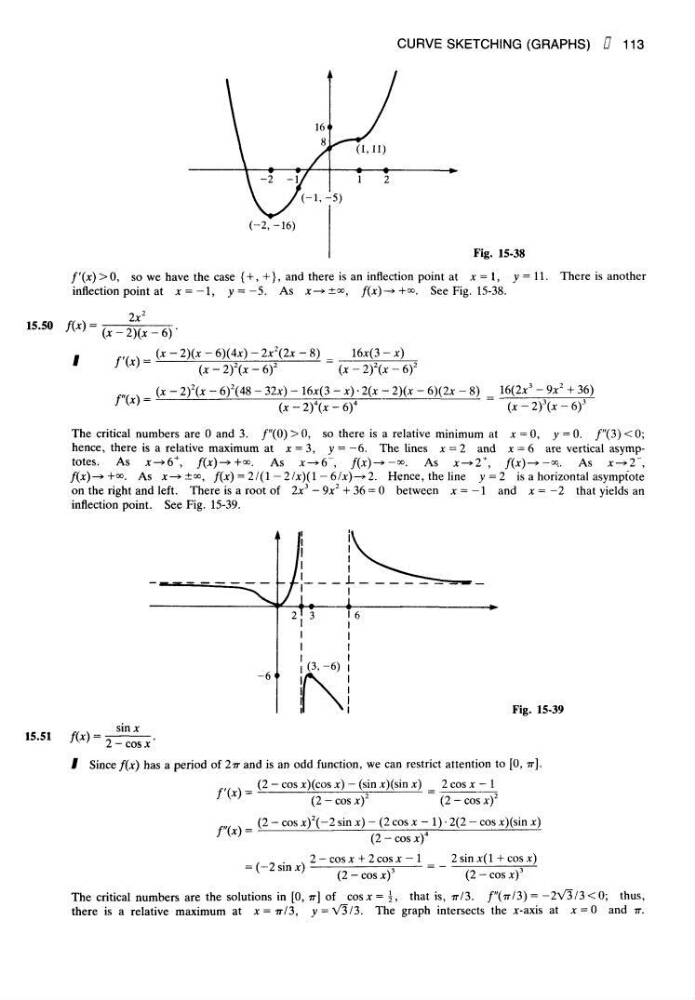
/'(x)>0, so we have the case { + , +}, and there is an inflection point at x = 1, y = 11. There is another
inflection point at * = —1, y = —5. As x—>±«>, /(*)—»+°°- See Fig. 15-38.
Fig. 15-39
The critical numbers are the solutions in [0, TT] of cos*= \, that is, ir/3. f"(ir/3)= -2V3/3<0; thus,
there is a relative maximum at x = ir/3, y = V3/3. The graph intersects the Jt-axis at x = 0 and ir.
Since f(x) has a period of 2w and is an odd function, we can restrict attention to [0, TT].
15.51
The critical numbers are 0 and 3. /"(O) > 0, so there is a relative minimum at x = 0, y = 0. /"(3) < 0;
hence, there is a relative maximum at je = 3, y — -6. The lines jc = 2 and x = 6 are vertical asymptotes. As *-»6
+ , /(*)-»+<». As *-*6~, /(*)-»-<». As x->2
+ , /(x)-»-oi. As A:->2",
/(jc)-»+«>. As x^»±co, /(Ac) = 2/(l-2/j:)(l-6/Ac)-»2. Hence, the line y = 2 is a horizontal asymptote
on the right and left. There is a root of 2x
3 - 9x
2 + 36 = 0 between x =-1 and ^=-2 that yields an
inflection point. See Fig. 15-39.
15.50
Fig. 15-38
/'(x)>0, so we have the case { + , +}, and there is an inflection point at x = 1, y = 11. There is another
inflection point at * = —1, y = —5. As x—>±«>, /(*)—»+°°- See Fig. 15-38.
Fig. 15-39
The critical numbers are the solutions in [0, TT] of cos*= \, that is, ir/3. f"(ir/3)= -2V3/3<0; thus,
there is a relative maximum at x = ir/3, y = V3/3. The graph intersects the Jt-axis at x = 0 and ir.
Since f(x) has a period of 2w and is an odd function, we can restrict attention to [0, TT].
15.51
The critical numbers are 0 and 3. /"(O) > 0, so there is a relative minimum at x = 0, y = 0. /"(3) < 0;
hence, there is a relative maximum at je = 3, y — -6. The lines jc = 2 and x = 6 are vertical asymptotes. As *-»6
+ , /(*)-»+<». As *-*6~, /(*)-»-<». As x->2
+ , /(x)-»-oi. As A:->2",
/(jc)-»+«>. As x^»±co, /(Ac) = 2/(l-2/j:)(l-6/Ac)-»2. Hence, the line y = 2 is a horizontal asymptote
on the right and left. There is a root of 2x
3 - 9x
2 + 36 = 0 between x =-1 and ^=-2 that yields an
inflection point. See Fig. 15-39.
15.50