

114 0 CHAPTER 15
There is an inflection point where
x = TT. See Fig. 15-40.
f"(x) = 0, that is, where sinjc = 0 or cosje=-l, namely, x = 0,
Fig. 15-41
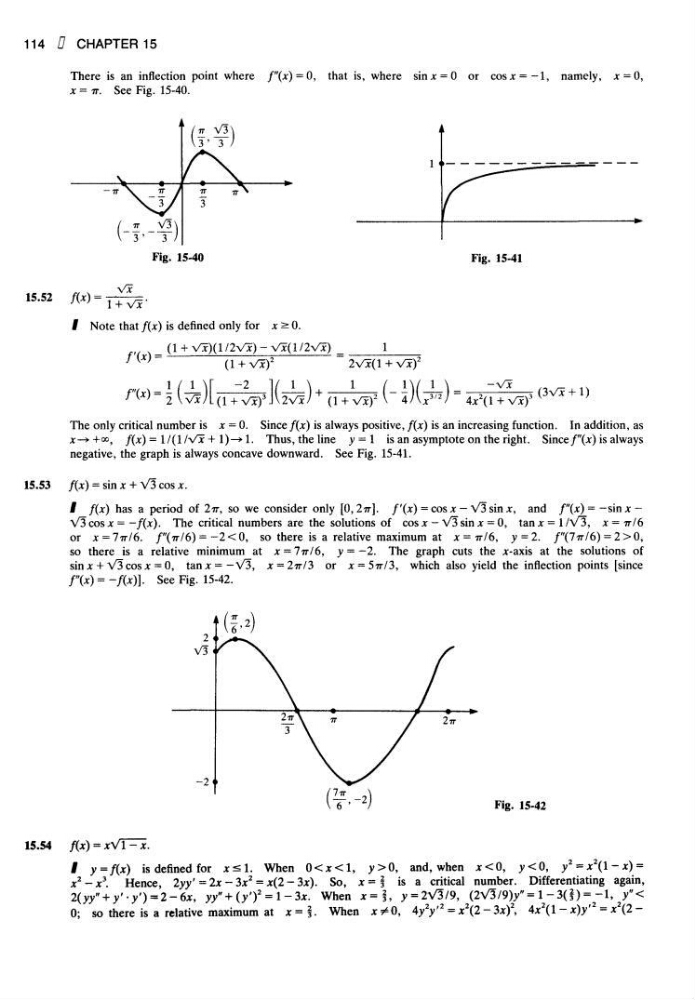
The only critical number is x = 0. Since /(x) is always positive, f(x) is an increasing function. In addition, as
jc—> +°°, /(*) = 1 /(I /V* + 1)—> 1. Thus, the line y = l is an asymptote on the right. Since/"(•*) is always
negative, the graph is always concave downward. See Fig. 15-41.
15.53 f(x) = sin x + V5 cos x.
I f(x) has a period of 2ir, so we consider only [0, 2ir]. f'(x) = cosx — V3sinx, and /"(*) = — sin x —
VScos x = -f(x). The critical numbers are the solutions of cos x — VSsinAc =0, tan^ = l/V
r 3, x = irl6
or jc = ?7r/6. /"(ir/6) = -2<0, so there is a relative maximum at A; = Tr/6, y=2. f"(7ir/6) = 2 > 0,
so there is a relative minimum at x = 777/6, y = — 2. The graph cuts the *-axis at the solutions of
sin x + V3 cos x = 0, tan;t=— V5, x = 2ir/3 or x = 57r/3, which also yield the inflection points [since
/"(*) = -/«]. See Fig. 15-42.
Fig. 15-42
Fig. 15-40
15.52
15.54
| y=f(x) isdefinedfor x0, and, when *<0, y<0, y
2 = x
2 (\ - x)• =
x
2 - x
3 . Hence, 2yy' = 2x- 3x
2 = x(2 - 3*). So, x = § is a critical number. Differentiating again,
2(yy + /-.y') = 2-6x, y/'+ (y')
2 = 1 ~3*. When je=§, y = 2V3/9, (2V3/9)/'= 1-3(|)=-1, >"<
0; so there is a relative maximum at x = f. When * * 0, 4/y'
2 = x\2 - 3x)
2
, 4x
2 (l - x)y'
2 = x\2 -
Note that f(x) is denned only for x > 0.
There is an inflection point where
x = TT. See Fig. 15-40.
f"(x) = 0, that is, where sinjc = 0 or cosje=-l, namely, x = 0,
Fig. 15-41
The only critical number is x = 0. Since /(x) is always positive, f(x) is an increasing function. In addition, as
jc—> +°°, /(*) = 1 /(I /V* + 1)—> 1. Thus, the line y = l is an asymptote on the right. Since/"(•*) is always
negative, the graph is always concave downward. See Fig. 15-41.
15.53 f(x) = sin x + V5 cos x.
I f(x) has a period of 2ir, so we consider only [0, 2ir]. f'(x) = cosx — V3sinx, and /"(*) = — sin x —
VScos x = -f(x). The critical numbers are the solutions of cos x — VSsinAc =0, tan^ = l/V
r 3, x = irl6
or jc = ?7r/6. /"(ir/6) = -2<0, so there is a relative maximum at A; = Tr/6, y=2. f"(7ir/6) = 2 > 0,
so there is a relative minimum at x = 777/6, y = — 2. The graph cuts the *-axis at the solutions of
sin x + V3 cos x = 0, tan;t=— V5, x = 2ir/3 or x = 57r/3, which also yield the inflection points [since
/"(*) = -/«]. See Fig. 15-42.
Fig. 15-42
Fig. 15-40
15.52
15.54
| y=f(x) isdefinedfor x
2 = x
2 (\ - x)• =
x
2 - x
3 . Hence, 2yy' = 2x- 3x
2 = x(2 - 3*). So, x = § is a critical number. Differentiating again,
2(yy + /-.y') = 2-6x, y/'+ (y')
2 = 1 ~3*. When je=§, y = 2V3/9, (2V3/9)/'= 1-3(|)=-1, >"<
0; so there is a relative maximum at x = f. When * * 0, 4/y'
2 = x\2 - 3x)
2
, 4x
2 (l - x)y'
2 = x\2 -
Note that f(x) is denned only for x > 0.