

112 0 CHAPTER 15
Fig. 15-36
Fig. 15-37
15.49
I f(x) = x
4 - 6x
2 + 8x + 8.
I /'(^) = 4x
3 - 12* + 8 = 4(x
3 -3x + 2), and /"(*) = 12x
2 - 12 = 12(^r
2 - 1) = I2(x - l)(x + 1). The critical
numbers are the solutions of JT
J — 3x + 2 = 0. Inspecting the integral factors of the constant term 2, we see that
1 is a root. Dividing x
3 - 3x + 2 by x-l, we obtain the quotient x
2 + x - 2 - (x - l)(x + 2). Hence,
/'(*) = 4(x - l)
2
(* + 2). Thus, the critical numbers are 1 and -2. /"(-2) = 36 > 0, so there is a relative
minimum at x = -2, y = -16. At x=l, use the first-derivative test. To the right and left of x = 1,
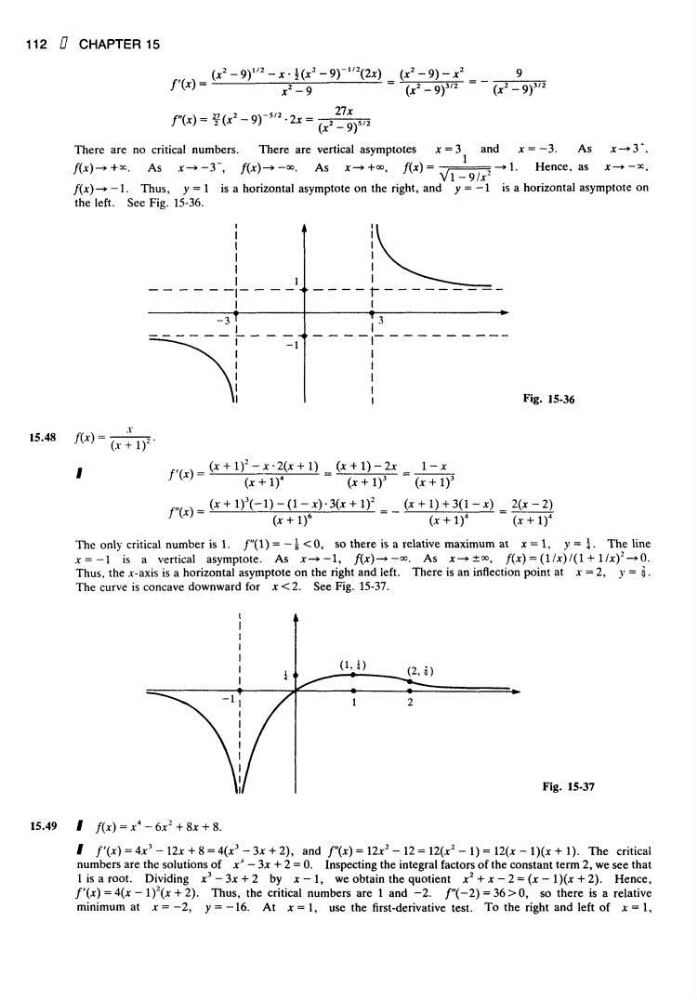
There are no critical numbers. There are vertical asymptotes jc = 3 and
x = — 3.
As x—>3*.
/(*)->+*. As x-*-3~, /(*)-»-°°. As *-»+°°, f(x) = —=== -»• 1. Hence, as x-*-*,
VI -9/jr"
f(x)-*-\. Thus, >> = 1 is a horizontal asymptote on the right, and y =-I is a horizontal asymptote on
the left. See Fig. 15-36.
15.48
The only critical number is 1. /"(!)=-g <0, so there is a relative maximum at x = \, y=\. The line
x=-\ is a vertical asymptote. As *-+-!, f(x)-*-°°. As *-»±«>, f(x) = (l/jr)/(l + l/jf)
2 -*0.
Thus, the *-axis is a horizontal asymptote on the right and left. There is an inflection point at x = 2, y = §.
The curve is concave downward for * <2. See Fig. 15-37.
Fig. 15-36
Fig. 15-37
15.49
I f(x) = x
4 - 6x
2 + 8x + 8.
I /'(^) = 4x
3 - 12* + 8 = 4(x
3 -3x + 2), and /"(*) = 12x
2 - 12 = 12(^r
2 - 1) = I2(x - l)(x + 1). The critical
numbers are the solutions of JT
J — 3x + 2 = 0. Inspecting the integral factors of the constant term 2, we see that
1 is a root. Dividing x
3 - 3x + 2 by x-l, we obtain the quotient x
2 + x - 2 - (x - l)(x + 2). Hence,
/'(*) = 4(x - l)
2
(* + 2). Thus, the critical numbers are 1 and -2. /"(-2) = 36 > 0, so there is a relative
minimum at x = -2, y = -16. At x=l, use the first-derivative test. To the right and left of x = 1,
There are no critical numbers. There are vertical asymptotes jc = 3 and
x = — 3.
As x—>3*.
/(*)->+*. As x-*-3~, /(*)-»-°°. As *-»+°°, f(x) = —=== -»• 1. Hence, as x-*-*,
VI -9/jr"
f(x)-*-\. Thus, >> = 1 is a horizontal asymptote on the right, and y =-I is a horizontal asymptote on
the left. See Fig. 15-36.
15.48
The only critical number is 1. /"(!)=-g <0, so there is a relative maximum at x = \, y=\. The line
x=-\ is a vertical asymptote. As *-+-!, f(x)-*-°°. As *-»±«>, f(x) = (l/jr)/(l + l/jf)
2 -*0.
Thus, the *-axis is a horizontal asymptote on the right and left. There is an inflection point at x = 2, y = §.
The curve is concave downward for * <2. See Fig. 15-37.