

CURVE SKETCHING (GRAPHS) 0 103
Fig. 15-6
Fig. 15-7
f(x) = x
2 + 2/x.
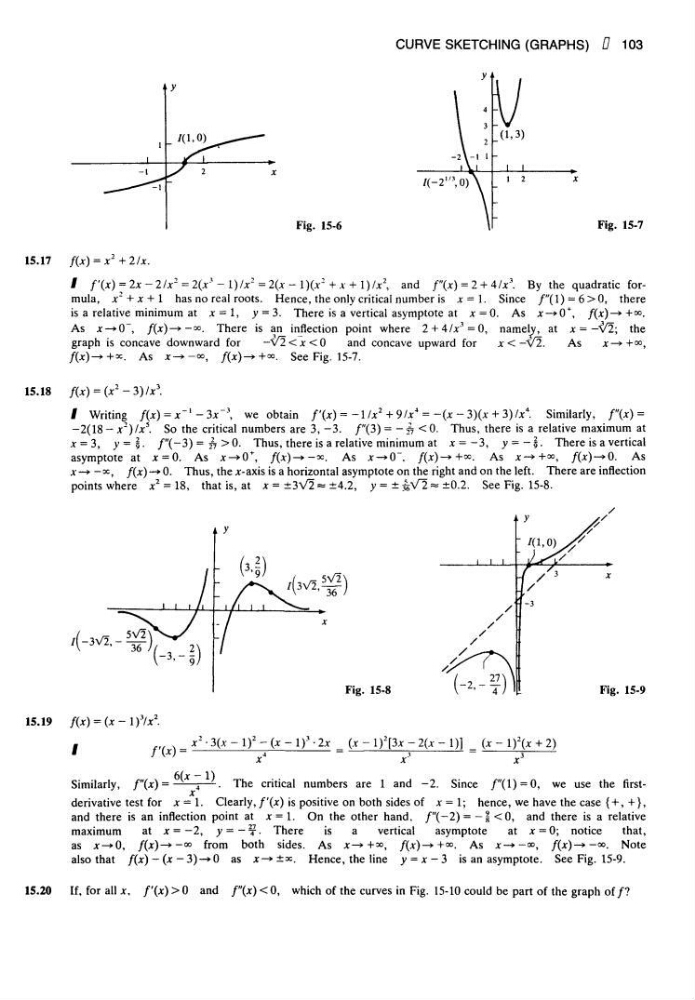
I f'(x) = 2x-2/x2 = 2(x3 -l)/x2 = 2(x-l)(x2+x + l)/x\ and /" (x) = 2 + 4 lx\ By the quadratic formula, x
2 + x + 1 has no real roots. Hence, the only critical number is x = 1. Since /"(I) = 6 > 0, there
is a relative minimum at x = l, y = 3. There is a vertical asymptote at x =0. As *-*0
+ , /(*)-> +°°As x— >0~, /(*)-»-°°. There is an inflection point where 2 + 4/*
3 =0, namely, at x = -i/2; the
graph is concave downward for
— V2<:c<0
and concave upward for
x < — V2.
As
x— » +=°,
/(*)->+:>=. As *-»-<», /(*)-» +°°. See Fig. 15-7.
f(x) = (x
2 -l)/x
3 .
I Writing f(x) = x> -3x} , we obtain /'(*) = ~l/x
2 + 9/x* = -(x - 3)(x + 3)/x\ Similarly, f"(x) =
-2(18 - x
2 )/x
5 . So the critical numbers are 3, -3. /"(3) = -f? <0. Thus, there is a relative maximum at
x = 3, _y=|. /"(~3)=n
> 0. Thus, there is a relative minimum at x = -3, y--\. There is a vertical
asymptote at x = 0. As x->0
+ , /(*)-»-*. As Af-*0~, /(j:)-»+=o. As A:-»+», /(jc)-^o. As
jc->-=e, /(*)-»0. Thus, the Jt-axis is a horizontal asymptote on the right and on the left. There are inflection
points where x
2 = 18, that is, at x = ±3V2 = ±4.2, y = ± ^Vl = ±0.2. See Fig. 15-8.
Fig. 15-8
Fig. 15-9
15.19
derivative test for x = 1. Clearly, f'(x) is positive on both sides of AT = 1; hence, we have the case { + , +},
and there is an inflection point at x = l. On the other hand, /"(~2) = — | <0, and there is a relative
maximum
at x = — 2, y — —
2 }. There
is
a
vertical
asymptote
at x = 0; notice
that,
as jc-»0, /(*)-> -°° from both sides. As x-* +», f(x)-*+<*>. As A:-*-", /(jc)-»-oo. Note
also that f(x) - (A: — 3)— »0 as x— > ±=e. Hence, the line y = x — 3 is an asymptote. See Fig. 15-9.
15.20
If, for all A:, f'(x)>0 and /"(A:)
15.18
Similarly,
The critical numbers are 1 and -2. Since /"(1) = 0, we use the firstf(x)=(x-1)3/x2
Fig. 15-6
Fig. 15-7
f(x) = x
2 + 2/x.
I f'(x) = 2x-2/x2 = 2(x3 -l)/x2 = 2(x-l)(x2+x + l)/x\ and /" (x) = 2 + 4 lx\ By the quadratic formula, x
2 + x + 1 has no real roots. Hence, the only critical number is x = 1. Since /"(I) = 6 > 0, there
is a relative minimum at x = l, y = 3. There is a vertical asymptote at x =0. As *-*0
+ , /(*)-> +°°As x— >0~, /(*)-»-°°. There is an inflection point where 2 + 4/*
3 =0, namely, at x = -i/2; the
graph is concave downward for
— V2<:c<0
and concave upward for
x < — V2.
As
x— » +=°,
/(*)->+:>=. As *-»-<», /(*)-» +°°. See Fig. 15-7.
f(x) = (x
2 -l)/x
3 .
I Writing f(x) = x> -3x} , we obtain /'(*) = ~l/x
2 + 9/x* = -(x - 3)(x + 3)/x\ Similarly, f"(x) =
-2(18 - x
2 )/x
5 . So the critical numbers are 3, -3. /"(3) = -f? <0. Thus, there is a relative maximum at
x = 3, _y=|. /"(~3)=n
> 0. Thus, there is a relative minimum at x = -3, y--\. There is a vertical
asymptote at x = 0. As x->0
+ , /(*)-»-*. As Af-*0~, /(j:)-»+=o. As A:-»+», /(jc)-^o. As
jc->-=e, /(*)-»0. Thus, the Jt-axis is a horizontal asymptote on the right and on the left. There are inflection
points where x
2 = 18, that is, at x = ±3V2 = ±4.2, y = ± ^Vl = ±0.2. See Fig. 15-8.
Fig. 15-8
Fig. 15-9
15.19
derivative test for x = 1. Clearly, f'(x) is positive on both sides of AT = 1; hence, we have the case { + , +},
and there is an inflection point at x = l. On the other hand, /"(~2) = — | <0, and there is a relative
maximum
at x = — 2, y — —
2 }. There
is
a
vertical
asymptote
at x = 0; notice
that,
as jc-»0, /(*)-> -°° from both sides. As x-* +», f(x)-*+<*>. As A:-*-", /(jc)-»-oo. Note
also that f(x) - (A: — 3)— »0 as x— > ±=e. Hence, the line y = x — 3 is an asymptote. See Fig. 15-9.
15.20
If, for all A:, f'(x)>0 and /"(A:)
15.18
Similarly,
The critical numbers are 1 and -2. Since /"(1) = 0, we use the firstf(x)=(x-1)3/x2