

104 D CHAPTER 15
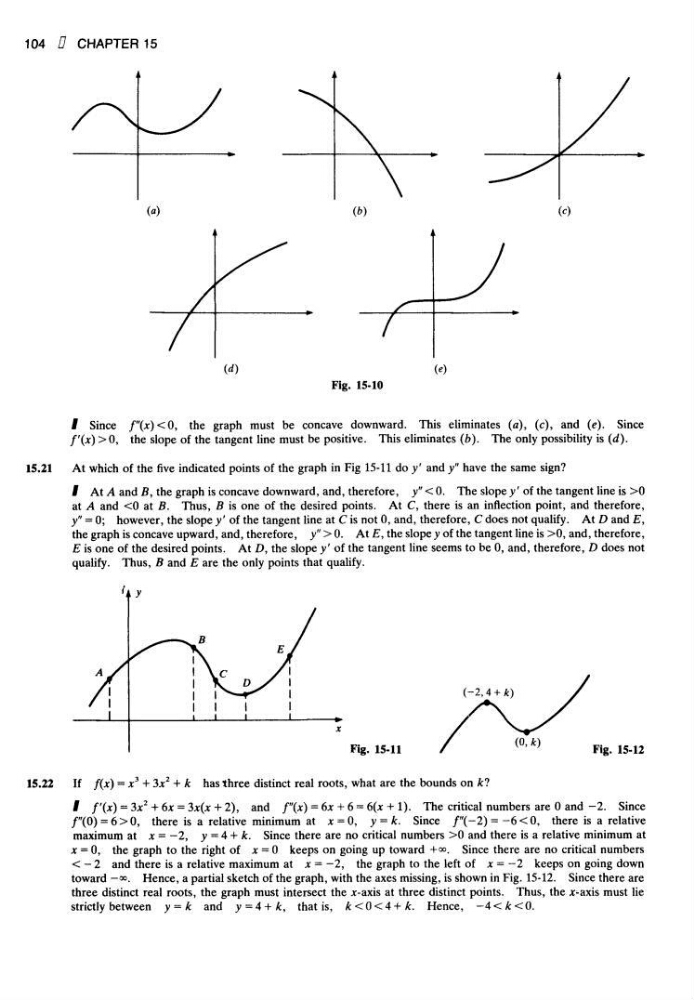
Fig. 15-10
I Since
f'(x)>0,
/"(*)<0, the graph must be concave downward. This eliminates (a), (c), and (e). Since
the slope of the tangent line must be positive. This eliminates (fo). The only possibility is (d).
15.21
At which of the five indicated points of the graph in Fig 15-11 do y' and y" have the same sign?
I At A and B, the graph is concave downward, and, therefore, y"<0. The slope y' of the tangent line is >0
at A and <0 at B. Thus, B is one of the desired points. At C, there is an inflection point, and therefore,
y" = 0; however, the slope y' of the tangent line at C is not 0, and, therefore, C does not qualify. At D and E,
the graph is concave upward, and, therefore, y" > 0. At E, the slope y of the tangent line is >0, and, therefore,
E is one of the desired points. At D, the slope y' of the tangent line seems to be 0, and, therefore, D does not
qualify. Thus, B and E are the only points that qualify.
Fig. 15-11
Fig. 15-12
15.22 If f(x) = x
3 + 3x
2 + k has three distinct real roots, what are the bounds on kl
I f'(x) = 3x
2 + 6x = 3x(x + 2), and /"(*) = 6* + 6 = 6(* + 1). The critical numbers are 0 and-2. Since
/"(0) = 6>0, there is a relative minimum at x = 0, y = k. Since /"(-2) =-6<0, there is a relative
maximum at x = —2, y = 4 + k. Since there are no critical numbers >0 and there is a relative minimum at
x = 0, the graph to the right of x = 0 keeps on going up toward +<». Since there are no critical numbers
< - 2 and there is a relative maximum at x = -2, the graph to the left of x = -2 keeps on going down
toward -°°. Hence, a partial sketch of the graph, with the axes missing, is shown in Fig. 15-12. Since there are
three distinct real roots, the graph must intersect the x-axis at three distinct points. Thus, the *-axis must lie
strictly between y = k and y = 4+k, that is, k<0<4+k. Hence, -4
<&)
(c)
(«)
(«o
Fig. 15-10
I Since
f'(x)>0,
/"(*)<0, the graph must be concave downward. This eliminates (a), (c), and (e). Since
the slope of the tangent line must be positive. This eliminates (fo). The only possibility is (d).
15.21
At which of the five indicated points of the graph in Fig 15-11 do y' and y" have the same sign?
I At A and B, the graph is concave downward, and, therefore, y"<0. The slope y' of the tangent line is >0
at A and <0 at B. Thus, B is one of the desired points. At C, there is an inflection point, and therefore,
y" = 0; however, the slope y' of the tangent line at C is not 0, and, therefore, C does not qualify. At D and E,
the graph is concave upward, and, therefore, y" > 0. At E, the slope y of the tangent line is >0, and, therefore,
E is one of the desired points. At D, the slope y' of the tangent line seems to be 0, and, therefore, D does not
qualify. Thus, B and E are the only points that qualify.
Fig. 15-11
Fig. 15-12
15.22 If f(x) = x
3 + 3x
2 + k has three distinct real roots, what are the bounds on kl
I f'(x) = 3x
2 + 6x = 3x(x + 2), and /"(*) = 6* + 6 = 6(* + 1). The critical numbers are 0 and-2. Since
/"(0) = 6>0, there is a relative minimum at x = 0, y = k. Since /"(-2) =-6<0, there is a relative
maximum at x = —2, y = 4 + k. Since there are no critical numbers >0 and there is a relative minimum at
x = 0, the graph to the right of x = 0 keeps on going up toward +<». Since there are no critical numbers
< - 2 and there is a relative maximum at x = -2, the graph to the left of x = -2 keeps on going down
toward -°°. Hence, a partial sketch of the graph, with the axes missing, is shown in Fig. 15-12. Since there are
three distinct real roots, the graph must intersect the x-axis at three distinct points. Thus, the *-axis must lie
strictly between y = k and y = 4+k, that is, k<0<4+k. Hence, -4
<&)
(c)
(«)
(«o