

102 0 CHAPTER 15
15.13 f(x) = x(x - 2)
2
.
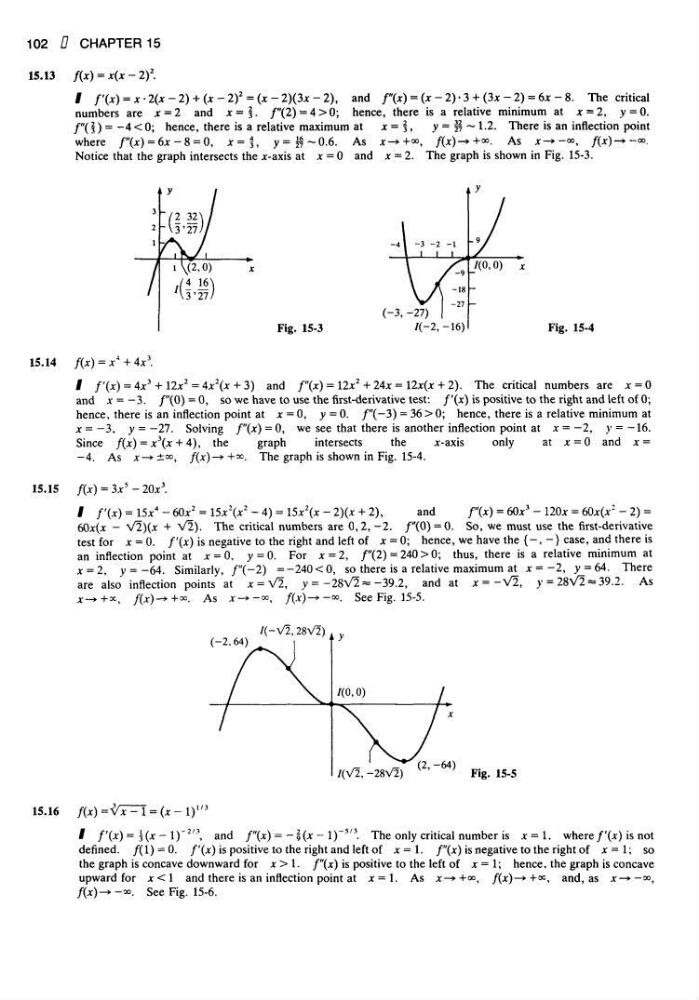
| f'( x) = x.2(x-2) + (x-2)2 = (x-2)(3x-2), and f"(x) = (x -2)-3 + (3* -2) = 6* -8. The critical
numbers are jc = 2 and jc=|. /"(2) = 4>0; hence, there is a relative minimum at Jt = 2, y=0.
/"(|) = -4 < Q; hence, there is a relative maximum at * = |, y = H ~ 1.2. There is an inflection point
where /"(*) = 6* - 8 = 0, x=§, y=$~0.6. As x -»+«>, /(*)-»+00. As x-»-oo, /(*)-»-°°.
Notice that the graph intersects the x-axis at x = 0 and x-2. The graph is shown in Fig. 15-3.
Fig. 15-3
Fig. 15-4
15.14
f(x) = x*+4x
3 .
15.15
I f'( x ) = 4x
3 + 12x
2 = 4x
2 (x + 3) and /"(*) = 12x
2 + 24x = 12X* + 2). The critical numbers are x = 0
and x = -3. /"(O) = 0, so we have to use the first-derivative test: f'(x) is positive to the right and left of 0;
hence, there is an inflection point at x = Q, y = 0. /"(-3) = 36>0; hence, there is a relative minimum at
x=—3, y = —27. Solving f"(x) = 0, we see that there is another inflection point at x = — 2, y = —16.
Since f(x) = x
} (x + 4), the
graph
intersects
the
AT-axis
only
at x = 0 and x =
—4. As x—* ±o°, /(*)—»+<». The graph is shown in Fig. 15-4.
Fig. 15-5
15.16
' /'W = s(jf - l)"
2/ "\ an
d
/"(*) = ~i(
x ~ V'*- The only critical number is x = l, where/'(*) is not
denned. /(1) = 0. f'(x) is positive to the right and left of x = \. f"(x) is negative to the right of jc=l; so
the graph is concave downward for x > 1. f"(x) is positive to the left of x = 1; hence, the graph is concave
upward for x
/(A:) = 3A:
5 - 2(k
3
.
I /'(A:) = 15A:
4 -60jc
2 = 15xV-4) = 15A:
2 (^-2)(A: + 2),
and
/"(*) = 60x
3 - 120x = 6CU(;r - 2)i =
60A:(A: - V2)(x + V2). The critical numbers are 0,2, -2. /"(0) = 0. So, we must use the first-derivative
test for x = 0. f'(x) is negative to the right and left of x = 0; hence, we have the {-,-} case, and there is
an inflection point at x = 0, y = 0. For x = 2, f"(2) = 240 > 0; thus, there is a relative minimum at
x = 2, y = -64. Similarly, f"(-2) =-240<0, so there is a relative maximum at x = -2, y = (A. There
are also inflection points at x = V2, y = -28V5« -39.2, and at x =-V2, >• = 28V2 = 39.2. As
A:-*+=C, /(X)-*+M. As JT-»-<», /(*)-»-<». See Fig. 15-5.
15.13 f(x) = x(x - 2)
2
.
| f'( x) = x.2(x-2) + (x-2)2 = (x-2)(3x-2), and f"(x) = (x -2)-3 + (3* -2) = 6* -8. The critical
numbers are jc = 2 and jc=|. /"(2) = 4>0; hence, there is a relative minimum at Jt = 2, y=0.
/"(|) = -4 < Q; hence, there is a relative maximum at * = |, y = H ~ 1.2. There is an inflection point
where /"(*) = 6* - 8 = 0, x=§, y=$~0.6. As x -»+«>, /(*)-»+00. As x-»-oo, /(*)-»-°°.
Notice that the graph intersects the x-axis at x = 0 and x-2. The graph is shown in Fig. 15-3.
Fig. 15-3
Fig. 15-4
15.14
f(x) = x*+4x
3 .
15.15
I f'( x ) = 4x
3 + 12x
2 = 4x
2 (x + 3) and /"(*) = 12x
2 + 24x = 12X* + 2). The critical numbers are x = 0
and x = -3. /"(O) = 0, so we have to use the first-derivative test: f'(x) is positive to the right and left of 0;
hence, there is an inflection point at x = Q, y = 0. /"(-3) = 36>0; hence, there is a relative minimum at
x=—3, y = —27. Solving f"(x) = 0, we see that there is another inflection point at x = — 2, y = —16.
Since f(x) = x
} (x + 4), the
graph
intersects
the
AT-axis
only
at x = 0 and x =
—4. As x—* ±o°, /(*)—»+<». The graph is shown in Fig. 15-4.
Fig. 15-5
15.16
' /'W = s(jf - l)"
2/ "\ an
d
/"(*) = ~i(
x ~ V'*- The only critical number is x = l, where/'(*) is not
denned. /(1) = 0. f'(x) is positive to the right and left of x = \. f"(x) is negative to the right of jc=l; so
the graph is concave downward for x > 1. f"(x) is positive to the left of x = 1; hence, the graph is concave
upward for x
/(A:) = 3A:
5 - 2(k
3
.
I /'(A:) = 15A:
4 -60jc
2 = 15xV-4) = 15A:
2 (^-2)(A: + 2),
and
/"(*) = 60x
3 - 120x = 6CU(;r - 2)i =
60A:(A: - V2)(x + V2). The critical numbers are 0,2, -2. /"(0) = 0. So, we must use the first-derivative
test for x = 0. f'(x) is negative to the right and left of x = 0; hence, we have the {-,-} case, and there is
an inflection point at x = 0, y = 0. For x = 2, f"(2) = 240 > 0; thus, there is a relative minimum at
x = 2, y = -64. Similarly, f"(-2) =-240<0, so there is a relative maximum at x = -2, y = (A. There
are also inflection points at x = V2, y = -28V5« -39.2, and at x =-V2, >• = 28V2 = 39.2. As
A:-*+=C, /(X)-*+M. As JT-»-<», /(*)-»-<». See Fig. 15-5.