

15.8
f(x) = x-5x -8*+ 3.
CURVE SKETCHING (GRAPHS) D 101
I /'(*) = 3*
2 -10jt-8 = (3;c + 2)(.x-4). /"(*) = 6x - 10. The critical numbers are x = -\
and A: = 4.
/"(-§)=-14 <0; hence, *=-§ yields a relative maximum. /"(4)=14>0; hence, x = 4 yields a
relative minimum. There is an inflection point at x = f.
15.9
15.10
f(x) = x
2 /(x
2 + l).
I f(x) = 1- l/(jc
2 + 1). So, f'(x) = 2x/(x
2 + I)
2 . The only critical number is x = 0. Use the first-derivative test. To the right of 0, f'(x)>0, and to the left of 0, /'(*)<0. Thus, we have the case {-,+}, and,
therefore, x = 0 yields a relative minimum. Using the quotient rule, f"(x) = 2(1 - 3jt
2 )/(;t
2 + I)
3
. So,
there are inflection points at x = ± 1 /V3, y = 1.
In Problems 15.11 to 15.19, sketch the graph of the given function.
15.11
f(x) = (x
2 - I)
3
.
| f(x) = 3(x - i)2 . 2x = 6x(x2 - I)2 = 6x(x - l)\x + I)2. There are three critical numbers 0,1, and -1.
2
At x=Q, f'(x)>0 to the right of 0, and /'(*)< 0 to the left of 0. Hence, we have the case {-,+} of
the first derivative test; thus x = 0 yields a relative minimum at (0, -1). For both x = l and x = —I,
f'(x) has the same sign to the right and to the left of the critical number; therefore, there are inflection points at
(1,0) and (-1,0). When x-»±=°, /(*)-»+».
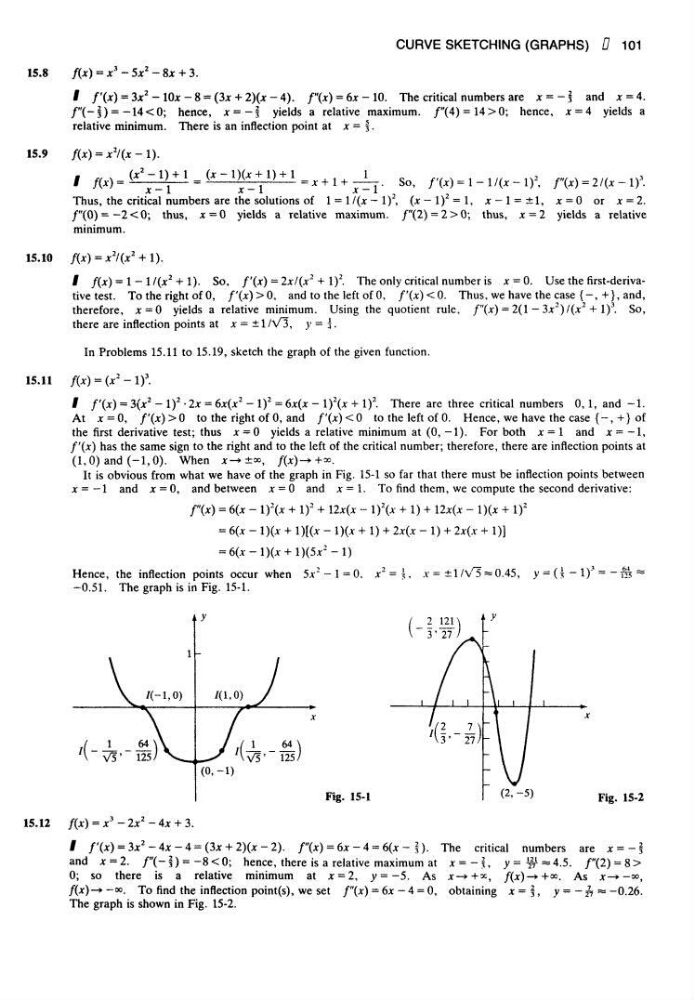
It is obvious from what we have of the graph in Fig. 15-1 so far that there must be inflection points between
x=— 1 and x = 0, and between x = Q and jc = l. To find them, we compute the second derivative:
/"(*) = 6(x - l)
2 (x + I)
2 + I2x(x - l)
2 (x + 1) + 12*(x - l)(x + I)
2
= 6(x — l)(x + l)[(x — l)(x + 1) + 2x(x - 1) + 2x(x + 1)]
Hence, the inflection points occur when
—0.51. The graph is in Fig. 15-1.
5x
2 -1=0. x
2 = \,
Fig. 15-1
15.12
(2, -5)
Fig. 15-2
I /'(*) = 3*
2 -4A:-4=(3.x + 2)(;c-2). /"(*) = 6x - 4 = 6(x - 1). The critical numbers are * = -f
and x = 2. /"(-§)=-8<0; hence, there is a relative maximum at Jt = -|, >>=^=4.5. /"(2) = 8>
0; so there is a relative minimum at A: = 2, y = — 5. As jc-»+x, /(*)—* +°°- As x—»—»,
/(j:)-» -oo. To find the inflection point(s), we set f"(x) = 6x - 4 = 0, obtaining *=§, y--yi'
a -0.26.
The graph is shown in Fig. 15-2.
Thus, the critical numbers are the solutions of l = l/(je—1), (*-l) = 1, * —1 = ±1, x=Q or x = 2.
/"(0) = -2<0; thus, jc=0 yields a relative maximum. /"(2) = 2>0; thus, A: = 2 yields a relative
minimum.
So, /'W=l-l/(x-l)
2 , /"(x) = 2/(^-l)
3 .
f(x) = x2/(x-l).
=6(x-1)(x+1)(5x2-1)
f(x) = x3 - 2x2 - 4x + 3.
f(x) = x-5x -8*+ 3.
CURVE SKETCHING (GRAPHS) D 101
I /'(*) = 3*
2 -10jt-8 = (3;c + 2)(.x-4). /"(*) = 6x - 10. The critical numbers are x = -\
and A: = 4.
/"(-§)=-14 <0; hence, *=-§ yields a relative maximum. /"(4)=14>0; hence, x = 4 yields a
relative minimum. There is an inflection point at x = f.
15.9
15.10
f(x) = x
2 /(x
2 + l).
I f(x) = 1- l/(jc
2 + 1). So, f'(x) = 2x/(x
2 + I)
2 . The only critical number is x = 0. Use the first-derivative test. To the right of 0, f'(x)>0, and to the left of 0, /'(*)<0. Thus, we have the case {-,+}, and,
therefore, x = 0 yields a relative minimum. Using the quotient rule, f"(x) = 2(1 - 3jt
2 )/(;t
2 + I)
3
. So,
there are inflection points at x = ± 1 /V3, y = 1.
In Problems 15.11 to 15.19, sketch the graph of the given function.
15.11
f(x) = (x
2 - I)
3
.
| f(x) = 3(x - i)2 . 2x = 6x(x2 - I)2 = 6x(x - l)\x + I)2. There are three critical numbers 0,1, and -1.
2
At x=Q, f'(x)>0 to the right of 0, and /'(*)< 0 to the left of 0. Hence, we have the case {-,+} of
the first derivative test; thus x = 0 yields a relative minimum at (0, -1). For both x = l and x = —I,
f'(x) has the same sign to the right and to the left of the critical number; therefore, there are inflection points at
(1,0) and (-1,0). When x-»±=°, /(*)-»+».
It is obvious from what we have of the graph in Fig. 15-1 so far that there must be inflection points between
x=— 1 and x = 0, and between x = Q and jc = l. To find them, we compute the second derivative:
/"(*) = 6(x - l)
2 (x + I)
2 + I2x(x - l)
2 (x + 1) + 12*(x - l)(x + I)
2
= 6(x — l)(x + l)[(x — l)(x + 1) + 2x(x - 1) + 2x(x + 1)]
Hence, the inflection points occur when
—0.51. The graph is in Fig. 15-1.
5x
2 -1=0. x
2 = \,
Fig. 15-1
15.12
(2, -5)
Fig. 15-2
I /'(*) = 3*
2 -4A:-4=(3.x + 2)(;c-2). /"(*) = 6x - 4 = 6(x - 1). The critical numbers are * = -f
and x = 2. /"(-§)=-8<0; hence, there is a relative maximum at Jt = -|, >>=^=4.5. /"(2) = 8>
0; so there is a relative minimum at A: = 2, y = — 5. As jc-»+x, /(*)—* +°°- As x—»—»,
/(j:)-» -oo. To find the inflection point(s), we set f"(x) = 6x - 4 = 0, obtaining *=§, y--yi'
a -0.26.
The graph is shown in Fig. 15-2.
Thus, the critical numbers are the solutions of l = l/(je—1), (*-l) = 1, * —1 = ±1, x=Q or x = 2.
/"(0) = -2<0; thus, jc=0 yields a relative maximum. /"(2) = 2>0; thus, A: = 2 yields a relative
minimum.
So, /'W=l-l/(x-l)
2 , /"(x) = 2/(^-l)
3 .
f(x) = x2/(x-l).
=6(x-1)(x+1)(5x2-1)
f(x) = x3 - 2x2 - 4x + 3.