

RELATED RATES Q 97
14.47
14.48
I Let s be the length of the two equal sides, and let h be the height. Then, from Fig. 14-18, h
2 = s
2 - b
2 /4,
2h-D,h = 2s-D,s, h-D,h = s-D,s. When s = b, h
2 =\b
2 , h = (V3/2)b, (V5/2)fe • D,h = b • D,s,
(Vl/2)- D,h = D,s. We are told that D,s = -3. Hence, D,h = -2V5. Now, A=\bh, D,A =
An object moves on the parabola 3y = x
2
. When x = 3, the .x-coordinate of the object is increasing at the
rate of 1 foot per minute. How fast is the y-coordinate increasing at that moment?
I 3 • D,y = 2x • D,x. When x = 3, So 3-D,y = 6, D.y = 2 ft/min.
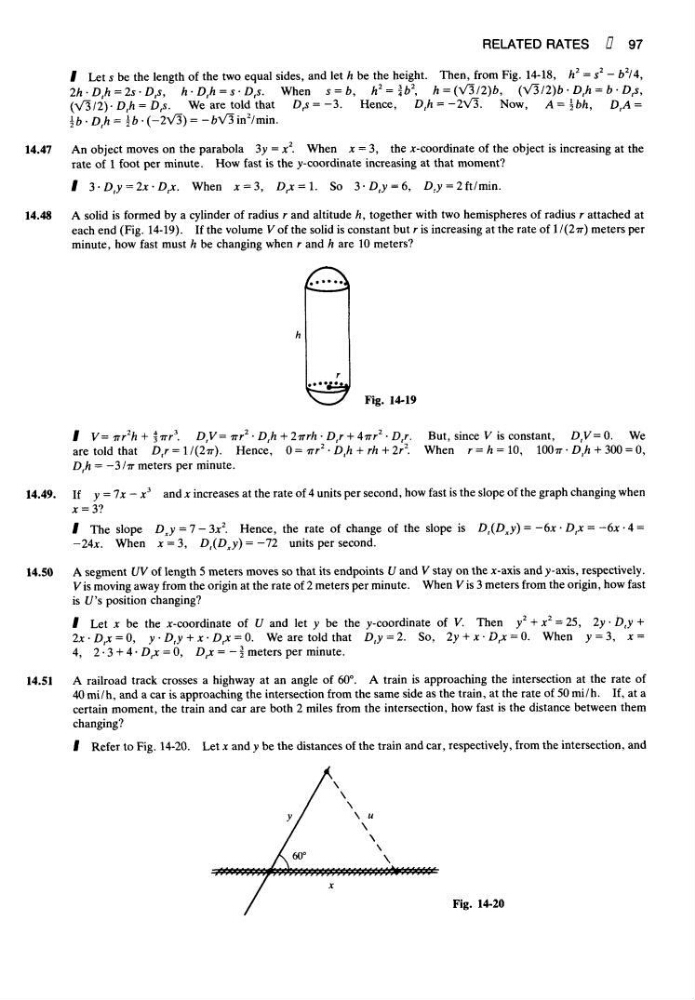
A solid is formed by a cylinder of radius r and altitude h, together with two hemispheres of radius r attached at
each end (Fig. 14-19). If the volume V of the solid is constant but r is increasing at the rate of \ 1 (ITT) meters per
minute, how fast must h be changing when r and h are 10 meters?
Fig. 14-19
I y= irr
2 h + fTrr
3 . D t V= irr
2 • D,h + 2-irrh • D,r + 4irr
2 • D,r. But, since V is constant, D,V=0. We
are told that Dtr = l/(2ir). Hence, 0= irr2 • D,h + rh +2r2. When r = /z = 10, lOOir • D,h + 300 = 0,
D t h = — 3/ir meters per minute.
If y = 7x - x
3 and x increases at the rate of 4 units per second, how fast is the slope of the graph changing when
x = 3?
I The slope Dj>=7-3x
2 . Hence, the rate of change of the slope is Dt(Dfy) = -6x • D,x = -6x -4 =
-24*. When x = 3, D,(D x y)=-12 units per second.
A segment UV of length 5 meters moves so that its endpoints U and V stay on the x-axis and y-axis, respectively.
V is moving away from the origin at the rate of 2 meters per minute. When V is 3 meters from the origin, how fast
is U's position changing?
I Let x be the x-coordinate of U and let y be the y-coordinate of V. Then y
2 + x
2 = 25, 2y D,y +
2x-D,x = 0, y-D,y + x- D,x = 0. We are told that D,y = 2. So, 2y + x • D t x = 0. When y = 3, x =
4, 2 • 3 + 4 • D,x = 0, D,x = -1 meters per minute.
A railroad track crosses a highway at an angle of 60°. A train is approaching the intersection at the rate of
40 mi/h, and a car is approaching the intersection from the same side as the train, at the rate of 50 mi/h. If, at a
certain moment, the train and car are both 2 miles from the intersection, how fast is the distance between them
changing?
f Refer to Fig. 14-20. Let x and y be the distances of the train and car, respectively, from the intersection, and
Fig. 14-20
14.49.
14.50
14.51
14.47
14.48
I Let s be the length of the two equal sides, and let h be the height. Then, from Fig. 14-18, h
2 = s
2 - b
2 /4,
2h-D,h = 2s-D,s, h-D,h = s-D,s. When s = b, h
2 =\b
2 , h = (V3/2)b, (V5/2)fe • D,h = b • D,s,
(Vl/2)- D,h = D,s. We are told that D,s = -3. Hence, D,h = -2V5. Now, A=\bh, D,A =
An object moves on the parabola 3y = x
2
. When x = 3, the .x-coordinate of the object is increasing at the
rate of 1 foot per minute. How fast is the y-coordinate increasing at that moment?
I 3 • D,y = 2x • D,x. When x = 3, So 3-D,y = 6, D.y = 2 ft/min.
A solid is formed by a cylinder of radius r and altitude h, together with two hemispheres of radius r attached at
each end (Fig. 14-19). If the volume V of the solid is constant but r is increasing at the rate of \ 1 (ITT) meters per
minute, how fast must h be changing when r and h are 10 meters?
Fig. 14-19
I y= irr
2 h + fTrr
3 . D t V= irr
2 • D,h + 2-irrh • D,r + 4irr
2 • D,r. But, since V is constant, D,V=0. We
are told that Dtr = l/(2ir). Hence, 0= irr2 • D,h + rh +2r2. When r = /z = 10, lOOir • D,h + 300 = 0,
D t h = — 3/ir meters per minute.
If y = 7x - x
3 and x increases at the rate of 4 units per second, how fast is the slope of the graph changing when
x = 3?
I The slope Dj>=7-3x
2 . Hence, the rate of change of the slope is Dt(Dfy) = -6x • D,x = -6x -4 =
-24*. When x = 3, D,(D x y)=-12 units per second.
A segment UV of length 5 meters moves so that its endpoints U and V stay on the x-axis and y-axis, respectively.
V is moving away from the origin at the rate of 2 meters per minute. When V is 3 meters from the origin, how fast
is U's position changing?
I Let x be the x-coordinate of U and let y be the y-coordinate of V. Then y
2 + x
2 = 25, 2y D,y +
2x-D,x = 0, y-D,y + x- D,x = 0. We are told that D,y = 2. So, 2y + x • D t x = 0. When y = 3, x =
4, 2 • 3 + 4 • D,x = 0, D,x = -1 meters per minute.
A railroad track crosses a highway at an angle of 60°. A train is approaching the intersection at the rate of
40 mi/h, and a car is approaching the intersection from the same side as the train, at the rate of 50 mi/h. If, at a
certain moment, the train and car are both 2 miles from the intersection, how fast is the distance between them
changing?
f Refer to Fig. 14-20. Let x and y be the distances of the train and car, respectively, from the intersection, and
Fig. 14-20
14.49.
14.50
14.51