

96 0 CHAPTER 14
ladder reaches the top of the wall, u = 20, x
2 = (20)
2 - (12)
2 = 256, x = 16. Hence, 20-D,M = 5-16,
D,«=4. By similar triangles, y/12 = 20/M, y = 240/u, D,y = -(240/u
2 )- D,u = -|g -4= -2.4ft/min.
Thus, the height of the ladder is decreasing at the rate of 2.4 feet per minute.
Fig. 14-16
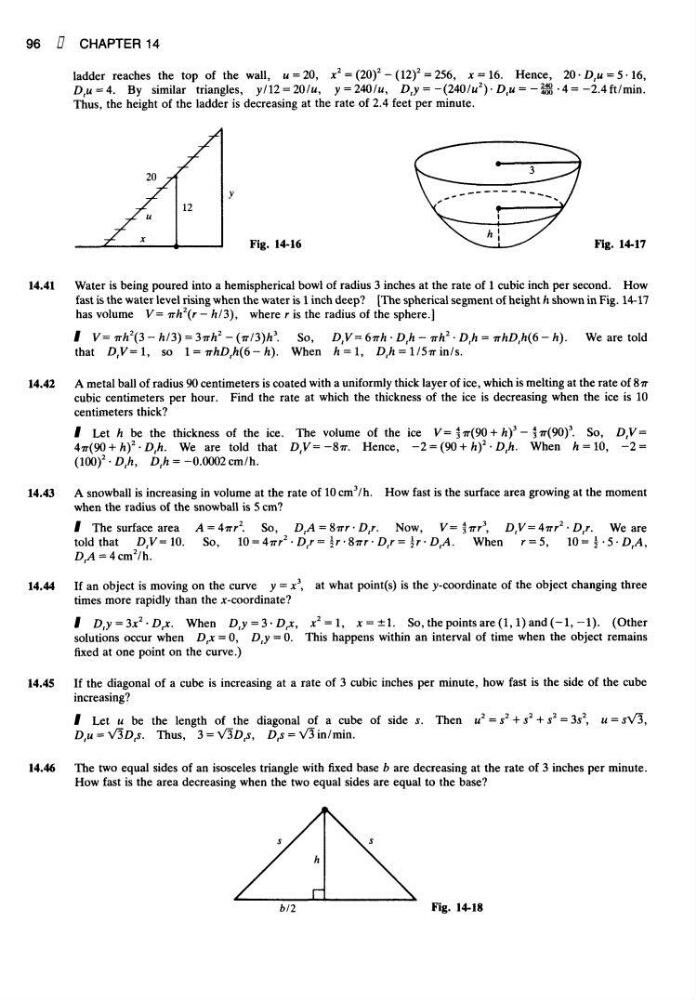
Fig. 14-17
Water is being poured into a hemispherical bowl of radius 3 inches at the rate of 1 cubic inch per second. How
fast is the water level rising when the water is 1 inch deep? [The spherical segment of height h shown in Fig. 14-17
has volume V = wh
2 (r - h/3), where r is the radius of the sphere.]
14.42
A metal ball of radius 90 centimeters is coated with a uniformly thick layer of ice, which is melting at the rate of Sir
cubic centimeters per hour. Find the rate at which the thickness of the ice is decreasing when the ice is 10
centimeters thick?
I Let h be the thickness of the ice. The volume of the ice V= |ir(90 + hf - 3ir(90)
3
. So, D,V=
4Tr(9Q+h)
2 -D,h. We are told that D,V=-Sir. Hence, -2 = (90 + h)
2 • D,h. When fc = 10, -2 =
(100)
2 • D,h, D,h = -0.0002 cm/h.
14.43
A snowball is increasing in volume at the rate of 10 cm
3 /h. How fast is the surface area growing at the moment
when the radius of the snowball is 5 cm?
I The surface area A = 4irr
2 . So, D,A = 8ur • D,r. Now, V= firr
3 , D,V=4irr
2 • D,r. We are
told that D,V=W. So, W = 4irr
2 • D,r= {r -Sirr- D,r = \r- D,A.
When r = 5, W=$-5-D,A,
14.44 If an object is moving on the curve y = x
3 , at what point(s) is the y-coordinate of the object changing three
times more rapidly than the ^-coordinate?
I D,y = 3x
2 • D,x. When £>j> = 3 • D,*, x
2 = 1, x = ±\. So, the points are (1, 1) and (-1, -1). (Other
solutions occur when D,x = 0, D,y = 0. This happens within an interval of time when the object remains
fixed at one point on the curve.)
14.45
If the diagonal of a cube is increasing at a rate of 3 cubic inches per minute, how fast is the side of the cube
increasing?
I Let M be the length of the diagonal of a cube of side s. Then u
2 = s
2 + s
2 + s
2 = 3s
2
, « = sV3,
D,u = V3D,s. Thus, 3 = V3D,s, D,s = V3 in/min.
14.46
The two equal sides of an isosceles triangle with fixed base b are decreasing at the rate of 3 inches per minute.
How fast is the area decreasing when the two equal sides are equal to the base?
Fig. 14-18
14.41
I V=irh
2 (3-h/3) = 3TTh
2 -(ir/3)h
3 .
So, D,V = 6irh • D t h - -jrh
2 • D,h = irhD,h(6- h). We are told
that D,V=1, so l = irhD,h(6-h). When h = l, D,h = I/Sir in/s.
D,A=4 cm/h.
ladder reaches the top of the wall, u = 20, x
2 = (20)
2 - (12)
2 = 256, x = 16. Hence, 20-D,M = 5-16,
D,«=4. By similar triangles, y/12 = 20/M, y = 240/u, D,y = -(240/u
2 )- D,u = -|g -4= -2.4ft/min.
Thus, the height of the ladder is decreasing at the rate of 2.4 feet per minute.
Fig. 14-16
Fig. 14-17
Water is being poured into a hemispherical bowl of radius 3 inches at the rate of 1 cubic inch per second. How
fast is the water level rising when the water is 1 inch deep? [The spherical segment of height h shown in Fig. 14-17
has volume V = wh
2 (r - h/3), where r is the radius of the sphere.]
14.42
A metal ball of radius 90 centimeters is coated with a uniformly thick layer of ice, which is melting at the rate of Sir
cubic centimeters per hour. Find the rate at which the thickness of the ice is decreasing when the ice is 10
centimeters thick?
I Let h be the thickness of the ice. The volume of the ice V= |ir(90 + hf - 3ir(90)
3
. So, D,V=
4Tr(9Q+h)
2 -D,h. We are told that D,V=-Sir. Hence, -2 = (90 + h)
2 • D,h. When fc = 10, -2 =
(100)
2 • D,h, D,h = -0.0002 cm/h.
14.43
A snowball is increasing in volume at the rate of 10 cm
3 /h. How fast is the surface area growing at the moment
when the radius of the snowball is 5 cm?
I The surface area A = 4irr
2 . So, D,A = 8ur • D,r. Now, V= firr
3 , D,V=4irr
2 • D,r. We are
told that D,V=W. So, W = 4irr
2 • D,r= {r -Sirr- D,r = \r- D,A.
When r = 5, W=$-5-D,A,
14.44 If an object is moving on the curve y = x
3 , at what point(s) is the y-coordinate of the object changing three
times more rapidly than the ^-coordinate?
I D,y = 3x
2 • D,x. When £>j> = 3 • D,*, x
2 = 1, x = ±\. So, the points are (1, 1) and (-1, -1). (Other
solutions occur when D,x = 0, D,y = 0. This happens within an interval of time when the object remains
fixed at one point on the curve.)
14.45
If the diagonal of a cube is increasing at a rate of 3 cubic inches per minute, how fast is the side of the cube
increasing?
I Let M be the length of the diagonal of a cube of side s. Then u
2 = s
2 + s
2 + s
2 = 3s
2
, « = sV3,
D,u = V3D,s. Thus, 3 = V3D,s, D,s = V3 in/min.
14.46
The two equal sides of an isosceles triangle with fixed base b are decreasing at the rate of 3 inches per minute.
How fast is the area decreasing when the two equal sides are equal to the base?
Fig. 14-18
14.41
I V=irh
2 (3-h/3) = 3TTh
2 -(ir/3)h
3 .
So, D,V = 6irh • D t h - -jrh
2 • D,h = irhD,h(6- h). We are told
that D,V=1, so l = irhD,h(6-h). When h = l, D,h = I/Sir in/s.
D,A=4 cm/h.