

RELATED RATES 0 95
The area of an expanding rectangle is increasing at the rate of 48 square centimeters per second. The length of
the rectangle is always equal to the square of its width (in centimeters). At what rate is the length increasing at
the instant when the width is 2 cm?
I A = fw, and e = w
2 . So, A = w
3 . Hence, D,A = 3w
2 • D,w. We are told that D,^=48. Hence,
48 = 3w
2 -D,w, I6=w
2 -D,w. When w = 2, 16 = 4-D,»v, D,w = 4. Since e = w
2 , D,€ = 2wD,w.
Hence, D,f = 2-2-4 = 16cm/s.
A spherical snowball is melting (symmetrically) at the rate of 4ir cubic centimeters per hour. How fast is the
diameter changing when it is 20 centimeters?
I The volume V= fur
3 . So, D,V=4irr
2 • D,r. We are told that D,V=-4ir. Hence, -4-n- =
4irr~ • D,r. Thus, —\ = r
2 -D l r. When the diameter is 20 centimeters, the radius r = 10. Hence, -1 =
100 • D,r, D,r=-0.0l. Since the diameter d = 2r, D,d = 2- D,r = 2- (-0.01) = -0.02. So, the diameter
is decreasing at the rate of 0.02 centimeter per hour.
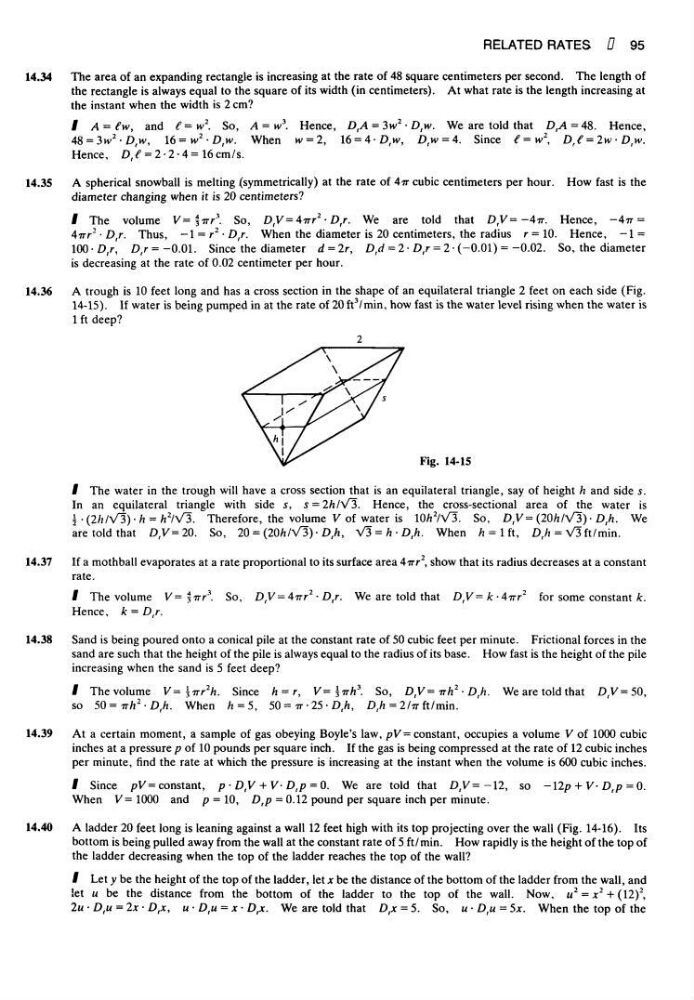
A trough is 10 feet long and has a cross section in the shape of an equilateral triangle 2 feet on each side (Fig.
14-15). If water is being pumped in at the rate of 20 ft
3 /min, how fast is the water level rising when the water is
1 ft deep?
I The water in the trough will have a cross section that is an equilateral triangle, say of height h and side s.
In an equilateral triangle with side s, s = 2/Z/V3. Hence, the cross-sectional area of the water is
| • (2/J/V3) • h = /z
2
/V3. Therefore, the volume V of water is 10/iW3. So, D,V= (20/I/V3) • D, h. We
are told that D,V=20. So, 20 = (20A/V3)- D,h, V3 = h-D,h. When h = 1 ft, D,h = V3 ft/min.
If a mothball evaporates at a rate proportional to its surface area 4irr
2 , show that its radius decreases at a constant
rate.
I The volume V= $irr3. So, D,V = 4-irr2 • D,r. We are told that D,V= k -4irr2 for some constant k.
Hence, k = D r r.
Sand is being poured onto a conical pile at the constant rate of 50 cubic feet per minute. Frictional forces in the
sand are such that the height of the pile is always equal to the radius of its base. How fast is the height of the pile
increasing when the sand is 5 feet deep?
I The volume V=\-rtr
l h. Since h = r, V= $irh
3 . So, D,V= irh
2 • D,h. We are told that D,V=50,
so 5Q=Trh
2 -D,h. When h = 5, 50 = TT -25- D,h, D,h = 2/v ft/min.
At a certain moment, a sample of gas obeying Boyle's law, pV= constant, occupies a volume V of 1000 cubic
inches at a pressure p of 10 pounds per square inch. If the gas is being compressed at the rate of 12 cubic inches
per minute, find the rate at which the pressure is increasing at the instant when the volume is 600 cubic inches.
I Since pV= constant, p • D,V + V- D,p =0. We are told that D,V= -12, so -12p + V- D,p =0.
When V= 1000 and p = 10, D t p = 0.12 pound per square inch per minute.
A ladder 20 feet long is leaning against a wall 12 feet high with its top projecting over the wall (Fig. 14-16). Its
bottom is being pulled away from the wall at the constant rate of 5 ft/min. How rapidly is the height of the top of
the ladder decreasing when the top of the ladder reaches the top of the wall?
I Let y be the height of the top of the ladder, let x be the distance of the bottom of the ladder from the wall, and
let u be the distance from the bottom of the ladder to the top of the wall. Now, u
2 = x
2 + (12)
2
,
2u • D,u = 2x • D,x, u • D,u = x • D,x. We are told that D,x = 5. So, u • D,u = 5*. When the top of the
Fig. 14-15
14.34
14.35
14.36
14.37
14.38
14.39
14.40
The area of an expanding rectangle is increasing at the rate of 48 square centimeters per second. The length of
the rectangle is always equal to the square of its width (in centimeters). At what rate is the length increasing at
the instant when the width is 2 cm?
I A = fw, and e = w
2 . So, A = w
3 . Hence, D,A = 3w
2 • D,w. We are told that D,^=48. Hence,
48 = 3w
2 -D,w, I6=w
2 -D,w. When w = 2, 16 = 4-D,»v, D,w = 4. Since e = w
2 , D,€ = 2wD,w.
Hence, D,f = 2-2-4 = 16cm/s.
A spherical snowball is melting (symmetrically) at the rate of 4ir cubic centimeters per hour. How fast is the
diameter changing when it is 20 centimeters?
I The volume V= fur
3 . So, D,V=4irr
2 • D,r. We are told that D,V=-4ir. Hence, -4-n- =
4irr~ • D,r. Thus, —\ = r
2 -D l r. When the diameter is 20 centimeters, the radius r = 10. Hence, -1 =
100 • D,r, D,r=-0.0l. Since the diameter d = 2r, D,d = 2- D,r = 2- (-0.01) = -0.02. So, the diameter
is decreasing at the rate of 0.02 centimeter per hour.
A trough is 10 feet long and has a cross section in the shape of an equilateral triangle 2 feet on each side (Fig.
14-15). If water is being pumped in at the rate of 20 ft
3 /min, how fast is the water level rising when the water is
1 ft deep?
I The water in the trough will have a cross section that is an equilateral triangle, say of height h and side s.
In an equilateral triangle with side s, s = 2/Z/V3. Hence, the cross-sectional area of the water is
| • (2/J/V3) • h = /z
2
/V3. Therefore, the volume V of water is 10/iW3. So, D,V= (20/I/V3) • D, h. We
are told that D,V=20. So, 20 = (20A/V3)- D,h, V3 = h-D,h. When h = 1 ft, D,h = V3 ft/min.
If a mothball evaporates at a rate proportional to its surface area 4irr
2 , show that its radius decreases at a constant
rate.
I The volume V= $irr3. So, D,V = 4-irr2 • D,r. We are told that D,V= k -4irr2 for some constant k.
Hence, k = D r r.
Sand is being poured onto a conical pile at the constant rate of 50 cubic feet per minute. Frictional forces in the
sand are such that the height of the pile is always equal to the radius of its base. How fast is the height of the pile
increasing when the sand is 5 feet deep?
I The volume V=\-rtr
l h. Since h = r, V= $irh
3 . So, D,V= irh
2 • D,h. We are told that D,V=50,
so 5Q=Trh
2 -D,h. When h = 5, 50 = TT -25- D,h, D,h = 2/v ft/min.
At a certain moment, a sample of gas obeying Boyle's law, pV= constant, occupies a volume V of 1000 cubic
inches at a pressure p of 10 pounds per square inch. If the gas is being compressed at the rate of 12 cubic inches
per minute, find the rate at which the pressure is increasing at the instant when the volume is 600 cubic inches.
I Since pV= constant, p • D,V + V- D,p =0. We are told that D,V= -12, so -12p + V- D,p =0.
When V= 1000 and p = 10, D t p = 0.12 pound per square inch per minute.
A ladder 20 feet long is leaning against a wall 12 feet high with its top projecting over the wall (Fig. 14-16). Its
bottom is being pulled away from the wall at the constant rate of 5 ft/min. How rapidly is the height of the top of
the ladder decreasing when the top of the ladder reaches the top of the wall?
I Let y be the height of the top of the ladder, let x be the distance of the bottom of the ladder from the wall, and
let u be the distance from the bottom of the ladder to the top of the wall. Now, u
2 = x
2 + (12)
2
,
2u • D,u = 2x • D,x, u • D,u = x • D,x. We are told that D,x = 5. So, u • D,u = 5*. When the top of the
Fig. 14-15
14.34
14.35
14.36
14.37
14.38
14.39
14.40