

CHAPTER 14
let u be the distance between the train and the car. By the law of cosines, u
2 = x
2 + y
2 - 2xy • cos 60° =
x
2 + y
2 -xy (since cos 60° = £). Hence, 2u • D,u = 2x • D,x + 2y • D,y - x • D,y - y • D,x. We are told
that D,x = -40 and D,y = -50, so 2« • D,u = -80* - lOOy + 5Qx + 40y = -30x - dOy. When y = 2
and jc=2, u
2 = 4 + 4-4 = 4, u = 2. Hence, 4- D,u = -60- 120= -180, D,«=-45mi/h.
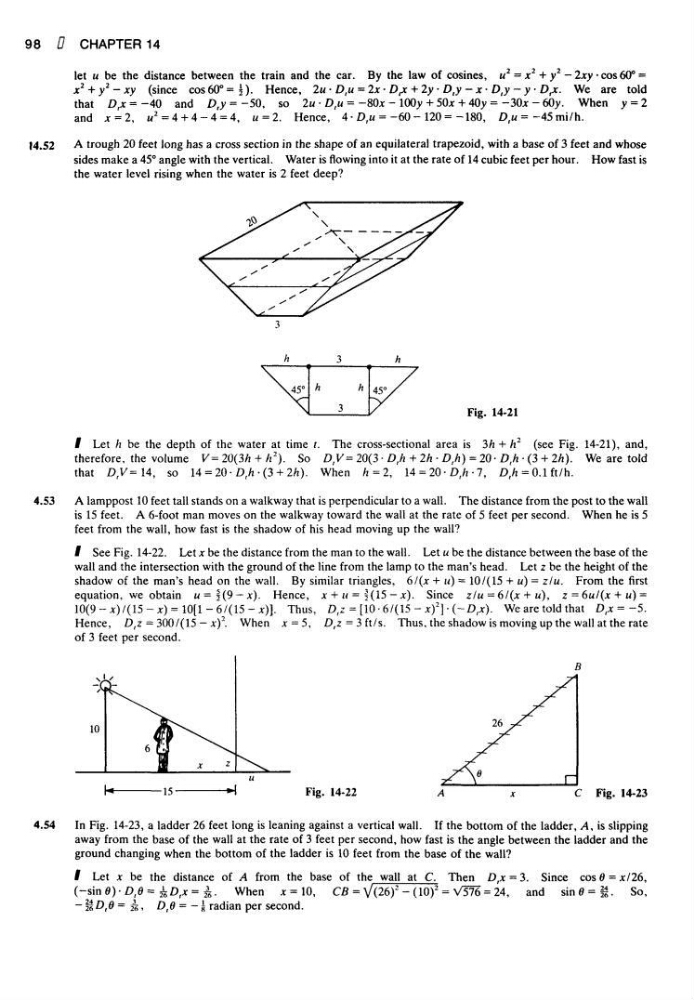
A trough 20 feet long has a cross section in the shape of an equilateral trapezoid, with a base of 3 feet and whose
sides make a 45° angle with the vertical. Water is flowing into it at the rate of 14 cubic feet per hour. How fast is
the water level rising when the water is 2 feet deep?
Fig. 14-21
I Let h be the depth of the water at time t. The cross-sectional area is 3h + h
2
(see Fig. 14-21), and,
therefore, the volume V = 20(3h + h
1 ). So D,V= 20(3 • D,h + 2h • D,h) = 20 • D,h • (3 + 2h). We are told
that D,K=14, so 14 = 20- D,h • (3 + 2h). When h=2, U = 20-D,h-l, D,h = 0.1 ft/h.
4.53
A lamppost 10 feet tall stands on a walkway that is perpendicular to a wall. The distance from the post to the wall
is 15 feet. A 6-foot man moves on the walkway toward the wall at the rate of 5 feet per second. When he is 5
feet from the wall, how fast is the shadow of his head moving up the wall?
I See Fig. 14-22. Let x be the distance from the man to the wall. Let u be the distance between the base of the
wall and the intersection with the ground of the line from the lamp to the man's head. Let z be the height of the
shadow of the man's head on the wall. By similar triangles, 6/(x + u) — 10/(15 + u) = zlu. From the first
equation, we obtain w=f(9-;t). Hence, x + u = f(15 - x). Since zlu = 6/(x + u), z = 6u/(* + w) =
10(9-x)/(15-je) = 10[l-6/(15-jc)]. Thus, D,z = [10- 6/(15 - x)
2 } • (~D,x). We are told that D,x = -5.
Hence, D,z = 300/(15 — x)
2 . When x = 5, D,z=3ft/s. Thus, the shadow is moving up the wall at the rate
of 3 feet per second.
Fig. 14-22
C Fig. 14-23
4.54
In Fig. 14-23, a ladder 26 feet long is leaning against a vertical wall. If the bottom of the ladder, A, is slipping
away from the base of the wall at the rate of 3 feet per second, how fast is the angle between the ladder and the
ground changing when the bottom of the ladder is 10 feet from the base of the wall?
I Let x be the distance of A from the base of the wall at C.
(-smO)-D,0=&D,x=&.
When x = 10,
- §iD,0 = js, D,0 = -1 radian per second.
Then D,x = 3. Since cos 6 = x/26,
CB = V(26)
2 -(10)
2 = V576 = 24, and sin 0 = g. So,
98
14.52
let u be the distance between the train and the car. By the law of cosines, u
2 = x
2 + y
2 - 2xy • cos 60° =
x
2 + y
2 -xy (since cos 60° = £). Hence, 2u • D,u = 2x • D,x + 2y • D,y - x • D,y - y • D,x. We are told
that D,x = -40 and D,y = -50, so 2« • D,u = -80* - lOOy + 5Qx + 40y = -30x - dOy. When y = 2
and jc=2, u
2 = 4 + 4-4 = 4, u = 2. Hence, 4- D,u = -60- 120= -180, D,«=-45mi/h.
A trough 20 feet long has a cross section in the shape of an equilateral trapezoid, with a base of 3 feet and whose
sides make a 45° angle with the vertical. Water is flowing into it at the rate of 14 cubic feet per hour. How fast is
the water level rising when the water is 2 feet deep?
Fig. 14-21
I Let h be the depth of the water at time t. The cross-sectional area is 3h + h
2
(see Fig. 14-21), and,
therefore, the volume V = 20(3h + h
1 ). So D,V= 20(3 • D,h + 2h • D,h) = 20 • D,h • (3 + 2h). We are told
that D,K=14, so 14 = 20- D,h • (3 + 2h). When h=2, U = 20-D,h-l, D,h = 0.1 ft/h.
4.53
A lamppost 10 feet tall stands on a walkway that is perpendicular to a wall. The distance from the post to the wall
is 15 feet. A 6-foot man moves on the walkway toward the wall at the rate of 5 feet per second. When he is 5
feet from the wall, how fast is the shadow of his head moving up the wall?
I See Fig. 14-22. Let x be the distance from the man to the wall. Let u be the distance between the base of the
wall and the intersection with the ground of the line from the lamp to the man's head. Let z be the height of the
shadow of the man's head on the wall. By similar triangles, 6/(x + u) — 10/(15 + u) = zlu. From the first
equation, we obtain w=f(9-;t). Hence, x + u = f(15 - x). Since zlu = 6/(x + u), z = 6u/(* + w) =
10(9-x)/(15-je) = 10[l-6/(15-jc)]. Thus, D,z = [10- 6/(15 - x)
2 } • (~D,x). We are told that D,x = -5.
Hence, D,z = 300/(15 — x)
2 . When x = 5, D,z=3ft/s. Thus, the shadow is moving up the wall at the rate
of 3 feet per second.
Fig. 14-22
C Fig. 14-23
4.54
In Fig. 14-23, a ladder 26 feet long is leaning against a vertical wall. If the bottom of the ladder, A, is slipping
away from the base of the wall at the rate of 3 feet per second, how fast is the angle between the ladder and the
ground changing when the bottom of the ladder is 10 feet from the base of the wall?
I Let x be the distance of A from the base of the wall at C.
(-smO)-D,0=&D,x=&.
When x = 10,
- §iD,0 = js, D,0 = -1 radian per second.
Then D,x = 3. Since cos 6 = x/26,
CB = V(26)
2 -(10)
2 = V576 = 24, and sin 0 = g. So,
98
14.52