

457
Answers
701–800
Answers and Explanations
W
x
x
x dx
x x
n
i
i
n
water =
−
(
)
=
−
( )
=
−
→∞ =
∑
∫
lim
*
50 1
2
50 2
50
4
1
0
100
2
∆
=
−
=
−
=
⋅
0
100
2
50 100
100
4
5 000 2 500
2 500
(
)
(
)
,
,
,
ft lb
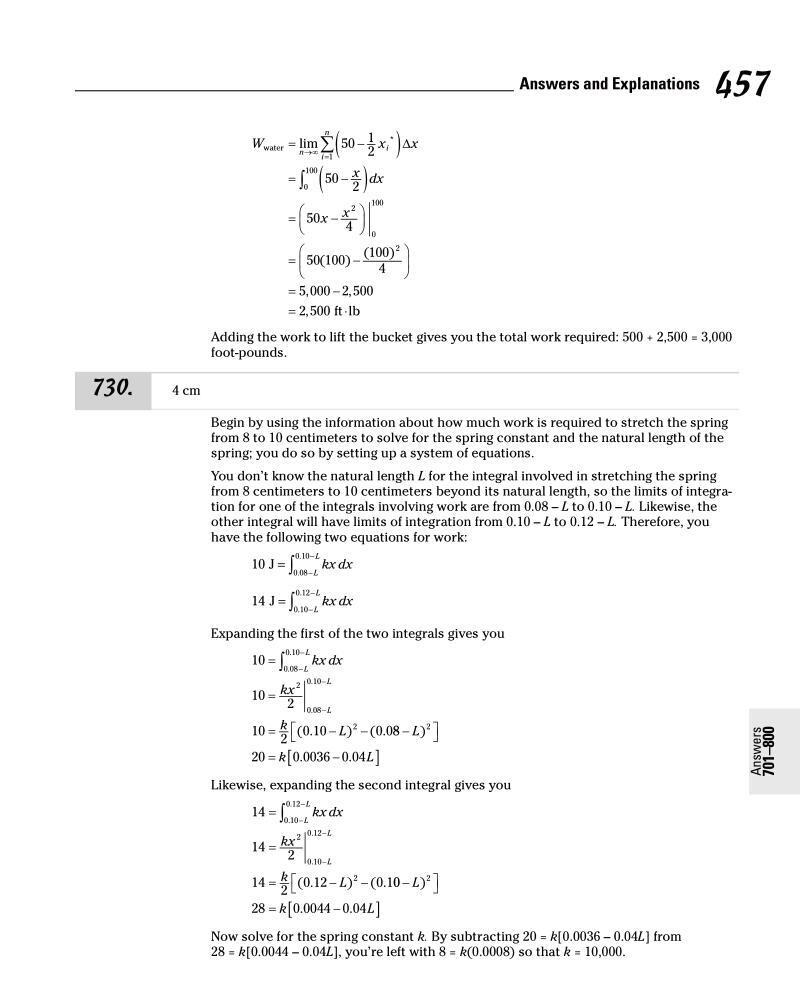
Adding the work to lift the bucket gives you the total work required: 500 + 2,500 = 3,000
foot-pounds.
730.
4 cm
Begin by using the information about how much work is required to stretch the spring
from 8 to 10 centimeters to solve for the spring constant and the natural length of the
spring; you do so by setting up a system of equations.
You don’t know the natural length L for the integral involved in stretching the spring
from 8 centimeters to 10 centimeters beyond its natural length, so the limits of integration for one of the integrals involving work are from 0.08 – L to 0.10 – L. Likewise, the
other integral will have limits of integration from 0.10 – L to 0.12 – L. Therefore, you
have the following two equations for work:
10
0 08
0 10
J =
−
−
∫ kx dx
L
L
.
.
14
0 10
0 12
J =
−
−
∫ kx dx
L
L
.
.
Expanding the first of the two integrals gives you
10
10
2
10 2
0 10
00
0 08
0 10
2
0 08
0 10
2
=
=
=
−
−
−
−
−
−
∫ kx dx
kx
k
L
L
L
L
L
.
.
.
.
( .
) ( . 8 8
20
0 0036 0 04
2
−
=
−
[
]
L
k
L
)
.
.
Likewise, expanding the second integral gives you
14
14
2
14 2
0 12
01
0 10
0 12
2
0 10
0 12
2
=
=
=
−
−
−
−
−
−
∫ kx dx
kx
k
L
L
L
L
L
.
.
.
.
( .
) ( . 0
0
28
0 0044 0 04
2
−
=
−
[
]
L
k
L
)
.
.
Now solve for the spring constant k. By subtracting 20 = k[0.0036 – 0.04L] from
28 = k[0.0044 – 0.04L], you’re left with 8 = k(0.0008) so that k = 10,000.
Answers
701–800
Answers and Explanations
W
x
x
x dx
x x
n
i
i
n
water =
−
(
)
=
−
( )
=
−
→∞ =
∑
∫
lim
*
50 1
2
50 2
50
4
1
0
100
2
∆
=
−
=
−
=
⋅
0
100
2
50 100
100
4
5 000 2 500
2 500
(
)
(
)
,
,
,
ft lb
Adding the work to lift the bucket gives you the total work required: 500 + 2,500 = 3,000
foot-pounds.
730.
4 cm
Begin by using the information about how much work is required to stretch the spring
from 8 to 10 centimeters to solve for the spring constant and the natural length of the
spring; you do so by setting up a system of equations.
You don’t know the natural length L for the integral involved in stretching the spring
from 8 centimeters to 10 centimeters beyond its natural length, so the limits of integration for one of the integrals involving work are from 0.08 – L to 0.10 – L. Likewise, the
other integral will have limits of integration from 0.10 – L to 0.12 – L. Therefore, you
have the following two equations for work:
10
0 08
0 10
J =
−
−
∫ kx dx
L
L
.
.
14
0 10
0 12
J =
−
−
∫ kx dx
L
L
.
.
Expanding the first of the two integrals gives you
10
10
2
10 2
0 10
00
0 08
0 10
2
0 08
0 10
2
=
=
=
−
−
−
−
−
−
∫ kx dx
kx
k
L
L
L
L
L
.
.
.
.
( .
) ( . 8 8
20
0 0036 0 04
2
−
=
−
[
]
L
k
L
)
.
.
Likewise, expanding the second integral gives you
14
14
2
14 2
0 12
01
0 10
0 12
2
0 10
0 12
2
=
=
=
−
−
−
−
−
−
∫ kx dx
kx
k
L
L
L
L
L
.
.
.
.
( .
) ( . 0
0
28
0 0044 0 04
2
−
=
−
[
]
L
k
L
)
.
.
Now solve for the spring constant k. By subtracting 20 = k[0.0036 – 0.04L] from
28 = k[0.0044 – 0.04L], you’re left with 8 = k(0.0008) so that k = 10,000.