

Part II: The Answers
458
Answers
701–800
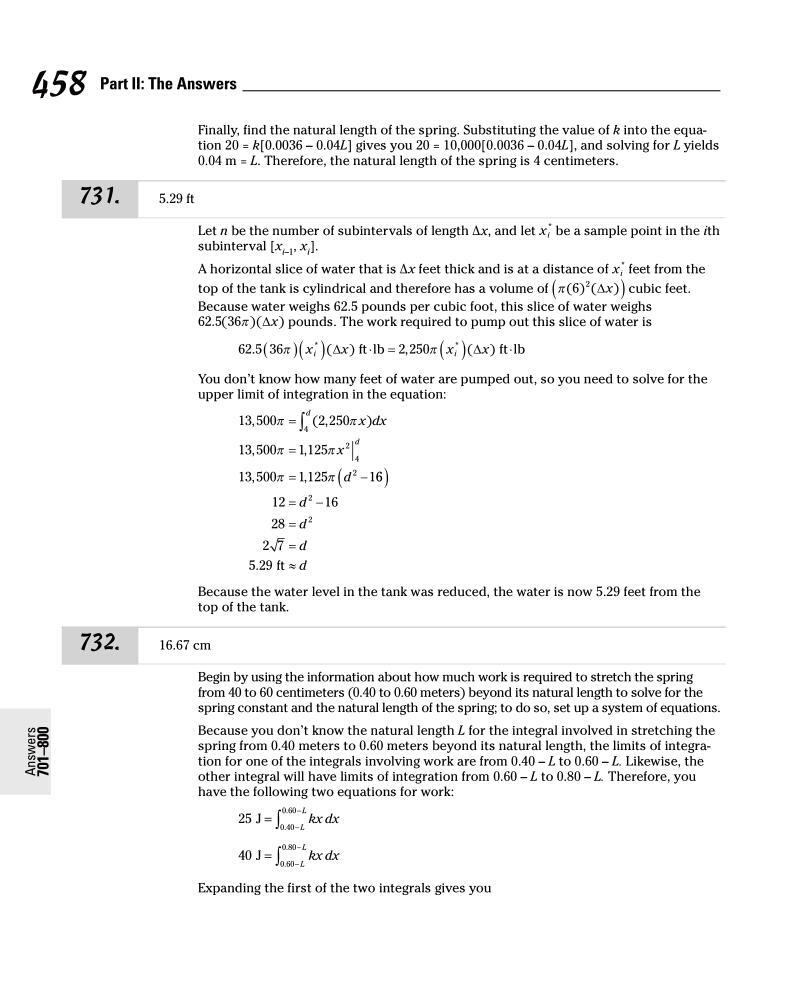
Finally, find the natural length of the spring. Substituting the value of k into the equation 20 = k[0.0036 – 0.04L] gives you 20 = 10,000[0.0036 – 0.04L], and solving for L yields
0.04 m = L. Therefore, the natural length of the spring is 4 centimeters.
731.
5.29 ft
Let n be the number of subintervals of length Δ x, and let x i
* be a sample point in the ith
subinterval [x i–1 , x i ].
A horizontal slice of water that is Δ x feet thick and is at a distance of x i
* feet from the
top of the tank is cylindrical and therefore has a volume of π ( ) ( )
6
2
∆x
(
) cubic feet.
Because water weighs 62.5 pounds per cubic foot, this slice of water weighs
62 5 36
. (
)( )
π ∆x pounds. The work required to pump out this slice of water is
62 5 36
2 250
.
( )
,
( )
*
*
π
π
( )( )
⋅ =
( )
⋅
x
x
x
x
i
i
∆
∆ ft lb
ft lb
You don’t know how many feet of water are pumped out, so you need to solve for the
upper limit of integration in the equation:
13 500
2250
13 500
1125
13 500
1125
1
4
2
4
2
,
(,
)
,
,
,
,
π
π
π
π
π
π
=
=
=
−
∫
x dx
x
d
d
d
6 6
12
16
28
2 7
5 29
2
2
(
)
=
−
=
=
≈
d
d
d
d
. ft
Because the water level in the tank was reduced, the water is now 5.29 feet from the
top of the tank.
732.
16.67 cm
Begin by using the information about how much work is required to stretch the spring
from 40 to 60 centimeters (0.40 to 0.60 meters) beyond its natural length to solve for the
spring constant and the natural length of the spring; to do so, set up a system of equations.
Because you don’t know the natural length L for the integral involved in stretching the
spring from 0.40 meters to 0.60 meters beyond its natural length, the limits of integration for one of the integrals involving work are from 0.40 – L to 0.60 – L. Likewise, the
other integral will have limits of integration from 0.60 – L to 0.80 – L. Therefore, you
have the following two equations for work:
25
0 40
0 60
J =
−
−
∫ kx dx
L
L
.
.
40
0 60
0 80
J =
−
−
∫ kx dx
L
L
.
.
Expanding the first of the two integrals gives you
458
Answers
701–800
Finally, find the natural length of the spring. Substituting the value of k into the equation 20 = k[0.0036 – 0.04L] gives you 20 = 10,000[0.0036 – 0.04L], and solving for L yields
0.04 m = L. Therefore, the natural length of the spring is 4 centimeters.
731.
5.29 ft
Let n be the number of subintervals of length Δ x, and let x i
* be a sample point in the ith
subinterval [x i–1 , x i ].
A horizontal slice of water that is Δ x feet thick and is at a distance of x i
* feet from the
top of the tank is cylindrical and therefore has a volume of π ( ) ( )
6
2
∆x
(
) cubic feet.
Because water weighs 62.5 pounds per cubic foot, this slice of water weighs
62 5 36
. (
)( )
π ∆x pounds. The work required to pump out this slice of water is
62 5 36
2 250
.
( )
,
( )
*
*
π
π
( )( )
⋅ =
( )
⋅
x
x
x
x
i
i
∆
∆ ft lb
ft lb
You don’t know how many feet of water are pumped out, so you need to solve for the
upper limit of integration in the equation:
13 500
2250
13 500
1125
13 500
1125
1
4
2
4
2
,
(,
)
,
,
,
,
π
π
π
π
π
π
=
=
=
−
∫
x dx
x
d
d
d
6 6
12
16
28
2 7
5 29
2
2
(
)
=
−
=
=
≈
d
d
d
d
. ft
Because the water level in the tank was reduced, the water is now 5.29 feet from the
top of the tank.
732.
16.67 cm
Begin by using the information about how much work is required to stretch the spring
from 40 to 60 centimeters (0.40 to 0.60 meters) beyond its natural length to solve for the
spring constant and the natural length of the spring; to do so, set up a system of equations.
Because you don’t know the natural length L for the integral involved in stretching the
spring from 0.40 meters to 0.60 meters beyond its natural length, the limits of integration for one of the integrals involving work are from 0.40 – L to 0.60 – L. Likewise, the
other integral will have limits of integration from 0.60 – L to 0.80 – L. Therefore, you
have the following two equations for work:
25
0 40
0 60
J =
−
−
∫ kx dx
L
L
.
.
40
0 60
0 80
J =
−
−
∫ kx dx
L
L
.
.
Expanding the first of the two integrals gives you