

Part II: The Answers
456
Answers
701–800
728.
169,646 ft·lb
Let n be the number of subintervals of length Δ x, and let x i
* be a sample point in the ith
subinterval [x i–1 , x i ].
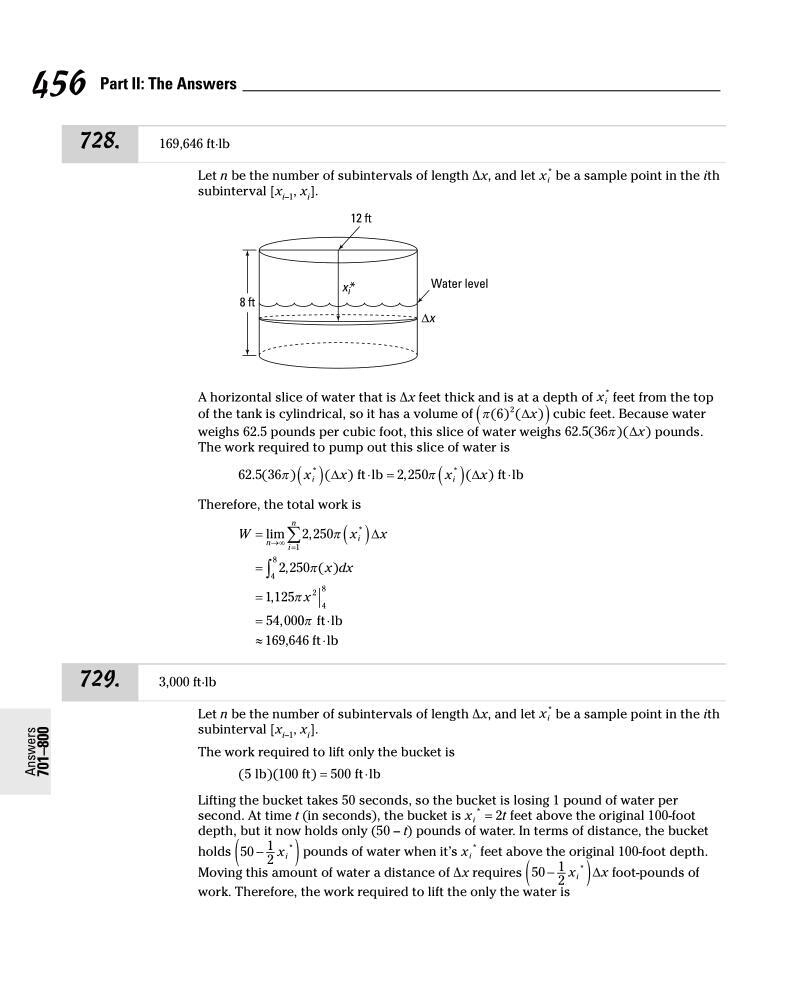
A horizontal slice of water that is Δ x feet thick and is at a depth of x i
* feet from the top
of the tank is cylindrical, so it has a volume of π ( ) ( )
6
2
∆x
(
) cubic feet. Because water
weighs 62.5 pounds per cubic foot, this slice of water weighs 62 5 36
. (
)( )
π ∆x pounds.
The work required to pump out this slice of water is
62 5 36
2 250
. (
)
( )
,
( )
*
*
π
π x
x
x
x
i
i
( )
⋅ =
( )
⋅
∆
∆ ft lb
ft lb
Therefore, the total work is
W
x
x
x dx
x
n
i
i
n
=
( )
=
=
=
→∞ =
∑
∫
lim
,
,
( )
,
,
*
2 250
2 250
1 125
54 00
1
4
8
2
4
8
π
π
π
∆
0 0π ft lb
169,646 ft lb
⋅
≈
⋅
729.
3,000 ft·lb
Let n be the number of subintervals of length Δ x, and let x i
* be a sample point in the ith
subinterval [x i–1 , x i ].
The work required to lift only the bucket is
(
)(
)
5
100
500
lb
ft
ft lb
=
⋅
Lifting the bucket takes 50 seconds, so the bucket is losing 1 pound of water per
second. At time t (in seconds), the bucket is x
t
i
*
= 2 feet above the original 100-foot
depth, but it now holds only (50 – t) pounds of water. In terms of distance, the bucket
holds 50 1
2
−
(
)
x i
* pounds of water when it’s x i
* feet above the original 100-foot depth.
Moving this amount of water a distance of Δ x requires 50 1
2
−
(
)
x
x
i
*
∆ foot-pounds of
work. Therefore, the work required to lift the only the water is
456
Answers
701–800
728.
169,646 ft·lb
Let n be the number of subintervals of length Δ x, and let x i
* be a sample point in the ith
subinterval [x i–1 , x i ].
A horizontal slice of water that is Δ x feet thick and is at a depth of x i
* feet from the top
of the tank is cylindrical, so it has a volume of π ( ) ( )
6
2
∆x
(
) cubic feet. Because water
weighs 62.5 pounds per cubic foot, this slice of water weighs 62 5 36
. (
)( )
π ∆x pounds.
The work required to pump out this slice of water is
62 5 36
2 250
. (
)
( )
,
( )
*
*
π
π x
x
x
x
i
i
( )
⋅ =
( )
⋅
∆
∆ ft lb
ft lb
Therefore, the total work is
W
x
x
x dx
x
n
i
i
n
=
( )
=
=
=
→∞ =
∑
∫
lim
,
,
( )
,
,
*
2 250
2 250
1 125
54 00
1
4
8
2
4
8
π
π
π
∆
0 0π ft lb
169,646 ft lb
⋅
≈
⋅
729.
3,000 ft·lb
Let n be the number of subintervals of length Δ x, and let x i
* be a sample point in the ith
subinterval [x i–1 , x i ].
The work required to lift only the bucket is
(
)(
)
5
100
500
lb
ft
ft lb
=
⋅
Lifting the bucket takes 50 seconds, so the bucket is losing 1 pound of water per
second. At time t (in seconds), the bucket is x
t
i
*
= 2 feet above the original 100-foot
depth, but it now holds only (50 – t) pounds of water. In terms of distance, the bucket
holds 50 1
2
−
(
)
x i
* pounds of water when it’s x i
* feet above the original 100-foot depth.
Moving this amount of water a distance of Δ x requires 50 1
2
−
(
)
x
x
i
*
∆ foot-pounds of
work. Therefore, the work required to lift the only the water is