

Part II: The Answers
330
Answers
501–600
You want the minimum cost, so find the derivative of this function:
′
C
x
x
x
x
=
−
=
−
−
80
480
80
480
2
3
2
Setting this equal to zero, you get 80x
3
– 480 = 0, which has the solution x =
≈
6 1 82
3
.
meters. Substituting this value into the cost function C(x) = 40x
2
+ 480x
−1
gives you the
minimum cost:
C 6
40 6
480 6
396 23
3
3
2
3
1
( ) ( )
( )
=
+
≈
−
$
.
509.
20 m
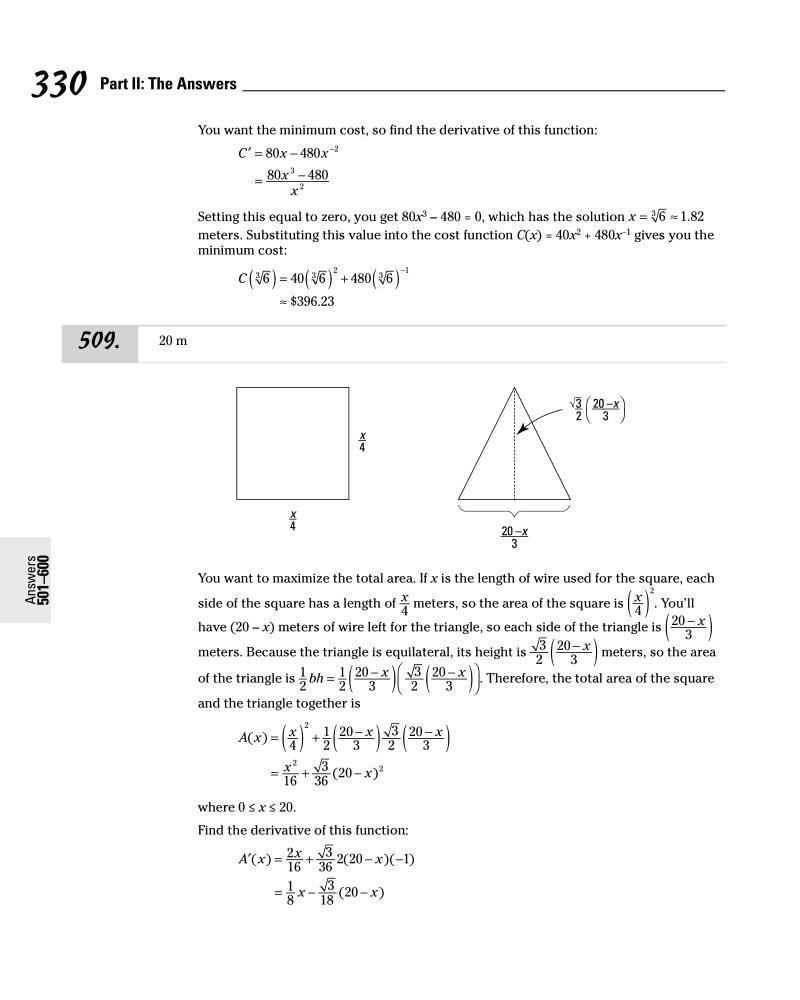
You want to maximize the total area. If x is the length of wire used for the square, each
side of the square has a length of x
4
meters, so the area of the square is x
4
2
( ) . You’ll
have (20 – x) meters of wire left for the triangle, so each side of the triangle is 20
3
− x
( )
meters. Because the triangle is equilateral, its height is
3
2
20
3
− x
( ) meters, so the area
of the triangle is 1
2
1
2
20
3
3
2
20
3
bh
x
x
=
−
−
( ) ( )
. Therefore, the total area of the square
and the triangle together is
A x
x
x
x
x
x
( )
(
)
=
+
−
−
=
+
−
4
1
2
20
3
3
2
20
3
16
3
36
20
2
2
2
( ) ( ) ( )
where 0 ≤ x ≤ 20.
Find the derivative of this function:
′
A x
x
x
x
x
( )
(
)( )
(
)
=
+
−
−
=
−
−
2
16
3
36
2 20
1
1
8
3
18
20
330
Answers
501–600
You want the minimum cost, so find the derivative of this function:
′
C
x
x
x
x
=
−
=
−
−
80
480
80
480
2
3
2
Setting this equal to zero, you get 80x
3
– 480 = 0, which has the solution x =
≈
6 1 82
3
.
meters. Substituting this value into the cost function C(x) = 40x
2
+ 480x
−1
gives you the
minimum cost:
C 6
40 6
480 6
396 23
3
3
2
3
1
( ) ( )
( )
=
+
≈
−
$
.
509.
20 m
You want to maximize the total area. If x is the length of wire used for the square, each
side of the square has a length of x
4
meters, so the area of the square is x
4
2
( ) . You’ll
have (20 – x) meters of wire left for the triangle, so each side of the triangle is 20
3
− x
( )
meters. Because the triangle is equilateral, its height is
3
2
20
3
− x
( ) meters, so the area
of the triangle is 1
2
1
2
20
3
3
2
20
3
bh
x
x
=
−
−
( ) ( )
. Therefore, the total area of the square
and the triangle together is
A x
x
x
x
x
x
( )
(
)
=
+
−
−
=
+
−
4
1
2
20
3
3
2
20
3
16
3
36
20
2
2
2
( ) ( ) ( )
where 0 ≤ x ≤ 20.
Find the derivative of this function:
′
A x
x
x
x
x
( )
(
)( )
(
)
=
+
−
−
=
−
−
2
16
3
36
2 20
1
1
8
3
18
20