

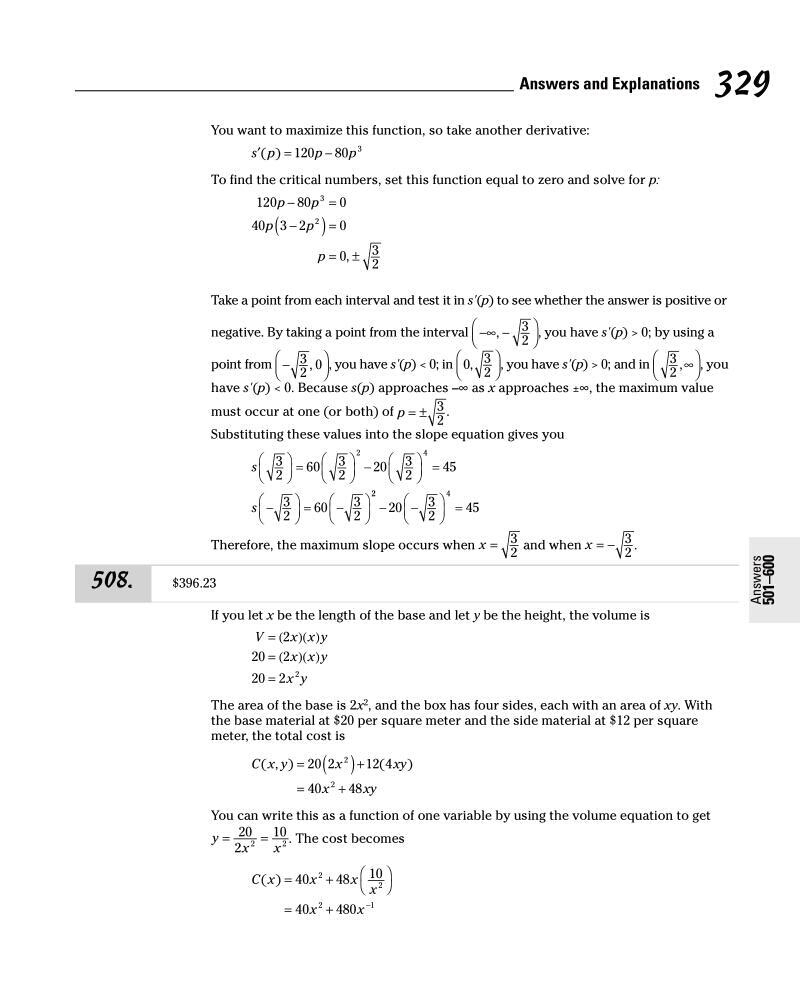
329
Answers
501–600
Answers and Explanations
You want to maximize this function, so take another derivative:
′
s p
p
p
( ) =
−
120
80
3
To find the critical numbers, set this function equal to zero and solve for p:
120
80
0
40 3 2
0
0
3
2
3
2
p
p
p
p
p
−
=
−
=
= ±
(
)
,
Take a point from each interval and test it in s'(p) to see whether the answer is positive or
negative. By taking a point from the interval −∞ −
,
3
2
, you have s'(p) > 0; by using a
point from − 3
2
0
,
, you have s'(p) < 0; in 0 3
2
,
, you have s'(p) > 0; and in
3
2
,∞
, you
have s'(p) < 0. Because s(p) approaches –∞ as x approaches ±∞, the maximum value
must occur at one (or both) of p = ± 3
2
.
Substituting these values into the slope equation gives you
s
s
3
2
60 3
2
20 3
2
45
3
2
60
3
2
2
4
=
−
=
−
=
−
2 2
4
20
3
2
45
−
−
=
Therefore, the maximum slope occurs when x = 3
2
and when x = − 3
2
.
508.
$396.23
If you let x be the length of the base and let y be the height, the volume is
V
x x y
x x y
x y
= ( )( )
= ( )( )
=
2
20 2
20 2
2
The area of the base is 2x
2
, and the box has four sides, each with an area of xy. With
the base material at $20 per square meter and the side material at $12 per square
meter, the total cost is
C x y
x
xy
x
xy
( , )
(
)
=
+
=
+
20 2
12 4
40
48
2
2
( )
You can write this as a function of one variable by using the volume equation to get
y
x
x
=
=
20
2
10
2
2 . The cost becomes
C x
x
x x
x
x
( ) =
+
=
+
−
40
48 10
40
480
2
2
2
1
Answers
501–600
Answers and Explanations
You want to maximize this function, so take another derivative:
′
s p
p
p
( ) =
−
120
80
3
To find the critical numbers, set this function equal to zero and solve for p:
120
80
0
40 3 2
0
0
3
2
3
2
p
p
p
p
p
−
=
−
=
= ±
(
)
,
Take a point from each interval and test it in s'(p) to see whether the answer is positive or
negative. By taking a point from the interval −∞ −
,
3
2
, you have s'(p) > 0; by using a
point from − 3
2
0
,
, you have s'(p) < 0; in 0 3
2
,
, you have s'(p) > 0; and in
3
2
,∞
, you
have s'(p) < 0. Because s(p) approaches –∞ as x approaches ±∞, the maximum value
must occur at one (or both) of p = ± 3
2
.
Substituting these values into the slope equation gives you
s
s
3
2
60 3
2
20 3
2
45
3
2
60
3
2
2
4
=
−
=
−
=
−
2 2
4
20
3
2
45
−
−
=
Therefore, the maximum slope occurs when x = 3
2
and when x = − 3
2
.
508.
$396.23
If you let x be the length of the base and let y be the height, the volume is
V
x x y
x x y
x y
= ( )( )
= ( )( )
=
2
20 2
20 2
2
The area of the base is 2x
2
, and the box has four sides, each with an area of xy. With
the base material at $20 per square meter and the side material at $12 per square
meter, the total cost is
C x y
x
xy
x
xy
( , )
(
)
=
+
=
+
20 2
12 4
40
48
2
2
( )
You can write this as a function of one variable by using the volume equation to get
y
x
x
=
=
20
2
10
2
2 . The cost becomes
C x
x
x x
x
x
( ) =
+
=
+
−
40
48 10
40
480
2
2
2
1