

331
Answers
501–600
Answers and Explanations
Then set the derivative equal to zero and solve for x:
1
8
3
18
20
0
1
8
10 3
9
3
18
0
9
72
80 3
72
4 3
72
0
9
72
4 3
72
x
x
x
x
x
x
x
x
−
−
=
−
+
=
−
+
=
+
(
)
= =
+
=
= +
80 3
72
9 4 3
72
80 3
72
80 3
9 4 3
x
x
It’s reasonable to let x = 0 (the wire is used entirely to make the triangle) or x = 20 (the wire
is used entirely to make the square), so check those values as well. Here are the areas:
A
A
0
0
16
3
36
20 0
3
36
400 19 25
20
20
16
3
36
20 20
2
2
2
2
( ) = +
−
(
) = ( )≈
( )=
+
−
(
)
.
= =
=
+
=
+
+
−
+
400
16
25
80 3
9 4 3
80 3
9 4 3
16
3
36
20
80 3
9 4 3
2
A
≈
2
10 87
.
The maximum occurs when x = 20.
510.
80 3
9 4 3
+
meters
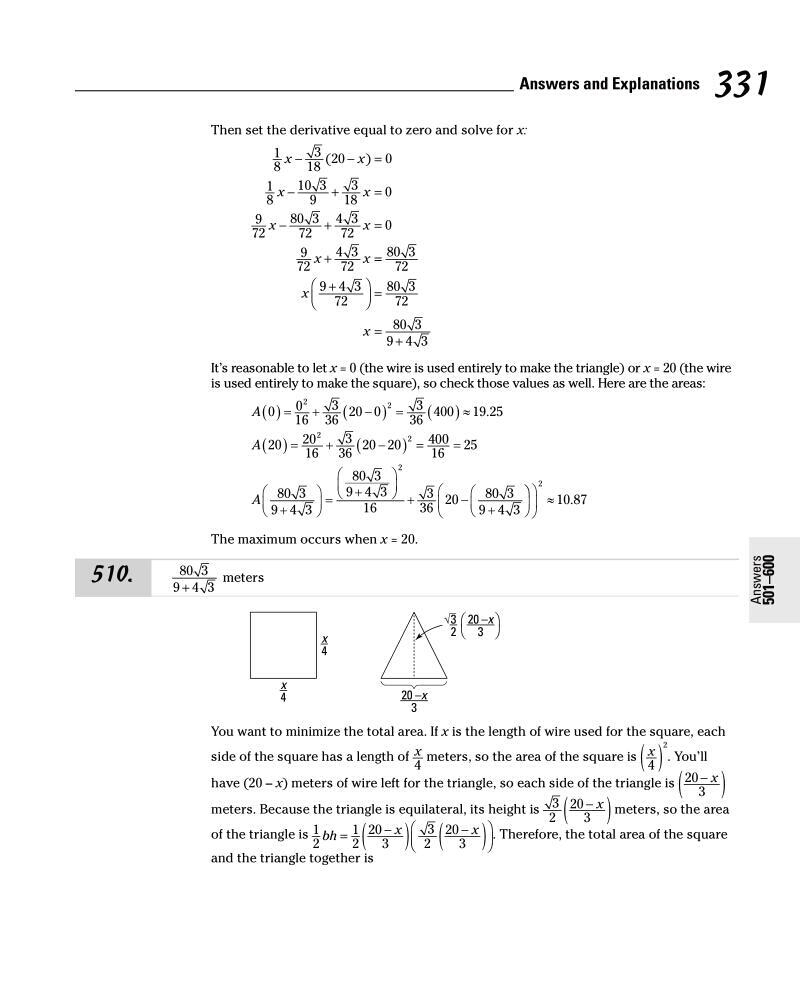
You want to minimize the total area. If x is the length of wire used for the square, each
side of the square has a length of x
4
meters, so the area of the square is x
4
2
( ) . You’ll
have (20 – x) meters of wire left for the triangle, so each side of the triangle is 20
3
− x
( )
meters. Because the triangle is equilateral, its height is 3
2
20
3
− x
( ) meters, so the area
of the triangle is 1
2
1
2
20
3
3
2
20
3
bh
x
x
=
−
−
( ) ( )
. Therefore, the total area of the square
and the triangle together is
Answers
501–600
Answers and Explanations
Then set the derivative equal to zero and solve for x:
1
8
3
18
20
0
1
8
10 3
9
3
18
0
9
72
80 3
72
4 3
72
0
9
72
4 3
72
x
x
x
x
x
x
x
x
−
−
=
−
+
=
−
+
=
+
(
)
= =
+
=
= +
80 3
72
9 4 3
72
80 3
72
80 3
9 4 3
x
x
It’s reasonable to let x = 0 (the wire is used entirely to make the triangle) or x = 20 (the wire
is used entirely to make the square), so check those values as well. Here are the areas:
A
A
0
0
16
3
36
20 0
3
36
400 19 25
20
20
16
3
36
20 20
2
2
2
2
( ) = +
−
(
) = ( )≈
( )=
+
−
(
)
.
= =
=
+
=
+
+
−
+
400
16
25
80 3
9 4 3
80 3
9 4 3
16
3
36
20
80 3
9 4 3
2
A
≈
2
10 87
.
The maximum occurs when x = 20.
510.
80 3
9 4 3
+
meters
You want to minimize the total area. If x is the length of wire used for the square, each
side of the square has a length of x
4
meters, so the area of the square is x
4
2
( ) . You’ll
have (20 – x) meters of wire left for the triangle, so each side of the triangle is 20
3
− x
( )
meters. Because the triangle is equilateral, its height is 3
2
20
3
− x
( ) meters, so the area
of the triangle is 1
2
1
2
20
3
3
2
20
3
bh
x
x
=
−
−
( ) ( )
. Therefore, the total area of the square
and the triangle together is