

Part II: The Answers
318
Answers
401–500
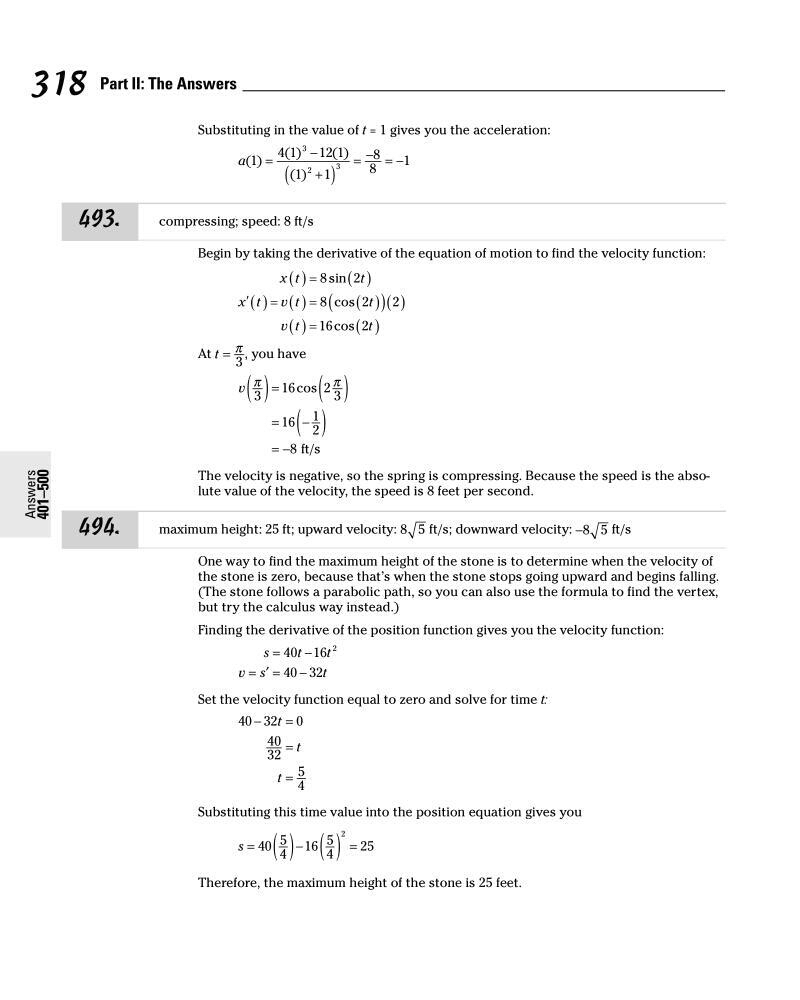
Substituting in the value of t = 1 gives you the acceleration:
a( )
( )
( )
( )
1
4 1
12 1
1
1
8
8
1
3
2
3
=
−
+
= − = −
(
)
493.
compressing; speed: 8 ft/s
Begin by taking the derivative of the equation of motion to find the velocity function:
x t
t
x t
v t
t
v t
t
( ) =
( )
′ ( ) = ( ) =
( )
(
)( )
( ) =
( )
8
2
8
2
2
16
2
sin
cos
cos
At t = π
3
, you have
v π
π
3
16
2 3
16 1
2
8
( )
( )
( )
=
=
−
= −
cos
ft/s
The velocity is negative, so the spring is compressing. Because the speed is the absolute value of the velocity, the speed is 8 feet per second.
494.
maximum height: 25 ft; upward velocity: 8 5 ft/s; downward velocity: −8 5 ft/s
One way to find the maximum height of the stone is to determine when the velocity of
the stone is zero, because that’s when the stone stops going upward and begins falling.
(The stone follows a parabolic path, so you can also use the formula to find the vertex,
but try the calculus way instead.)
Finding the derivative of the position function gives you the velocity function:
s
t
t
v s
t
=
−
= = −
4
16
2
0
40 32
′
Set the velocity function equal to zero and solve for time t:
40 32 0
40
32
5
4
−
=
=
=
t
t
t
Substituting this time value into the position equation gives you
s =
−
=
40 5
4
16 5
4
25
2
( ) ( )
Therefore, the maximum height of the stone is 25 feet.
318
Answers
401–500
Substituting in the value of t = 1 gives you the acceleration:
a( )
( )
( )
( )
1
4 1
12 1
1
1
8
8
1
3
2
3
=
−
+
= − = −
(
)
493.
compressing; speed: 8 ft/s
Begin by taking the derivative of the equation of motion to find the velocity function:
x t
t
x t
v t
t
v t
t
( ) =
( )
′ ( ) = ( ) =
( )
(
)( )
( ) =
( )
8
2
8
2
2
16
2
sin
cos
cos
At t = π
3
, you have
v π
π
3
16
2 3
16 1
2
8
( )
( )
( )
=
=
−
= −
cos
ft/s
The velocity is negative, so the spring is compressing. Because the speed is the absolute value of the velocity, the speed is 8 feet per second.
494.
maximum height: 25 ft; upward velocity: 8 5 ft/s; downward velocity: −8 5 ft/s
One way to find the maximum height of the stone is to determine when the velocity of
the stone is zero, because that’s when the stone stops going upward and begins falling.
(The stone follows a parabolic path, so you can also use the formula to find the vertex,
but try the calculus way instead.)
Finding the derivative of the position function gives you the velocity function:
s
t
t
v s
t
=
−
= = −
4
16
2
0
40 32
′
Set the velocity function equal to zero and solve for time t:
40 32 0
40
32
5
4
−
=
=
=
t
t
t
Substituting this time value into the position equation gives you
s =
−
=
40 5
4
16 5
4
25
2
( ) ( )
Therefore, the maximum height of the stone is 25 feet.