

Answers and Explanations 317
Answers
401–500
491.
velocity: 1; acceleration: –2
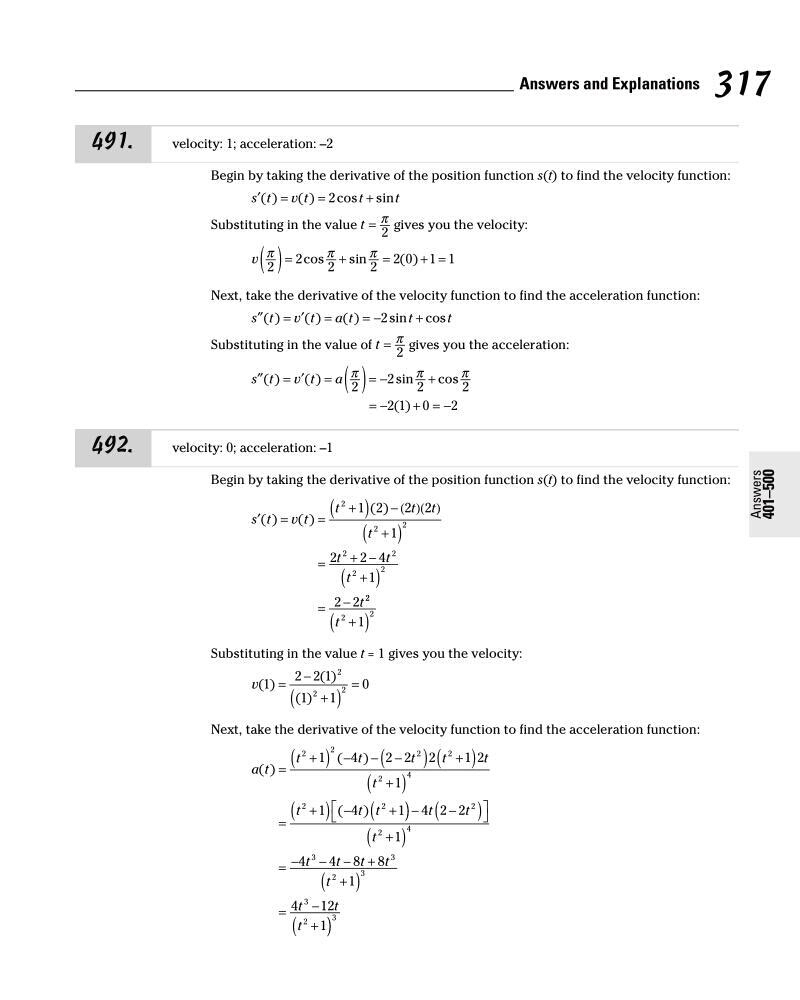
Begin by taking the derivative of the position function s(t) to find the velocity function:
′
s t
v t
t
t
( )
( )
cos sin
=
=
+
2
Substituting in the value t = π
2
gives you the velocity:
v π
π
π
2
2
2
2
2 0 1 1
( ) = + = + =
cos
sin
( )
Next, take the derivative of the velocity function to find the acceleration function:
′′
′
s t
v t
a t
t
t
( )
( )
( )
sin cos
=
=
= −
+
2
Substituting in the value of t = π
2
gives you the acceleration:
′′
′
( )
s t
v t
a
( )
( )
sin
cos
( )
=
=
= −
+
= −
+ = −
π
π
π
2
2
2
2
2 1 0
2
492.
velocity: 0; acceleration: –1
Begin by taking the derivative of the position function s(t) to find the velocity function:
′
( )
( )
( )
s t
v t
t
t t
t
t
t
t
t
( )
( )
( )
=
=
+
−( )( )
+
=
+ −
+
= −
2
2
2
2
2
2
2
1 2
2 2
1
2
2 4
1
2 2
2 2
2
2
1
t +
( )
Substituting in the value t = 1 gives you the velocity:
v( )
( )
( )
1
2 2 1
1
1
0
2
2
2
=
−
+
=
(
)
Next, take the derivative of the velocity function to find the acceleration function:
a t
t
t
t
t
t
t
t
t t
( )
(
)
(
)
=
+
−
− −
+
+
=
+
−
+
2
2
2
2
2
4
2
2
1
4
2 2 2
1 2
1
1
4
1
( )
(
) ( )
( )
( )
( ) ) (
)
( )
( )
(
−
−
+
= −
− − +
+
=
−
+
4 2 2
1
4
4 8 8
1
4
12
1
2
2
4
3
3
2
3
3
2
t
t
t
t
t
t
t
t
t
t
t
) )
3
Answers
401–500
491.
velocity: 1; acceleration: –2
Begin by taking the derivative of the position function s(t) to find the velocity function:
′
s t
v t
t
t
( )
( )
cos sin
=
=
+
2
Substituting in the value t = π
2
gives you the velocity:
v π
π
π
2
2
2
2
2 0 1 1
( ) = + = + =
cos
sin
( )
Next, take the derivative of the velocity function to find the acceleration function:
′′
′
s t
v t
a t
t
t
( )
( )
( )
sin cos
=
=
= −
+
2
Substituting in the value of t = π
2
gives you the acceleration:
′′
′
( )
s t
v t
a
( )
( )
sin
cos
( )
=
=
= −
+
= −
+ = −
π
π
π
2
2
2
2
2 1 0
2
492.
velocity: 0; acceleration: –1
Begin by taking the derivative of the position function s(t) to find the velocity function:
′
( )
( )
( )
s t
v t
t
t t
t
t
t
t
t
( )
( )
( )
=
=
+
−( )( )
+
=
+ −
+
= −
2
2
2
2
2
2
2
1 2
2 2
1
2
2 4
1
2 2
2 2
2
2
1
t +
( )
Substituting in the value t = 1 gives you the velocity:
v( )
( )
( )
1
2 2 1
1
1
0
2
2
2
=
−
+
=
(
)
Next, take the derivative of the velocity function to find the acceleration function:
a t
t
t
t
t
t
t
t
t t
( )
(
)
(
)
=
+
−
− −
+
+
=
+
−
+
2
2
2
2
2
4
2
2
1
4
2 2 2
1 2
1
1
4
1
( )
(
) ( )
( )
( )
( ) ) (
)
( )
( )
(
−
−
+
= −
− − +
+
=
−
+
4 2 2
1
4
4 8 8
1
4
12
1
2
2
4
3
3
2
3
3
2
t
t
t
t
t
t
t
t
t
t
t
) )
3