

Answers and Explanations 319
Answers
401–500
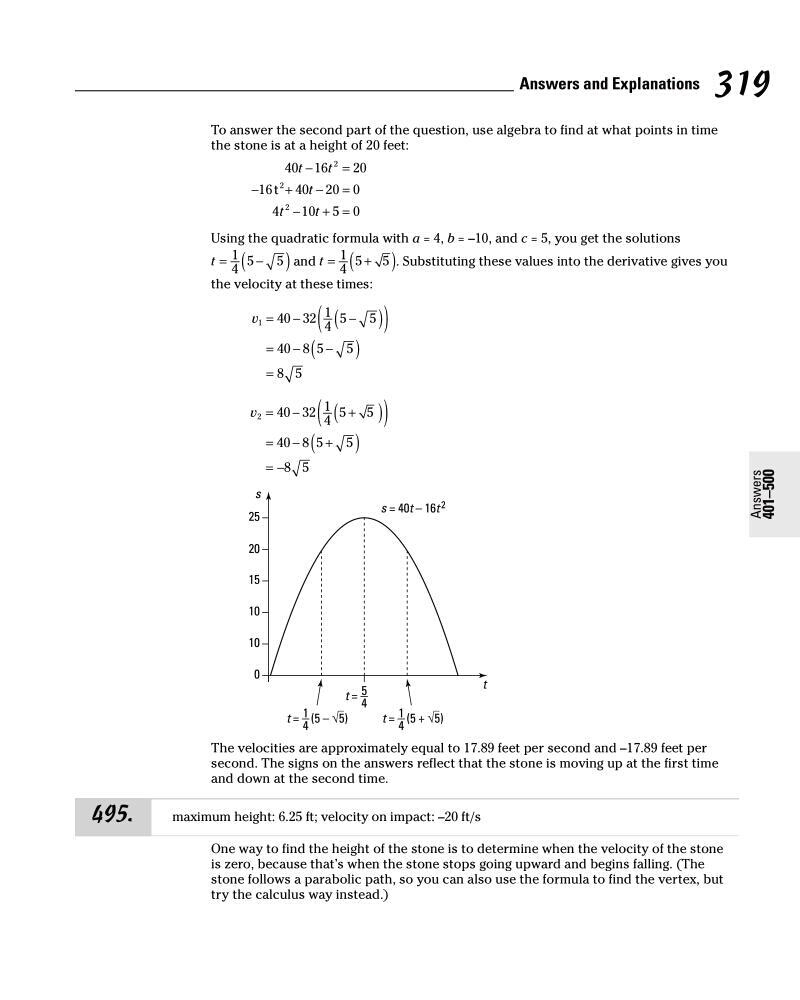
To answer the second part of the question, use algebra to find at what points in time
the stone is at a height of 20 feet:
40 16
20
16
40 20 0
4
10 5 0
2
2
2
t
t
t
t
t
−
=
−
+
− =
−
+ =
t
Using the quadratic formula with a = 4, b = –10, and c = 5, you get the solutions
t =
−
1
4
5
5
(
) and t = +
1
4
5
5
(
) . Substituting these values into the derivative gives you
the velocity at these times:
v 1 40 32 1
4
5
5
40 8 5
5
8 5
= −
−
= −
−
=
(
)
(
)
(
)
v 2 40 32 1
4
5
5
40 8 5
5
8 5
= −
+
= −
+
= −
(
)
(
)
(
)
The velocities are approximately equal to 17.89 feet per second and –17.89 feet per
second. The signs on the answers reflect that the stone is moving up at the first time
and down at the second time.
495.
maximum height: 6.25 ft; velocity on impact: –20 ft/s
One way to find the height of the stone is to determine when the velocity of the stone
is zero, because that’s when the stone stops going upward and begins falling. (The
stone follows a parabolic path, so you can also use the formula to find the vertex, but
try the calculus way instead.)
Answers
401–500
To answer the second part of the question, use algebra to find at what points in time
the stone is at a height of 20 feet:
40 16
20
16
40 20 0
4
10 5 0
2
2
2
t
t
t
t
t
−
=
−
+
− =
−
+ =
t
Using the quadratic formula with a = 4, b = –10, and c = 5, you get the solutions
t =
−
1
4
5
5
(
) and t = +
1
4
5
5
(
) . Substituting these values into the derivative gives you
the velocity at these times:
v 1 40 32 1
4
5
5
40 8 5
5
8 5
= −
−
= −
−
=
(
)
(
)
(
)
v 2 40 32 1
4
5
5
40 8 5
5
8 5
= −
+
= −
+
= −
(
)
(
)
(
)
The velocities are approximately equal to 17.89 feet per second and –17.89 feet per
second. The signs on the answers reflect that the stone is moving up at the first time
and down at the second time.
495.
maximum height: 6.25 ft; velocity on impact: –20 ft/s
One way to find the height of the stone is to determine when the velocity of the stone
is zero, because that’s when the stone stops going upward and begins falling. (The
stone follows a parabolic path, so you can also use the formula to find the vertex, but
try the calculus way instead.)