

Part II: The Answers
314
Answers
401–500
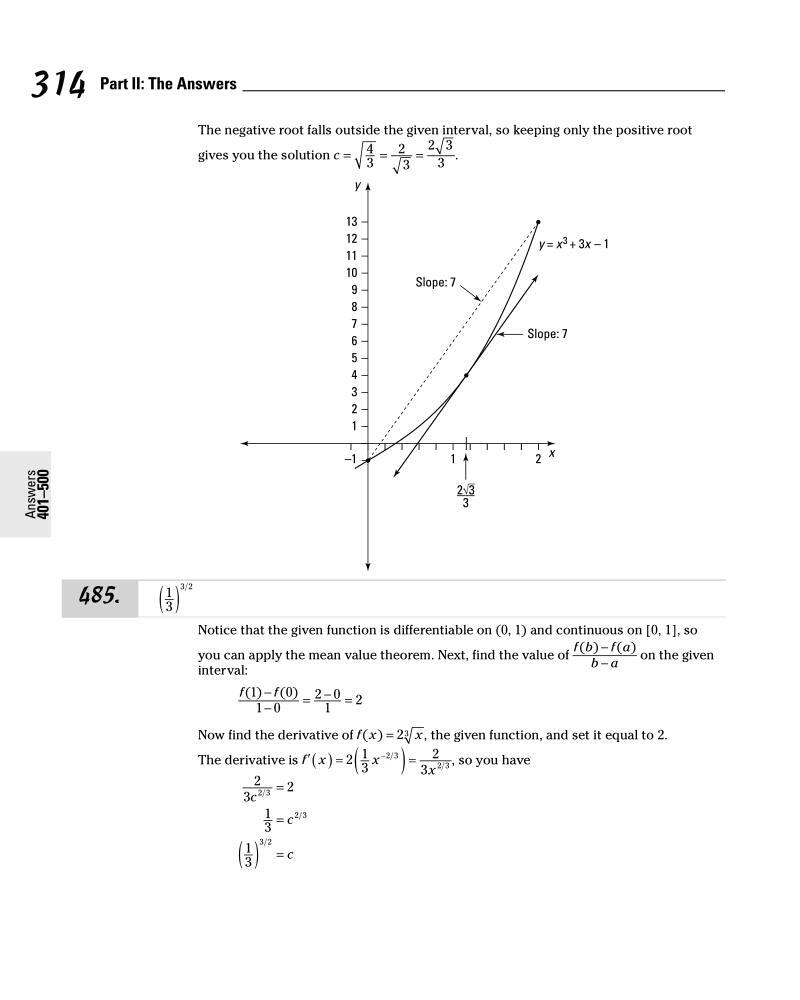
The negative root falls outside the given interval, so keeping only the positive root
gives you the solution c =
=
=
4
3
2
3
2 3
3
.
485.
1
3
3 2
( )
Notice that the given function is differentiable on (0, 1) and continuous on [0, 1], so
you can apply the mean value theorem. Next, find the value of
f b f a
b a
( ) ( )
−
−
on the given
interval:
f
f
( ) ( )
1
0
1 0
2 0
1
2
−
−
= − =
Now find the derivative of f x
x
( ) = 2 3 , the given function, and set it equal to 2.
The derivative is ′ ( ) = ( ) =
−
f x
x
x
2 1
3
2
3
2 3
2 3
, so you have
2
3
2
1
3
1
3
2 3
2 3
3 2
c
c
c
=
=
=
( )
314
Answers
401–500
The negative root falls outside the given interval, so keeping only the positive root
gives you the solution c =
=
=
4
3
2
3
2 3
3
.
485.
1
3
3 2
( )
Notice that the given function is differentiable on (0, 1) and continuous on [0, 1], so
you can apply the mean value theorem. Next, find the value of
f b f a
b a
( ) ( )
−
−
on the given
interval:
f
f
( ) ( )
1
0
1 0
2 0
1
2
−
−
= − =
Now find the derivative of f x
x
( ) = 2 3 , the given function, and set it equal to 2.
The derivative is ′ ( ) = ( ) =
−
f x
x
x
2 1
3
2
3
2 3
2 3
, so you have
2
3
2
1
3
1
3
2 3
2 3
3 2
c
c
c
=
=
=
( )