

Answers and Explanations 313
Answers
401–500
483.
0, ± 1
2
, ±1
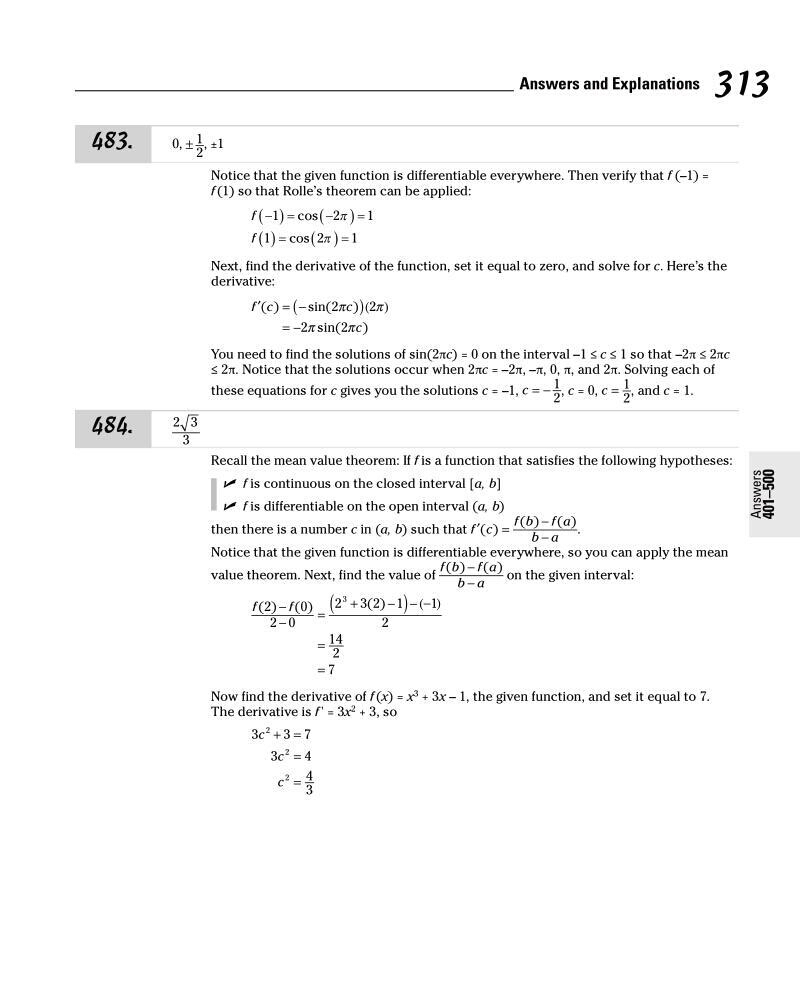
Notice that the given function is differentiable everywhere. Then verify that f (–1) =
f
(1) so that Rolle’s theorem can be applied:
f
f
−
( )=
−
( )=
( ) = ( )=
1
2
1
1
2
1
cos
cos
π
π
Next, find the derivative of the function, set it equal to zero, and solve for c. Here’s the
derivative:
′
(
)
f c
c
c
( )
sin(
)
sin(
)
= −
( )
= −
2
2
2
2
π
π
π
π
You need to find the solutions of sin(2πc) = 0 on the interval –1 ≤ c ≤ 1 so that –2π ≤ 2πc
≤ 2π. Notice that the solutions occur when 2πc = –2π, –π, 0, π, and 2π. Solving each of
these equations for c gives you the solutions c = –1, c = − 1
2
, c = 0, c = 1
2
, and c = 1.
484.
2 3
3
Recall the mean value theorem: If f is a function that satisfies the following hypotheses:
✓ f is continuous on the closed interval [a, b]
✓ f is differentiable on the open interval (a, b)
then there is a number c in (a, b) such that ′
f c
f b f a
b a
( )
( ) ( )
=
−
−
.
Notice that the given function is differentiable everywhere, so you can apply the mean
value theorem. Next, find the value of
f b f a
b a
( ) ( )
−
−
on the given interval:
f
f
( ) ( )
( )
2
0
2 0
2 3 2 1
1
2
14
2
7
3
−
−
=
+
− − (− )
=
=
(
)
Now find the derivative of f
(x) = x
3
+ 3x – 1, the given function, and set it equal to 7.
The derivative is f
' = 3x
2
+ 3, so
3
3 7
3
4
4
3
2
2
2
c
c
c
+ =
=
=
Answers
401–500
483.
0, ± 1
2
, ±1
Notice that the given function is differentiable everywhere. Then verify that f (–1) =
f
(1) so that Rolle’s theorem can be applied:
f
f
−
( )=
−
( )=
( ) = ( )=
1
2
1
1
2
1
cos
cos
π
π
Next, find the derivative of the function, set it equal to zero, and solve for c. Here’s the
derivative:
′
(
)
f c
c
c
( )
sin(
)
sin(
)
= −
( )
= −
2
2
2
2
π
π
π
π
You need to find the solutions of sin(2πc) = 0 on the interval –1 ≤ c ≤ 1 so that –2π ≤ 2πc
≤ 2π. Notice that the solutions occur when 2πc = –2π, –π, 0, π, and 2π. Solving each of
these equations for c gives you the solutions c = –1, c = − 1
2
, c = 0, c = 1
2
, and c = 1.
484.
2 3
3
Recall the mean value theorem: If f is a function that satisfies the following hypotheses:
✓ f is continuous on the closed interval [a, b]
✓ f is differentiable on the open interval (a, b)
then there is a number c in (a, b) such that ′
f c
f b f a
b a
( )
( ) ( )
=
−
−
.
Notice that the given function is differentiable everywhere, so you can apply the mean
value theorem. Next, find the value of
f b f a
b a
( ) ( )
−
−
on the given interval:
f
f
( ) ( )
( )
2
0
2 0
2 3 2 1
1
2
14
2
7
3
−
−
=
+
− − (− )
=
=
(
)
Now find the derivative of f
(x) = x
3
+ 3x – 1, the given function, and set it equal to 7.
The derivative is f
' = 3x
2
+ 3, so
3
3 7
3
4
4
3
2
2
2
c
c
c
+ =
=
=