

Answers and Explanations 315
Answers
401–500
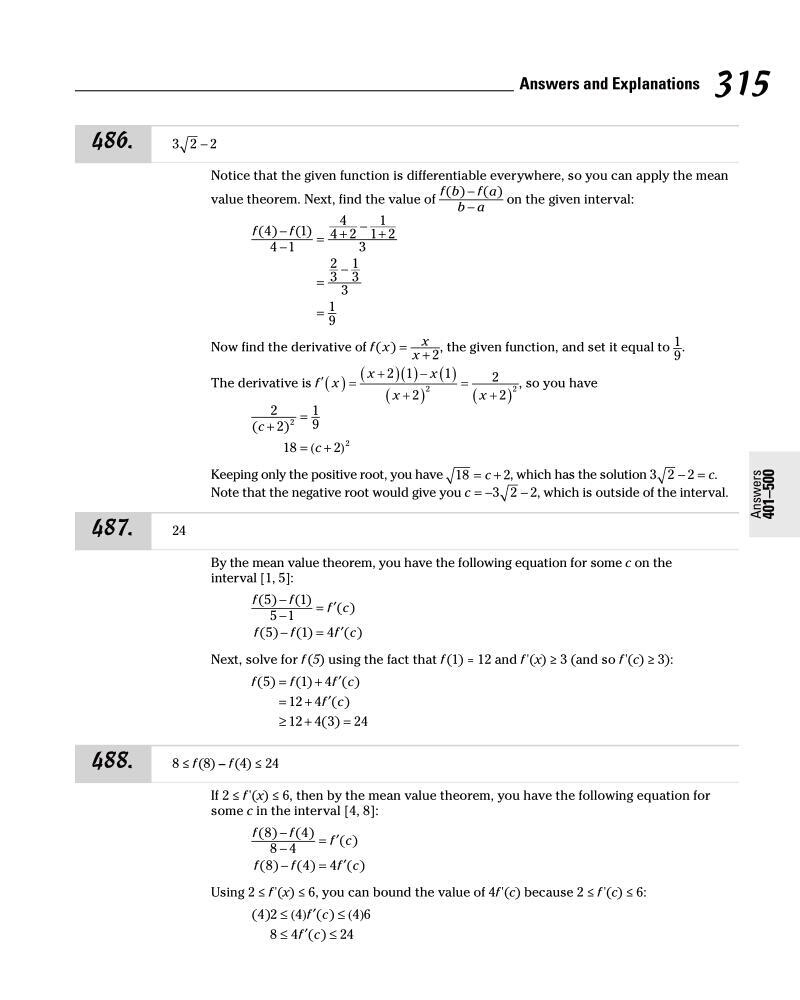
486.
3 2 2
−
Notice that the given function is differentiable everywhere, so you can apply the mean
value theorem. Next, find the value of
f b f a
b a
( ) ( )
−
−
on the given interval:
f
f
( ) ( )
4
1
4 1
4
4 2
1
1 2
3
2
3
1
3
3
1
9
−
−
= +
− +
=
−
=
Now find the derivative of f x
x
x
( ) = + 2
, the given function, and set it equal to 1
9
.
The derivative is ′ ( ) =
+
(
)( )− ( )
+
(
)
=
+
(
)
f x
x
x
x
x
2 1
1
2
2
2
2
2
, so you have
2
2
1
9
18
2
2
2
(
)
c
c
+
=
= ( + )
Keeping only the positive root, you have 18
2
= +
c , which has the solution 3 2 2
− = c.
Note that the negative root would give you c = −
−
3 2 2, which is outside of the interval.
487.
24
By the mean value theorem, you have the following equation for some c on the
interval [1, 5]:
f
f
f c
f
f
f c
( ) ( )
( )
( ) ( )
( )
5
1
5 1
5
1 4
−
−
=
−
=
′
′
Next, solve for f
(5) using the fact that f
(1) = 12 and f
'(x) ≥ 3 (and so f
'(c) ≥ 3):
f
f
f c
f c
( ) ( )
( )
( )
( )
5
1 4
12 4
12 4 3 24
=
+
= +
≥ +
=
′
′
488.
8 ≤ f
(8) – f
(4) ≤ 24
If 2 ≤ f
'(x) ≤ 6, then by the mean value theorem, you have the following equation for
some c in the interval [4, 8]:
f
f
f c
f
f
f c
( ) ( )
( )
( ) ( )
( )
8
4
8 4
8
4
4
−
−
=
−
=
′
′
Using 2 ≤ f
'(x) ≤ 6, you can bound the value of 4f
'(c) because 2 ≤ f
'(c) ≤ 6:
( )
( )
( )
4 2 4
46
8 4
24
≤ ( )
≤( )
≤
≤
′
′
f c
f c
Answers
401–500
486.
3 2 2
−
Notice that the given function is differentiable everywhere, so you can apply the mean
value theorem. Next, find the value of
f b f a
b a
( ) ( )
−
−
on the given interval:
f
f
( ) ( )
4
1
4 1
4
4 2
1
1 2
3
2
3
1
3
3
1
9
−
−
= +
− +
=
−
=
Now find the derivative of f x
x
x
( ) = + 2
, the given function, and set it equal to 1
9
.
The derivative is ′ ( ) =
+
(
)( )− ( )
+
(
)
=
+
(
)
f x
x
x
x
x
2 1
1
2
2
2
2
2
, so you have
2
2
1
9
18
2
2
2
(
)
c
c
+
=
= ( + )
Keeping only the positive root, you have 18
2
= +
c , which has the solution 3 2 2
− = c.
Note that the negative root would give you c = −
−
3 2 2, which is outside of the interval.
487.
24
By the mean value theorem, you have the following equation for some c on the
interval [1, 5]:
f
f
f c
f
f
f c
( ) ( )
( )
( ) ( )
( )
5
1
5 1
5
1 4
−
−
=
−
=
′
′
Next, solve for f
(5) using the fact that f
(1) = 12 and f
'(x) ≥ 3 (and so f
'(c) ≥ 3):
f
f
f c
f c
( ) ( )
( )
( )
( )
5
1 4
12 4
12 4 3 24
=
+
= +
≥ +
=
′
′
488.
8 ≤ f
(8) – f
(4) ≤ 24
If 2 ≤ f
'(x) ≤ 6, then by the mean value theorem, you have the following equation for
some c in the interval [4, 8]:
f
f
f c
f
f
f c
( ) ( )
( )
( ) ( )
( )
8
4
8 4
8
4
4
−
−
=
−
=
′
′
Using 2 ≤ f
'(x) ≤ 6, you can bound the value of 4f
'(c) because 2 ≤ f
'(c) ≤ 6:
( )
( )
( )
4 2 4
46
8 4
24
≤ ( )
≤( )
≤
≤
′
′
f c
f c