

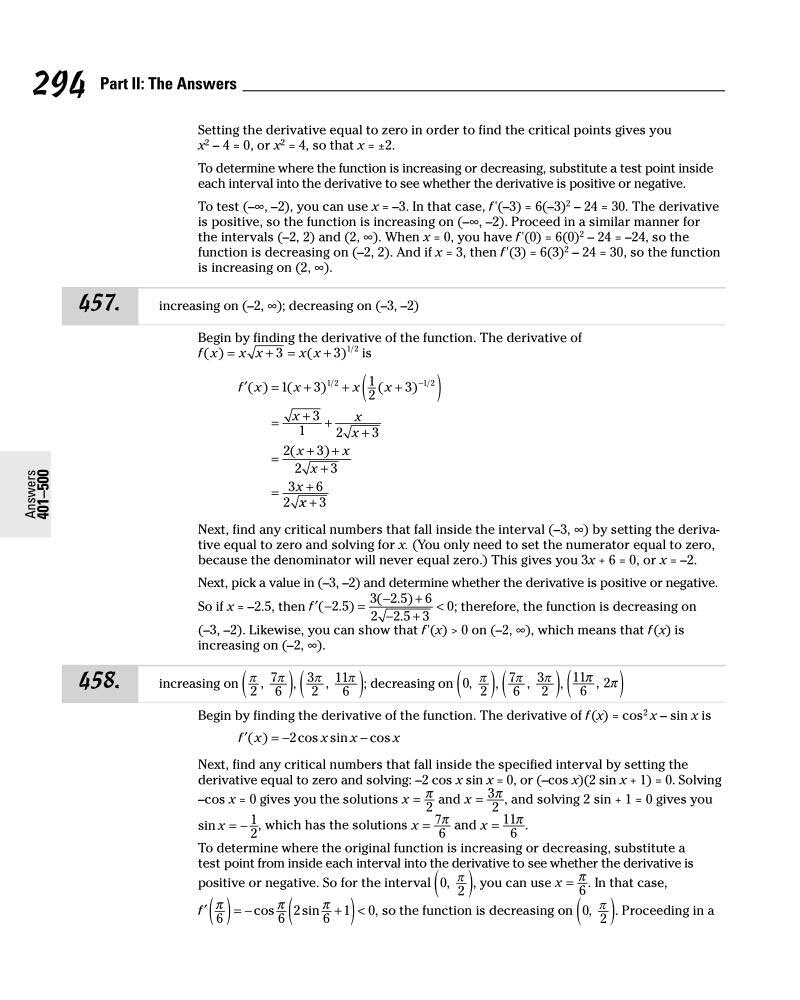
Part II: The Answers
294
Answers
401–500
Setting the derivative equal to zero in order to find the critical points gives you
x
2
– 4 = 0, or x
2
= 4, so that x = ±2.
To determine where the function is increasing or decreasing, substitute a test point inside
each interval into the derivative to see whether the derivative is positive or negative.
To test (–∞, –2), you can use x = –3. In that case, f
'(–3) = 6(–3)
2
– 24 = 30. The derivative
is positive, so the function is increasing on (–∞, –2). Proceed in a similar manner for
the intervals (–2, 2) and (2, ∞). When x = 0, you have f
'(0) = 6(0)
2
– 24 = –24, so the
function is decreasing on (–2, 2). And if x = 3, then f
'(3) = 6(3)
2
– 24 = 30, so the function
is increasing on (2, ∞).
457.
increasing on (–2, ∞); decreasing on (–3, –2)
Begin by finding the derivative of the function. The derivative of
f x
x x
x x
( )
(
)
=
+ =
+
3
3
1 2 is
′
(
)
f x
x
x
x
x
x
x
x
x
x
x
( ) (
)
(
)
(
)
=
+
+
+
=
+ +
+
=
+ +
+
=
+
−
1
3
1
2
3
3
1
2
3
2
3
2
3
3
6
2
1 2
1 2
x x + 3
Next, find any critical numbers that fall inside the interval (–3, ∞) by setting the derivative equal to zero and solving for x. (You only need to set the numerator equal to zero,
because the denominator will never equal zero.) This gives you 3x + 6 = 0, or x = –2.
Next, pick a value in (–3, –2) and determine whether the derivative is positive or negative.
So if x = –2.5, then ′ −
=
−
+
− +
<
f ( . )
( . )
.
2 5
3 2 5 6
2 2 5 3
0; therefore, the function is decreasing on
(–3, –2). Likewise, you can show that f
'(x) > 0 on (–2, ∞), which means that f
(x) is
increasing on (–2, ∞).
458.
increasing on π
π
2
7
6
,
( ) , 3
2
11
6
π
π
,
(
) ; decreasing on 0 2
, π
( ) , 7
6
3
2
π
π
,
(
) , 11
6
2
π π
,
(
)
Begin by finding the derivative of the function. The derivative of f
(x) = cos
2
x – sin x is
′
f x
x
x
x
( )
cos sin
cos
= −
−
2
Next, find any critical numbers that fall inside the specified interval by setting the
derivative equal to zero and solving: –2 cos x sin x = 0, or (–cos x)(2 sin x + 1) = 0. Solving
–cos x = 0 gives you the solutions x = π
2
and x = 3
2
π , and solving 2 sin + 1 = 0 gives you
sin x = − 1
2
, which has the solutions x = 7π
6
and x = 11
6
π .
To determine where the original function is increasing or decreasing, substitute a
test point from inside each interval into the derivative to see whether the derivative is
positive or negative. So for the interval 0 2
, π
( ) , you can use x = π
6
. In that case,
′ ( )
(
)
f π
π
π
6
6
2
6
1 0
= −
+ <
cos
sin
, so the function is decreasing on 0 2
, π
( ) . Proceeding in a
294
Answers
401–500
Setting the derivative equal to zero in order to find the critical points gives you
x
2
– 4 = 0, or x
2
= 4, so that x = ±2.
To determine where the function is increasing or decreasing, substitute a test point inside
each interval into the derivative to see whether the derivative is positive or negative.
To test (–∞, –2), you can use x = –3. In that case, f
'(–3) = 6(–3)
2
– 24 = 30. The derivative
is positive, so the function is increasing on (–∞, –2). Proceed in a similar manner for
the intervals (–2, 2) and (2, ∞). When x = 0, you have f
'(0) = 6(0)
2
– 24 = –24, so the
function is decreasing on (–2, 2). And if x = 3, then f
'(3) = 6(3)
2
– 24 = 30, so the function
is increasing on (2, ∞).
457.
increasing on (–2, ∞); decreasing on (–3, –2)
Begin by finding the derivative of the function. The derivative of
f x
x x
x x
( )
(
)
=
+ =
+
3
3
1 2 is
′
(
)
f x
x
x
x
x
x
x
x
x
x
x
( ) (
)
(
)
(
)
=
+
+
+
=
+ +
+
=
+ +
+
=
+
−
1
3
1
2
3
3
1
2
3
2
3
2
3
3
6
2
1 2
1 2
x x + 3
Next, find any critical numbers that fall inside the interval (–3, ∞) by setting the derivative equal to zero and solving for x. (You only need to set the numerator equal to zero,
because the denominator will never equal zero.) This gives you 3x + 6 = 0, or x = –2.
Next, pick a value in (–3, –2) and determine whether the derivative is positive or negative.
So if x = –2.5, then ′ −
=
−
+
− +
<
f ( . )
( . )
.
2 5
3 2 5 6
2 2 5 3
0; therefore, the function is decreasing on
(–3, –2). Likewise, you can show that f
'(x) > 0 on (–2, ∞), which means that f
(x) is
increasing on (–2, ∞).
458.
increasing on π
π
2
7
6
,
( ) , 3
2
11
6
π
π
,
(
) ; decreasing on 0 2
, π
( ) , 7
6
3
2
π
π
,
(
) , 11
6
2
π π
,
(
)
Begin by finding the derivative of the function. The derivative of f
(x) = cos
2
x – sin x is
′
f x
x
x
x
( )
cos sin
cos
= −
−
2
Next, find any critical numbers that fall inside the specified interval by setting the
derivative equal to zero and solving: –2 cos x sin x = 0, or (–cos x)(2 sin x + 1) = 0. Solving
–cos x = 0 gives you the solutions x = π
2
and x = 3
2
π , and solving 2 sin + 1 = 0 gives you
sin x = − 1
2
, which has the solutions x = 7π
6
and x = 11
6
π .
To determine where the original function is increasing or decreasing, substitute a
test point from inside each interval into the derivative to see whether the derivative is
positive or negative. So for the interval 0 2
, π
( ) , you can use x = π
6
. In that case,
′ ( )
(
)
f π
π
π
6
6
2
6
1 0
= −
+ <
cos
sin
, so the function is decreasing on 0 2
, π
( ) . Proceeding in a