

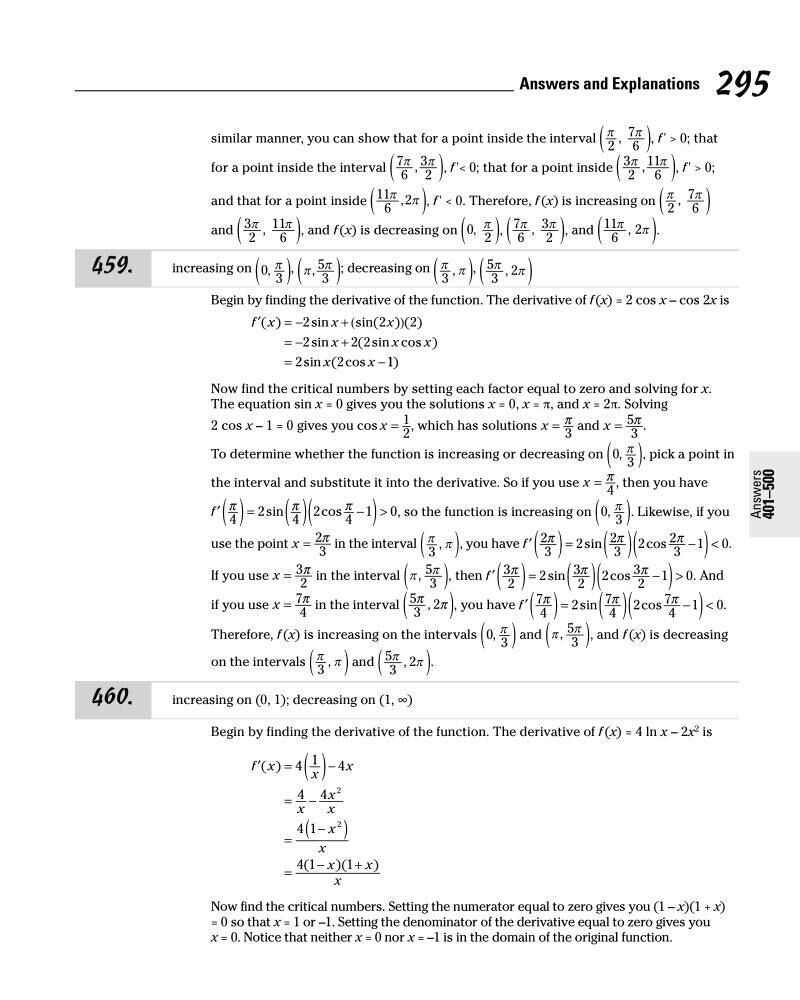
Answers and Explanations 295
Answers
401–500
similar manner, you can show that for a point inside the interval π
π
2
7
6
,
( ) , f
' > 0; that
for a point inside the interval 7
6
3
2
π π
,
( ) , f
'< 0; that for a point inside 3
2
11
6
π
π
,
(
) , f
' > 0;
and that for a point inside 11
6
2
π π
,
(
) , f
' < 0. Therefore, f
(x) is increasing on π
π
2
7
6
,
( )
and 3
2
11
6
π
π
,
(
) , and f
(x) is decreasing on 0 2
, π
( ) , 7
6
3
2
π
π
,
(
) , and 11
6
2
π π
,
(
) .
459.
increasing on 0 3
, π
( ) , π π
, 5
3
( ) ; decreasing on π π
3
,
( ) , 5
3
2
π π
,
( )
Begin by finding the derivative of the function. The derivative of f
(x) = 2 cos x – cos 2x is
′
f x
x
x
x
x
x
x
x
( )
sin
sin( ) ( )
sin
( sin cos )
sin ( cos
= −
+ (
)
= −
+
=
−
2
2
2
2
22
2
2
1 1)
Now find the critical numbers by setting each factor equal to zero and solving for x.
The equation sin x = 0 gives you the solutions x = 0, x = π, and x = 2π. Solving
2 cos x – 1 = 0 gives you cos x = 1
2
, which has solutions x = π
3
and x = 5
3
π .
To determine whether the function is increasing or decreasing on 0 3
, π
( ) , pick a point in
the interval and substitute it into the derivative. So if you use x = π
4
, then you have
′ ( ) ( )(
)
f π
π
π
4
2
4
2
4
1 0
=
− >
sin
c os
, so the function is increasing on 0 3
, π
( ) . Likewise, if you
use the point x = 2
3
π in the interval π π
3
,
( ) , you have ′ ( ) ( )(
)
f 2
3
2
2
3
2
2
3
1 0
π
π
π
=
− <
sin
c os
.
If you use x = 3
2
π in the interval π π
, 5
3
( ) , then ′ ( ) ( )(
)
f 3
2
2
3
2
2
3
2
1 0
π
π
π
=
− >
sin
c os
. And
if you use x = 7
4
π in the interval 5
3
2
π π
,
( ) , you have ′ ( ) ( )(
)
f 7
4
2
7
4
2
7
4
1 0
π
π
π
=
− <
sin
c os
.
Therefore, f
(x) is increasing on the intervals 0 3
, π
( ) and π π
, 5
3
( ) , and f
(x) is decreasing
on the intervals π π
3
,
( ) and 5
3
2
π π
,
( ) .
460.
increasing on (0, 1); decreasing on (1, ∞)
Begin by finding the derivative of the function. The derivative of f
(x) = 4 ln x – 2x
2
is
′
( )
( )
f x
x
x
x
x
x
x
x
x
x
x
( )
(
)(
)
=
−
= −
=
−
=
−
+
4 1 4
4 4
4 1
4 1
1
2
2
Now find the critical numbers. Setting the numerator equal to zero gives you (1 – x)(1 + x)
= 0 so that x = 1 or –1. Setting the denominator of the derivative equal to zero gives you
x = 0. Notice that neither x = 0 nor x = –1 is in the domain of the original function.
Answers
401–500
similar manner, you can show that for a point inside the interval π
π
2
7
6
,
( ) , f
' > 0; that
for a point inside the interval 7
6
3
2
π π
,
( ) , f
'< 0; that for a point inside 3
2
11
6
π
π
,
(
) , f
' > 0;
and that for a point inside 11
6
2
π π
,
(
) , f
' < 0. Therefore, f
(x) is increasing on π
π
2
7
6
,
( )
and 3
2
11
6
π
π
,
(
) , and f
(x) is decreasing on 0 2
, π
( ) , 7
6
3
2
π
π
,
(
) , and 11
6
2
π π
,
(
) .
459.
increasing on 0 3
, π
( ) , π π
, 5
3
( ) ; decreasing on π π
3
,
( ) , 5
3
2
π π
,
( )
Begin by finding the derivative of the function. The derivative of f
(x) = 2 cos x – cos 2x is
′
f x
x
x
x
x
x
x
x
( )
sin
sin( ) ( )
sin
( sin cos )
sin ( cos
= −
+ (
)
= −
+
=
−
2
2
2
2
22
2
2
1 1)
Now find the critical numbers by setting each factor equal to zero and solving for x.
The equation sin x = 0 gives you the solutions x = 0, x = π, and x = 2π. Solving
2 cos x – 1 = 0 gives you cos x = 1
2
, which has solutions x = π
3
and x = 5
3
π .
To determine whether the function is increasing or decreasing on 0 3
, π
( ) , pick a point in
the interval and substitute it into the derivative. So if you use x = π
4
, then you have
′ ( ) ( )(
)
f π
π
π
4
2
4
2
4
1 0
=
− >
sin
c os
, so the function is increasing on 0 3
, π
( ) . Likewise, if you
use the point x = 2
3
π in the interval π π
3
,
( ) , you have ′ ( ) ( )(
)
f 2
3
2
2
3
2
2
3
1 0
π
π
π
=
− <
sin
c os
.
If you use x = 3
2
π in the interval π π
, 5
3
( ) , then ′ ( ) ( )(
)
f 3
2
2
3
2
2
3
2
1 0
π
π
π
=
− >
sin
c os
. And
if you use x = 7
4
π in the interval 5
3
2
π π
,
( ) , you have ′ ( ) ( )(
)
f 7
4
2
7
4
2
7
4
1 0
π
π
π
=
− <
sin
c os
.
Therefore, f
(x) is increasing on the intervals 0 3
, π
( ) and π π
, 5
3
( ) , and f
(x) is decreasing
on the intervals π π
3
,
( ) and 5
3
2
π π
,
( ) .
460.
increasing on (0, 1); decreasing on (1, ∞)
Begin by finding the derivative of the function. The derivative of f
(x) = 4 ln x – 2x
2
is
′
( )
( )
f x
x
x
x
x
x
x
x
x
x
x
( )
(
)(
)
=
−
= −
=
−
=
−
+
4 1 4
4 4
4 1
4 1
1
2
2
Now find the critical numbers. Setting the numerator equal to zero gives you (1 – x)(1 + x)
= 0 so that x = 1 or –1. Setting the denominator of the derivative equal to zero gives you
x = 0. Notice that neither x = 0 nor x = –1 is in the domain of the original function.