

Answers and Explanations 293
Answers
401–500
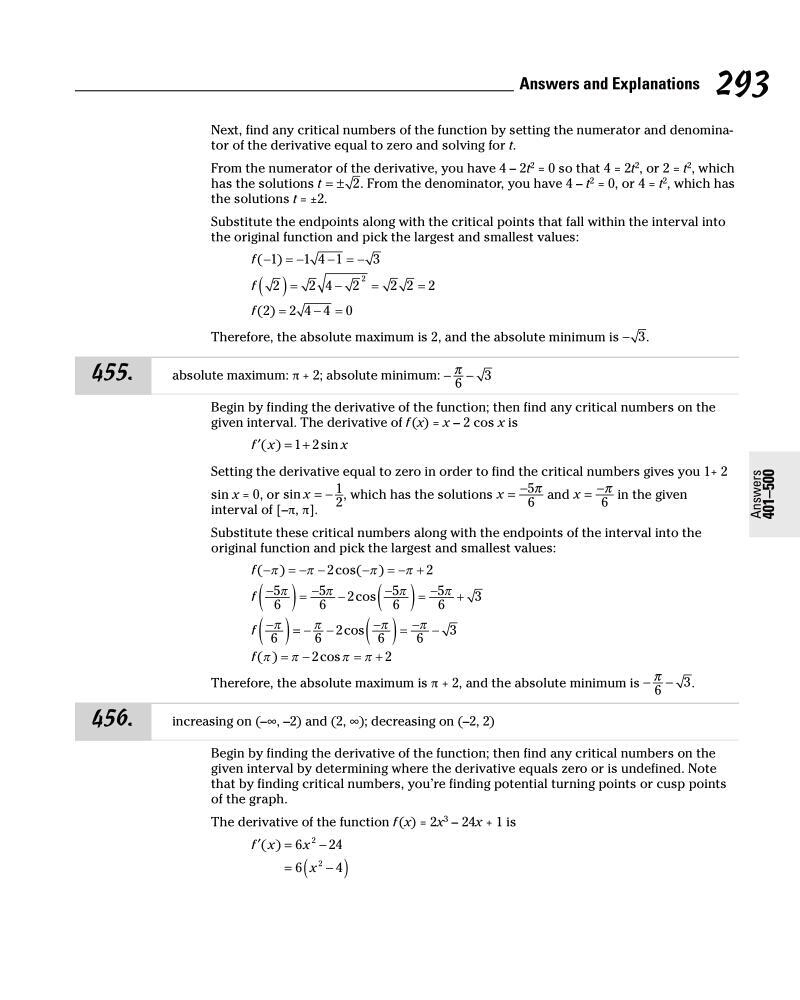
Next, find any critical numbers of the function by setting the numerator and denominator of the derivative equal to zero and solving for t.
From the numerator of the derivative, you have 4 – 2t
2
= 0 so that 4 = 2t
2
, or 2 = t
2
, which
has the solutions t = ± 2. From the denominator, you have 4 – t
2
= 0, or 4 = t
2
, which has
the solutions t = ±2.
Substitute the endpoints along with the critical points that fall within the interval into
the original function and pick the largest and smallest values:
f
f
f
( )
( )
− = −
− = −
( ) =
−
=
=
=
− =
1
1 4 1
3
2
2 4
2
2 2 2
2 2 4 4 0
2
Therefore, the absolute maximum is 2, and the absolute minimum is − 3.
455.
absolute maximum: π + 2; absolute minimum: − −
π
6
3
Begin by finding the derivative of the function; then find any critical numbers on the
given interval. The derivative of f
(x) = x – 2 cos x is
′
f x
x
( )
sin
= +
1 2
Setting the derivative equal to zero in order to find the critical numbers gives you 1+ 2
sin x = 0, or sin x = − 1
2
, which has the solutions x = −5
6
π and x = −π
6
in the given
interval of [–π, π].
Substitute these critical numbers along with the endpoints of the interval into the
original function and pick the largest and smallest values:
f
f
f
( )
cos( )
cos
− = − −
− = − +
−
( ) = − − −
( ) = − +
−
( )
π
π
π
π
π
π
π
π
π
2
2
5
6
5
6
2
5
6
5
6
3
6
= = − −
−
( ) = − −
= −
= +
π
π
π
π
π
π π
6
2
6
6
3
2
2
cos
( )
cos
f
Therefore, the absolute maximum is π + 2, and the absolute minimum is − −
π
6
3.
456.
increasing on (–∞, –2) and (2, ∞); decreasing on (–2, 2)
Begin by finding the derivative of the function; then find any critical numbers on the
given interval by determining where the derivative equals zero or is undefined. Note
that by finding critical numbers, you’re finding potential turning points or cusp points
of the graph.
The derivative of the function f
(x) = 2x
3
– 24x + 1 is
′
(
)
f x
x
x
( ) =
−
=
−
6
24
6
4
2
2
Answers
401–500
Next, find any critical numbers of the function by setting the numerator and denominator of the derivative equal to zero and solving for t.
From the numerator of the derivative, you have 4 – 2t
2
= 0 so that 4 = 2t
2
, or 2 = t
2
, which
has the solutions t = ± 2. From the denominator, you have 4 – t
2
= 0, or 4 = t
2
, which has
the solutions t = ±2.
Substitute the endpoints along with the critical points that fall within the interval into
the original function and pick the largest and smallest values:
f
f
f
( )
( )
− = −
− = −
( ) =
−
=
=
=
− =
1
1 4 1
3
2
2 4
2
2 2 2
2 2 4 4 0
2
Therefore, the absolute maximum is 2, and the absolute minimum is − 3.
455.
absolute maximum: π + 2; absolute minimum: − −
π
6
3
Begin by finding the derivative of the function; then find any critical numbers on the
given interval. The derivative of f
(x) = x – 2 cos x is
′
f x
x
( )
sin
= +
1 2
Setting the derivative equal to zero in order to find the critical numbers gives you 1+ 2
sin x = 0, or sin x = − 1
2
, which has the solutions x = −5
6
π and x = −π
6
in the given
interval of [–π, π].
Substitute these critical numbers along with the endpoints of the interval into the
original function and pick the largest and smallest values:
f
f
f
( )
cos( )
cos
− = − −
− = − +
−
( ) = − − −
( ) = − +
−
( )
π
π
π
π
π
π
π
π
π
2
2
5
6
5
6
2
5
6
5
6
3
6
= = − −
−
( ) = − −
= −
= +
π
π
π
π
π
π π
6
2
6
6
3
2
2
cos
( )
cos
f
Therefore, the absolute maximum is π + 2, and the absolute minimum is − −
π
6
3.
456.
increasing on (–∞, –2) and (2, ∞); decreasing on (–2, 2)
Begin by finding the derivative of the function; then find any critical numbers on the
given interval by determining where the derivative equals zero or is undefined. Note
that by finding critical numbers, you’re finding potential turning points or cusp points
of the graph.
The derivative of the function f
(x) = 2x
3
– 24x + 1 is
′
(
)
f x
x
x
( ) =
−
=
−
6
24
6
4
2
2