

Answers and Explanations 181
Answers
101–200
160.
2
2
To evaluate sin tan ( ) tan ( )
−
−
+
(
)
1
1
2
3 , first create two right triangles using the substitutions tan
−1
(2) = α and tan
−1
(3) = β.
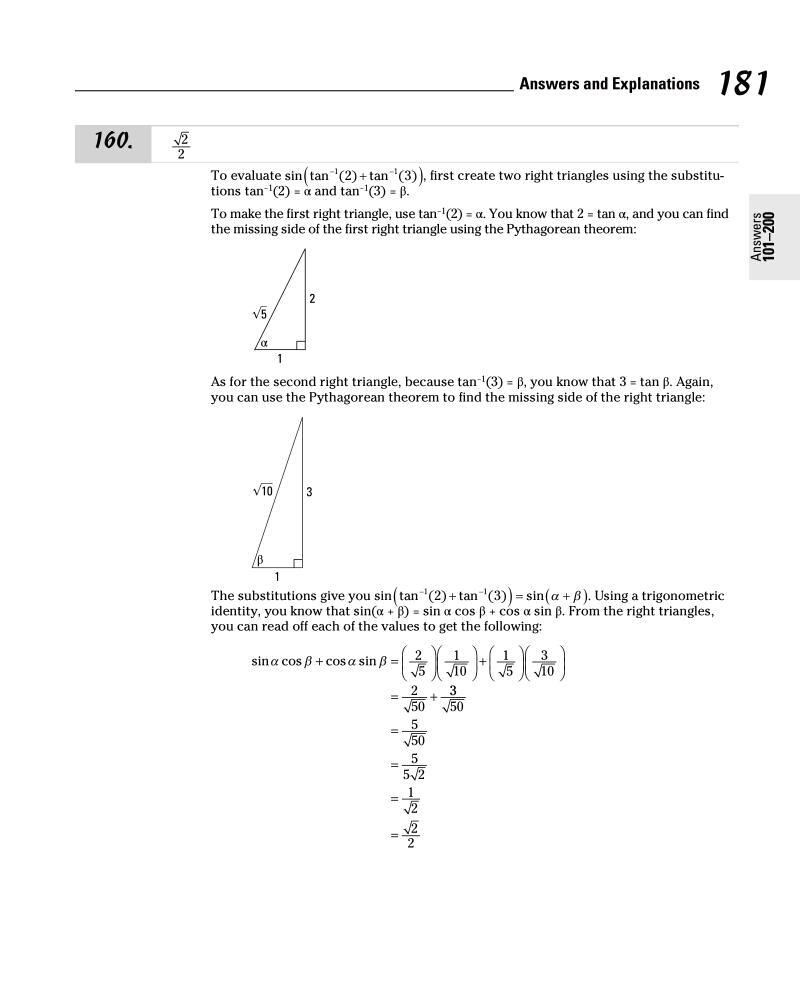
To make the first right triangle, use tan
−1
(2) = α. You know that 2 = tan α, and you can find
the missing side of the first right triangle using the Pythagorean theorem:
As for the second right triangle, because tan
−1
(3) = β, you know that 3 = tan β. Again,
you can use the Pythagorean theorem to find the missing side of the right triangle:
The substitutions give you sin tan ( ) tan ( ) sin
−
−
+
(
) =
+
(
)
1
1
2
3
α β . Using a trigonometric
identity, you know that sin(α + β) = sin α cos β + cos α sin β. From the right triangles,
you can read off each of the values to get the following:
sin cos
cos sin
α
β
α
β
+
=
+
=
+
2
5
1
10
1
5
3
10
2
50
3 3
50
5
50
5
5 2
1
2
2
2
=
=
=
=
Answers
101–200
160.
2
2
To evaluate sin tan ( ) tan ( )
−
−
+
(
)
1
1
2
3 , first create two right triangles using the substitutions tan
−1
(2) = α and tan
−1
(3) = β.
To make the first right triangle, use tan
−1
(2) = α. You know that 2 = tan α, and you can find
the missing side of the first right triangle using the Pythagorean theorem:
As for the second right triangle, because tan
−1
(3) = β, you know that 3 = tan β. Again,
you can use the Pythagorean theorem to find the missing side of the right triangle:
The substitutions give you sin tan ( ) tan ( ) sin
−
−
+
(
) =
+
(
)
1
1
2
3
α β . Using a trigonometric
identity, you know that sin(α + β) = sin α cos β + cos α sin β. From the right triangles,
you can read off each of the values to get the following:
sin cos
cos sin
α
β
α
β
+
=
+
=
+
2
5
1
10
1
5
3
10
2
50
3 3
50
5
50
5
5 2
1
2
2
2
=
=
=
=