

Part II: The Answers
180
Answers
101–200
156.
− π
4
To evaluate arctan(–1) = x, find the solution of –1 = tan x, where
− ≤ ≤
π
π
2
2
x
. Because tan −
( ) = −
π
4
1, you have arctan( )
− = −
1
4
π .
157.
3
2
To evaluate cos sin
−
( )
1 1
2
, first find the value of sin
−
( )
1 1
2
. To evaluate
sin
−
( ) =
1 1
2
x, where − ≤ ≤
π
π
2
2
x
, find the solution of 1
2
= sin x. Because
sin π
6
1
2
( ) = , you have sin
−
( ) =
1 1
2
6
π . Therefore, cos sin
cos
−
( )
=
( ) =
1 1
2
6
3
2
π
.
158.
3
3
To evaluate tan cos
−
1
3
2
, first find the value of cos
−
1
3
2
. To evaluate
cos
−
=
1
3
2
x, where 0 ≤ ≤
x π , find the solution of 3
2
= cos x. Because
cos π
6
3
2
( ) = , you have cos
−
=
1
3
2
6
π . Therefore,
tan cos
tan
−
=
( ) =
1
3
2
6
3
3
π
.
159.
5
3
The value of arccos 4
5
probably isn’t something you’ve memorized, so to
evaluate csc arccos 4
5
(
) , you can create a right triangle.
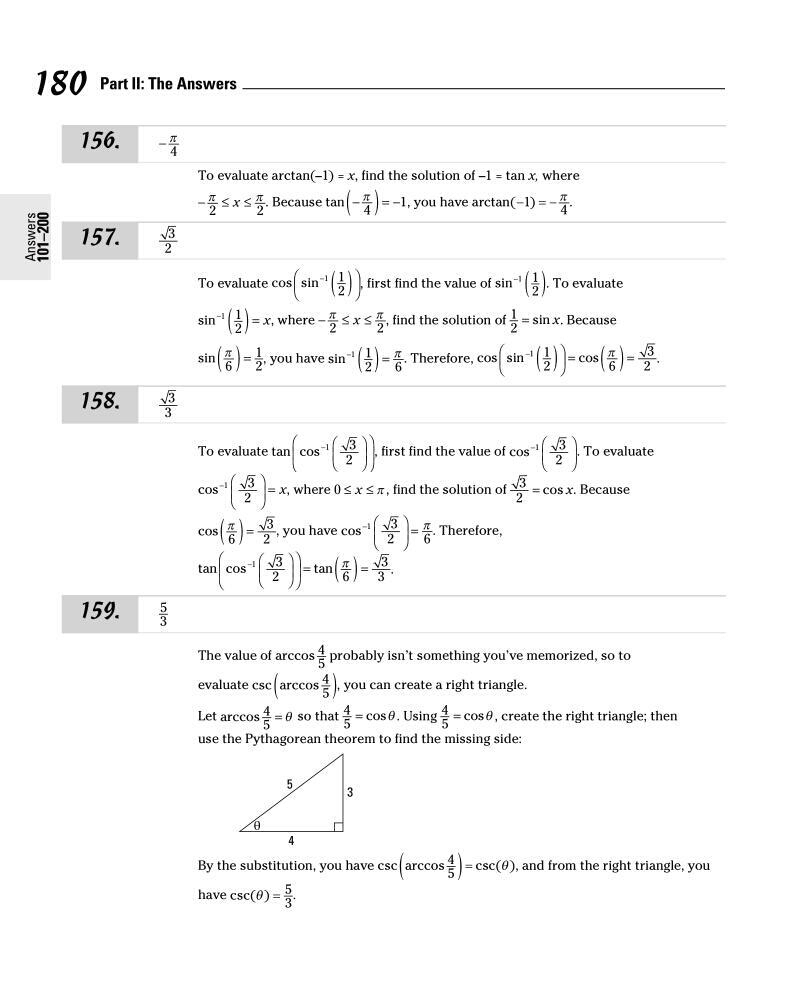
Let arccos 4
5
= θ so that 4
5
= cosθ . Using 4
5
= cosθ , create the right triangle; then
use the Pythagorean theorem to find the missing side:
By the substitution, you have csc arccos
csc( )
4
5
(
) = θ , and from the right triangle, you
have csc( )
θ = 5
3
.
180
Answers
101–200
156.
− π
4
To evaluate arctan(–1) = x, find the solution of –1 = tan x, where
− ≤ ≤
π
π
2
2
x
. Because tan −
( ) = −
π
4
1, you have arctan( )
− = −
1
4
π .
157.
3
2
To evaluate cos sin
−
( )
1 1
2
, first find the value of sin
−
( )
1 1
2
. To evaluate
sin
−
( ) =
1 1
2
x, where − ≤ ≤
π
π
2
2
x
, find the solution of 1
2
= sin x. Because
sin π
6
1
2
( ) = , you have sin
−
( ) =
1 1
2
6
π . Therefore, cos sin
cos
−
( )
=
( ) =
1 1
2
6
3
2
π
.
158.
3
3
To evaluate tan cos
−
1
3
2
, first find the value of cos
−
1
3
2
. To evaluate
cos
−
=
1
3
2
x, where 0 ≤ ≤
x π , find the solution of 3
2
= cos x. Because
cos π
6
3
2
( ) = , you have cos
−
=
1
3
2
6
π . Therefore,
tan cos
tan
−
=
( ) =
1
3
2
6
3
3
π
.
159.
5
3
The value of arccos 4
5
probably isn’t something you’ve memorized, so to
evaluate csc arccos 4
5
(
) , you can create a right triangle.
Let arccos 4
5
= θ so that 4
5
= cosθ . Using 4
5
= cosθ , create the right triangle; then
use the Pythagorean theorem to find the missing side:
By the substitution, you have csc arccos
csc( )
4
5
(
) = θ , and from the right triangle, you
have csc( )
θ = 5
3
.