

Part II: The Answers
182
Answers
101–200
161.
x = 0.412, π – 0.412
To solve sin x = 0.4 for x over the interval [0, 2π], begin by taking the inverse sine of
both sides:
sin
.
sin ( . )
.
x
x
=
=
≈
−
0 4
0 4
0 412
1
The other solution belongs to Quadrant II because the sine function also has positive
values there:
x = −
π 0 412
.
162.
x = 2.465, 2π – 2.456
To solve cos x = –0.78 for x over the interval [0, 2π], begin by taking the inverse cosine
of both sides:
cos
.
cos ( . )
.
x
x
= −
=
−
≈
−
0 78
0 78
2 465
1
The other solution belongs to Quadrant III because the cosine function also has negative values there:
2
2465
π − .
163.
x = 0.322,
π
2
0 322
− .
, π + 0.322,
3
2
0 322
π − .
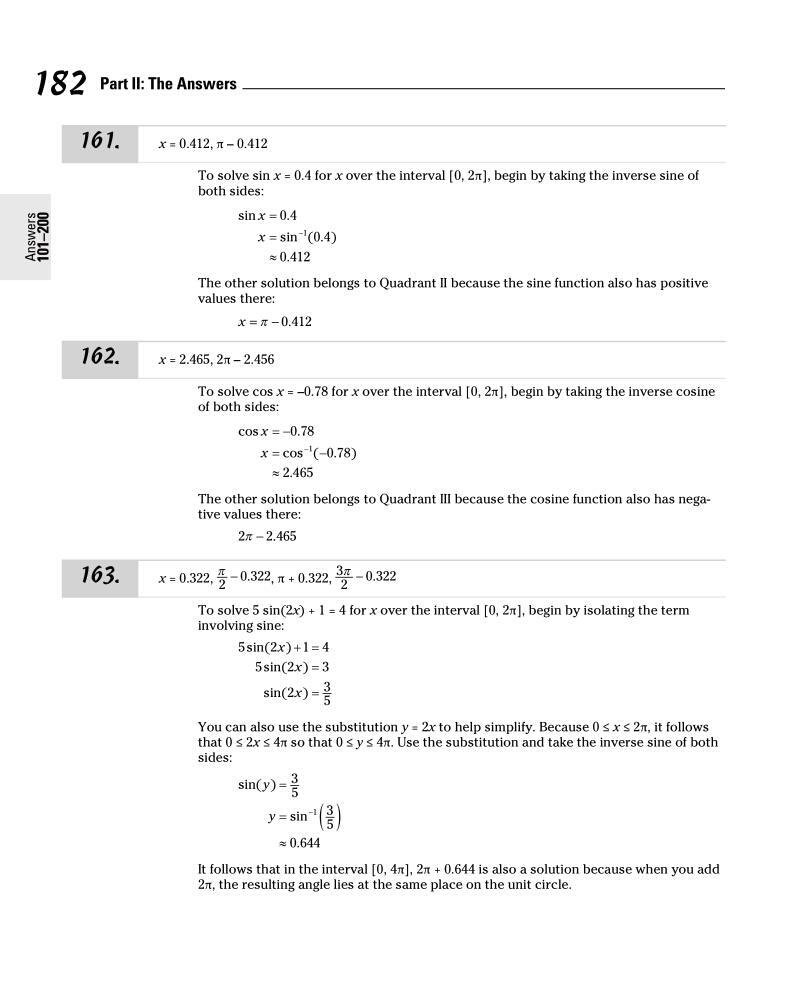
To solve 5 sin(2x) + 1 = 4 for x over the interval [0, 2π], begin by isolating the term
involving sine:
5
2
1 4
5
2
3
2
3
5
sin( )
sin( )
sin( )
x
x
x
+ =
=
=
You can also use the substitution y = 2x to help simplify. Because 0 ≤ x ≤ 2π, it follows
that 0 ≤ 2x ≤ 4π so that 0 ≤ y ≤ 4π. Use the substitution and take the inverse sine of both
sides:
sin( )
sin
.
y
y
=
=
( )
≈
−
3
5
3
5
0 644
1
It follows that in the interval [0, 4π], 2π + 0.644 is also a solution because when you add
2π, the resulting angle lies at the same place on the unit circle.
182
Answers
101–200
161.
x = 0.412, π – 0.412
To solve sin x = 0.4 for x over the interval [0, 2π], begin by taking the inverse sine of
both sides:
sin
.
sin ( . )
.
x
x
=
=
≈
−
0 4
0 4
0 412
1
The other solution belongs to Quadrant II because the sine function also has positive
values there:
x = −
π 0 412
.
162.
x = 2.465, 2π – 2.456
To solve cos x = –0.78 for x over the interval [0, 2π], begin by taking the inverse cosine
of both sides:
cos
.
cos ( . )
.
x
x
= −
=
−
≈
−
0 78
0 78
2 465
1
The other solution belongs to Quadrant III because the cosine function also has negative values there:
2
2465
π − .
163.
x = 0.322,
π
2
0 322
− .
, π + 0.322,
3
2
0 322
π − .
To solve 5 sin(2x) + 1 = 4 for x over the interval [0, 2π], begin by isolating the term
involving sine:
5
2
1 4
5
2
3
2
3
5
sin( )
sin( )
sin( )
x
x
x
+ =
=
=
You can also use the substitution y = 2x to help simplify. Because 0 ≤ x ≤ 2π, it follows
that 0 ≤ 2x ≤ 4π so that 0 ≤ y ≤ 4π. Use the substitution and take the inverse sine of both
sides:
sin( )
sin
.
y
y
=
=
( )
≈
−
3
5
3
5
0 644
1
It follows that in the interval [0, 4π], 2π + 0.644 is also a solution because when you add
2π, the resulting angle lies at the same place on the unit circle.