

Part II: The Answers
148
Answers
1–100
59.
− −
( ) ∪
1 1
3
,
(1, 3)
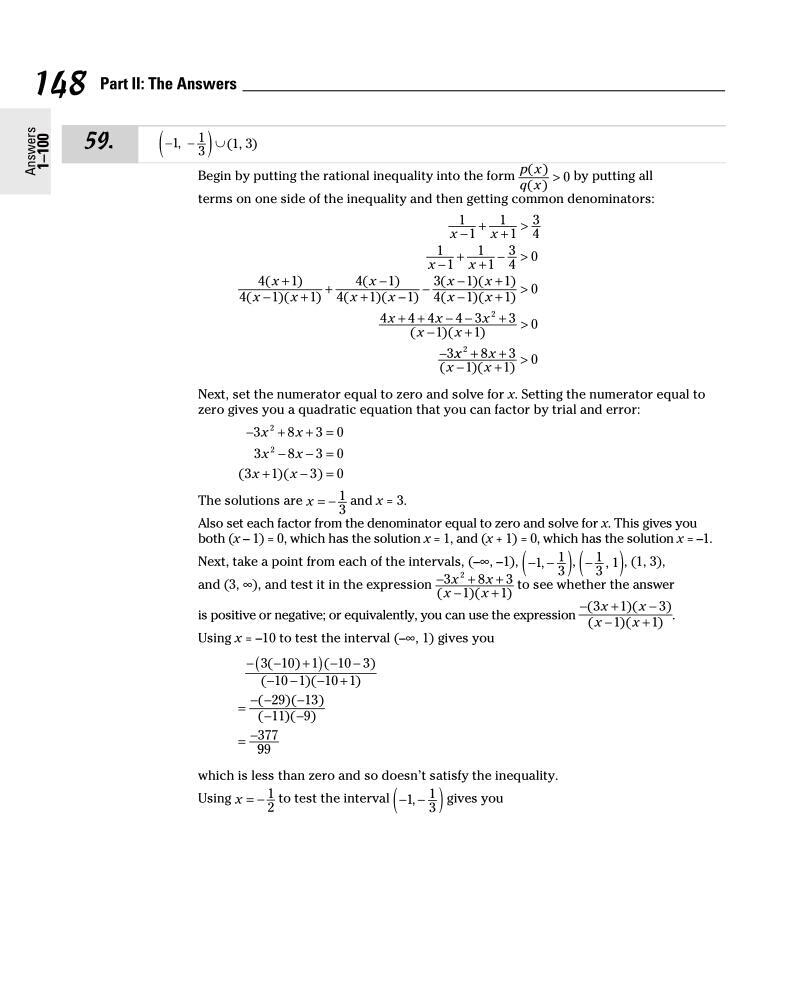
Begin by putting the rational inequality into the form
p x
q x
( )
( )
> 0 by putting all
terms on one side of the inequality and then getting common denominators:
1
1
1
1
3
4
1
1
1
1
3
4
0
4
1
4
1
1
4
1
4
1
x
x
x
x
x
x
x
x
x
x
−
+ +
>
−
+ +
− >
+
−
+
+
−
+
(
)
(
)(
)
(
)
(
)( − −
−
−
+
−
+
>
+ +
− −
+
−
+
>
−
1
3
1
1
4
1
1
0
4
4 4
4 3
3
1
1
0
3
2
)
(
)(
)
(
)(
)
(
)(
)
x
x
x
x
x
x
x
x
x
x x
x
x
x
2
8
3
1
1
0
+
+
−
+
>
(
)(
)
Next, set the numerator equal to zero and solve for x. Setting the numerator equal to
zero gives you a quadratic equation that you can factor by trial and error:
−
+
+ =
−
− =
+
− =
3
8
3 0
3
8
3 0
3
1
3 0
2
2
x
x
x
x
x
x
(
)(
)
The solutions are x = − 1
3
and x = 3.
Also set each factor from the denominator equal to zero and solve for x. This gives you
both (x – 1) = 0, which has the solution x = 1, and (x + 1) = 0, which has the solution x = –1.
Next, take a point from each of the intervals, (–∞, –1), − −
( )
1 1
3
,
, −
( )
1
3
1
, , (1, 3),
and (3, ∞), and test it in the expression −
+
+
−
+
3
8
3
1
1
2
x
x
x
x
(
)(
)
to see whether the answer
is positive or negative; or equivalently, you can use the expression
−
+
−
−
+
(
)(
)
(
)(
)
3
1
3
1
1
x
x
x
x
.
Using x = –10 to test the interval (–∞, 1) gives you
−
−
+
(
)− −
− − − +
=
− −
−
−
−
= −
3 10 1 10 3
10 1 10 1
29 13
11 9
377
(
)
(
)
(
) (
)
(
)(
)
(
)( )
9 99
which is less than zero and so doesn’t satisfy the inequality.
Using x = − 1
2
to test the interval − −
( )
1 1
3
,
gives you
148
Answers
1–100
59.
− −
( ) ∪
1 1
3
,
(1, 3)
Begin by putting the rational inequality into the form
p x
q x
( )
( )
> 0 by putting all
terms on one side of the inequality and then getting common denominators:
1
1
1
1
3
4
1
1
1
1
3
4
0
4
1
4
1
1
4
1
4
1
x
x
x
x
x
x
x
x
x
x
−
+ +
>
−
+ +
− >
+
−
+
+
−
+
(
)
(
)(
)
(
)
(
)( − −
−
−
+
−
+
>
+ +
− −
+
−
+
>
−
1
3
1
1
4
1
1
0
4
4 4
4 3
3
1
1
0
3
2
)
(
)(
)
(
)(
)
(
)(
)
x
x
x
x
x
x
x
x
x
x x
x
x
x
2
8
3
1
1
0
+
+
−
+
>
(
)(
)
Next, set the numerator equal to zero and solve for x. Setting the numerator equal to
zero gives you a quadratic equation that you can factor by trial and error:
−
+
+ =
−
− =
+
− =
3
8
3 0
3
8
3 0
3
1
3 0
2
2
x
x
x
x
x
x
(
)(
)
The solutions are x = − 1
3
and x = 3.
Also set each factor from the denominator equal to zero and solve for x. This gives you
both (x – 1) = 0, which has the solution x = 1, and (x + 1) = 0, which has the solution x = –1.
Next, take a point from each of the intervals, (–∞, –1), − −
( )
1 1
3
,
, −
( )
1
3
1
, , (1, 3),
and (3, ∞), and test it in the expression −
+
+
−
+
3
8
3
1
1
2
x
x
x
x
(
)(
)
to see whether the answer
is positive or negative; or equivalently, you can use the expression
−
+
−
−
+
(
)(
)
(
)(
)
3
1
3
1
1
x
x
x
x
.
Using x = –10 to test the interval (–∞, 1) gives you
−
−
+
(
)− −
− − − +
=
− −
−
−
−
= −
3 10 1 10 3
10 1 10 1
29 13
11 9
377
(
)
(
)
(
) (
)
(
)(
)
(
)( )
9 99
which is less than zero and so doesn’t satisfy the inequality.
Using x = − 1
2
to test the interval − −
( )
1 1
3
,
gives you