

Answers and Explanations 149
Answers
1–100
−
−
( ) +
− −
( )
− −
( ) − +
( )
=
− −
( ) −
( )
−
( )( )
=
3 1
2
1
1
2
3
1
2
1
1
2
1
1
2
7
2
3
2
1
2
7 7
3
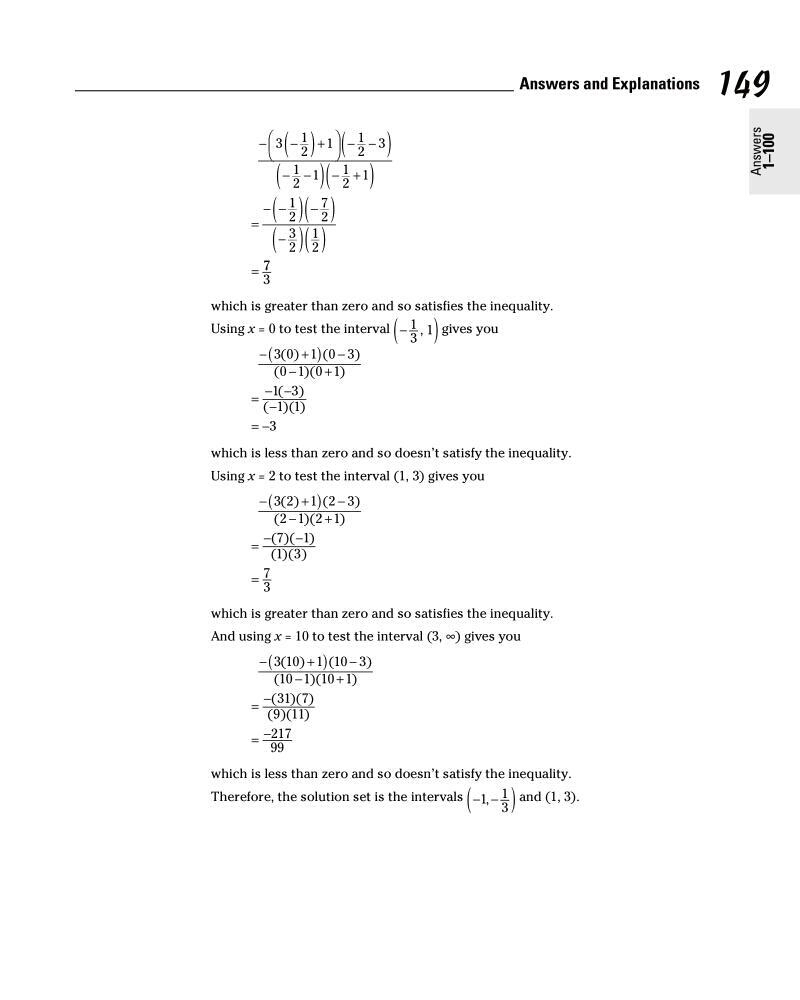
which is greater than zero and so satisfies the inequality.
Using x = 0 to test the interval −
( )
1
3
1
, gives you
−
+
(
) −
−
+
=
− −
−
= −
3 0 1 0 3
0 1 0 1
1 3
1 1
3
( )
(
)
(
)(
)
( )
( )( )
which is less than zero and so doesn’t satisfy the inequality.
Using x = 2 to test the interval (1, 3) gives you
−
+
(
) −
−
+
=
−
−
=
3 2 1 2 3
2 1 2 1
7 1
1 3
7
3
( )
(
)
(
)(
)
( )( )
( )( )
which is greater than zero and so satisfies the inequality.
And using x = 10 to test the interval (3, ∞) gives you
−
+
(
) −
−
+
=
−
= −
3 10 1 10 3
10 1 10 1
31 7
9 11
217
99
( )
(
)
(
)(
)
( )( )
( )( )
which is less than zero and so doesn’t satisfy the inequality.
Therefore, the solution set is the intervals − −
( )
1 1
3
,
and (1, 3).
Answers
1–100
−
−
( ) +
− −
( )
− −
( ) − +
( )
=
− −
( ) −
( )
−
( )( )
=
3 1
2
1
1
2
3
1
2
1
1
2
1
1
2
7
2
3
2
1
2
7 7
3
which is greater than zero and so satisfies the inequality.
Using x = 0 to test the interval −
( )
1
3
1
, gives you
−
+
(
) −
−
+
=
− −
−
= −
3 0 1 0 3
0 1 0 1
1 3
1 1
3
( )
(
)
(
)(
)
( )
( )( )
which is less than zero and so doesn’t satisfy the inequality.
Using x = 2 to test the interval (1, 3) gives you
−
+
(
) −
−
+
=
−
−
=
3 2 1 2 3
2 1 2 1
7 1
1 3
7
3
( )
(
)
(
)(
)
( )( )
( )( )
which is greater than zero and so satisfies the inequality.
And using x = 10 to test the interval (3, ∞) gives you
−
+
(
) −
−
+
=
−
= −
3 10 1 10 3
10 1 10 1
31 7
9 11
217
99
( )
(
)
(
)(
)
( )( )
( )( )
which is less than zero and so doesn’t satisfy the inequality.
Therefore, the solution set is the intervals − −
( )
1 1
3
,
and (1, 3).