

Answers and Explanations 147
Answers
1–100
58.
( , ) ( , )
−∞ − ∪ −
3
12
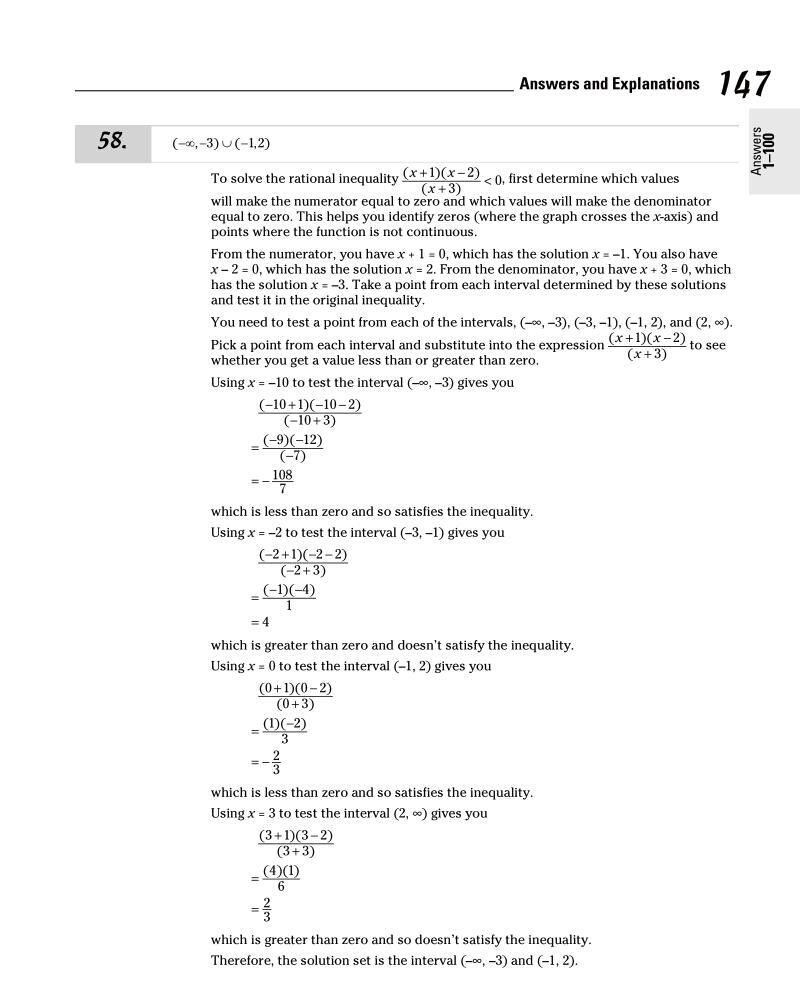
To solve the rational inequality (
)(
)
(
)
x
x
x
+
−
+
<
1
2
3
0 , first determine which values
will make the numerator equal to zero and which values will make the denominator
equal to zero. This helps you identify zeros (where the graph crosses the x-axis) and
points where the function is not continuous.
From the numerator, you have x + 1 = 0, which has the solution x = –1. You also have
x – 2 = 0, which has the solution x = 2. From the denominator, you have x + 3 = 0, which
has the solution x = –3. Take a point from each interval determined by these solutions
and test it in the original inequality.
You need to test a point from each of the intervals, (–∞, –3), (–3, –1), (–1, 2), and (2, ∞).
Pick a point from each interval and substitute into the expression
(
)(
)
(
)
x
x
x
+
−
+
1
2
3
to see
whether you get a value less than or greater than zero.
Using x = –10 to test the interval (–∞, –3) gives you
(
) (
)
(
)
( )(
)
( )
− +
− −
− +
=
− −
−
= −
10 1 10 2
10 3
9 12
7
108
7
which is less than zero and so satisfies the inequality.
Using x = –2 to test the interval (–3, –1) gives you
(
)(
)
(
)
( )( )
− +
− −
− +
=
− −
=
2 1 2 2
2 3
1 4
1
4
which is greater than zero and doesn’t satisfy the inequality.
Using x = 0 to test the interval (–1, 2) gives you
(
)(
)
(
)
( )( )
0 1 0 2
0 3
1 2
3
2
3
+
−
+
=
−
= −
which is less than zero and so satisfies the inequality.
Using x = 3 to test the interval (2, ∞) gives you
(
)(
)
(
)
( )( )
3 1 3 2
3 3
4 1
6
2
3
+
−
+
=
=
which is greater than zero and so doesn’t satisfy the inequality.
Therefore, the solution set is the interval (–∞, –3) and (–1, 2).
Answers
1–100
58.
( , ) ( , )
−∞ − ∪ −
3
12
To solve the rational inequality (
)(
)
(
)
x
x
x
+
−
+
<
1
2
3
0 , first determine which values
will make the numerator equal to zero and which values will make the denominator
equal to zero. This helps you identify zeros (where the graph crosses the x-axis) and
points where the function is not continuous.
From the numerator, you have x + 1 = 0, which has the solution x = –1. You also have
x – 2 = 0, which has the solution x = 2. From the denominator, you have x + 3 = 0, which
has the solution x = –3. Take a point from each interval determined by these solutions
and test it in the original inequality.
You need to test a point from each of the intervals, (–∞, –3), (–3, –1), (–1, 2), and (2, ∞).
Pick a point from each interval and substitute into the expression
(
)(
)
(
)
x
x
x
+
−
+
1
2
3
to see
whether you get a value less than or greater than zero.
Using x = –10 to test the interval (–∞, –3) gives you
(
) (
)
(
)
( )(
)
( )
− +
− −
− +
=
− −
−
= −
10 1 10 2
10 3
9 12
7
108
7
which is less than zero and so satisfies the inequality.
Using x = –2 to test the interval (–3, –1) gives you
(
)(
)
(
)
( )( )
− +
− −
− +
=
− −
=
2 1 2 2
2 3
1 4
1
4
which is greater than zero and doesn’t satisfy the inequality.
Using x = 0 to test the interval (–1, 2) gives you
(
)(
)
(
)
( )( )
0 1 0 2
0 3
1 2
3
2
3
+
−
+
=
−
= −
which is less than zero and so satisfies the inequality.
Using x = 3 to test the interval (2, ∞) gives you
(
)(
)
(
)
( )( )
3 1 3 2
3 3
4 1
6
2
3
+
−
+
=
=
which is greater than zero and so doesn’t satisfy the inequality.
Therefore, the solution set is the interval (–∞, –3) and (–1, 2).