

"'O
0
c
::J
0
lil
.-t
0
N
@
.......
..c
O'l
·;::::
> a.
0
u
336
O,l 25[complexe) 0
2
1
ln
= ln0,125 = - 4,95 · 10- h- · t
[complexe) 0
~ t = 42 h
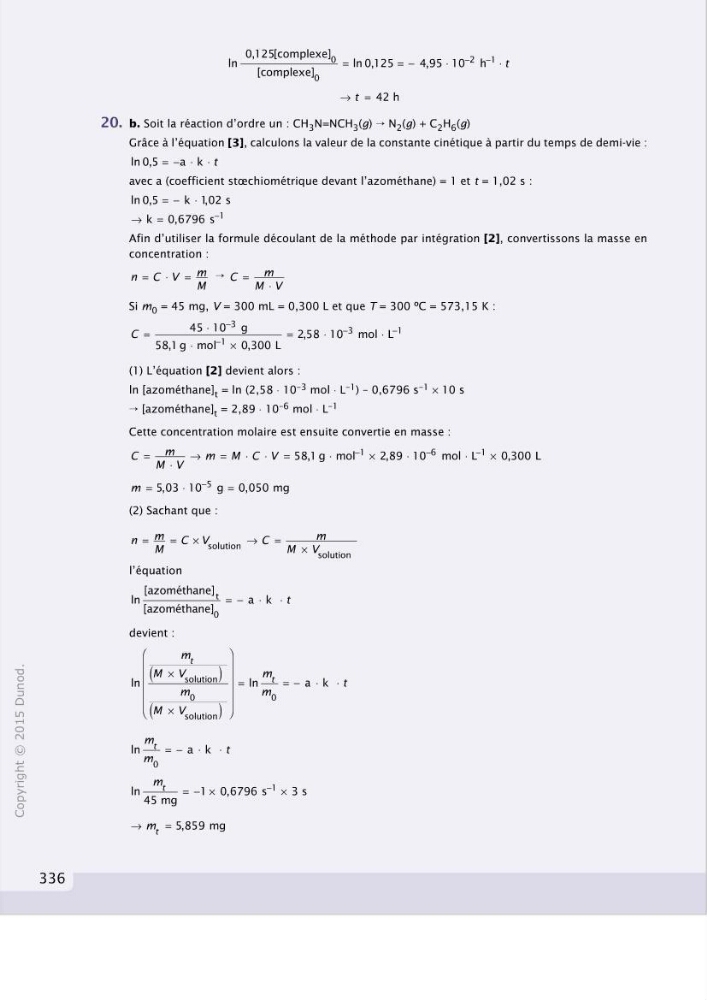
20. b. Soit la réaction d'ordre un: CH 3 N=NCH 3 (g) _, N 2 (g) + C 2 H 6 (g)
Grâce à l'équation [3], calculons la valeur de la constante cinétique à partir du temps de demi-vie :
ln 0,5 = - a · k · t
avec a (coefficient stœchiométrique devant l'azométhane) = l et t = l ,02 s :
ln 0,5 = - k · 1,02 s
~ k = 0,6796 s- 1
Afin d ' utiliser la formule découlant de la méthode par intégration [2], convertissons la masse en
concentration :
n = C·V = m -> C =_m__
M
M·V
Si m 0 = 45 mg, V= 300 ml= 0,300 Let que T= 300 °C = 573, 15 K:
c =
45 · 10 -
3
g
= 2,58 · 10- 3 mol · L- 1
58,l g · mo1- 1 x 0,300 L
(l) L'équation [2] devient alors :
ln [azométhane)t =ln (2,58 . 10-3 mol · L- 1) - 0,6796 çl x 10 s
-. [azométhane)t = 2,89 . l o-6 mol . L- 1
Cette concentration molaire est ensuite convertie en masse :
C = _m__ ~ m = M . C. V = 58,l g . mo1- 1 x 2,89. l o- 6 mol . L- 1 x 0,300 L
M · V
m = 5,03 · 1 o-s g = 0,050 mg
(2) Sachant que :
n = m = C x V
. ~ C =
m
M
solution
M x V
.
l'équation
[azométhane] t
ln
= - a · k · t
[azométhane] 0
devient :
solution
ln (M X v solution)
mo
1
mt
m
= ln _ t = - a · k · t
( M X vsolution)
ln mt = - a · k · t
mo
mo
m
ln - - t - = - 1 X 0,6796 ç l X 3 S
45 mg
~ mt = 5,859 mg
0
c
::J
0
lil
.-t
0
N
@
.......
..c
O'l
·;::::
> a.
0
u
336
O,l 25[complexe) 0
2
1
ln
= ln0,125 = - 4,95 · 10- h- · t
[complexe) 0
~ t = 42 h
20. b. Soit la réaction d'ordre un: CH 3 N=NCH 3 (g) _, N 2 (g) + C 2 H 6 (g)
Grâce à l'équation [3], calculons la valeur de la constante cinétique à partir du temps de demi-vie :
ln 0,5 = - a · k · t
avec a (coefficient stœchiométrique devant l'azométhane) = l et t = l ,02 s :
ln 0,5 = - k · 1,02 s
~ k = 0,6796 s- 1
Afin d ' utiliser la formule découlant de la méthode par intégration [2], convertissons la masse en
concentration :
n = C·V = m -> C =_m__
M
M·V
Si m 0 = 45 mg, V= 300 ml= 0,300 Let que T= 300 °C = 573, 15 K:
c =
45 · 10 -
3
g
= 2,58 · 10- 3 mol · L- 1
58,l g · mo1- 1 x 0,300 L
(l) L'équation [2] devient alors :
ln [azométhane)t =ln (2,58 . 10-3 mol · L- 1) - 0,6796 çl x 10 s
-. [azométhane)t = 2,89 . l o-6 mol . L- 1
Cette concentration molaire est ensuite convertie en masse :
C = _m__ ~ m = M . C. V = 58,l g . mo1- 1 x 2,89. l o- 6 mol . L- 1 x 0,300 L
M · V
m = 5,03 · 1 o-s g = 0,050 mg
(2) Sachant que :
n = m = C x V
. ~ C =
m
M
solution
M x V
.
l'équation
[azométhane] t
ln
= - a · k · t
[azométhane] 0
devient :
solution
ln (M X v solution)
mo
1
mt
m
= ln _ t = - a · k · t
( M X vsolution)
ln mt = - a · k · t
mo
mo
m
ln - - t - = - 1 X 0,6796 ç l X 3 S
45 mg
~ mt = 5,859 mg