

.~
:;;
"O
"'O
c:
0
::l
c
"'
::i
" "
0
~
lJ)
·;::
.9
T"-i
::l
0
"' c:
N
0
c:
@
c:
.!2
.......
ü
..c
.g
0\
2
ï:::
Q.
>~
a. .!l
0
"
u
<2
-0
0
c:
::l
Cl
@
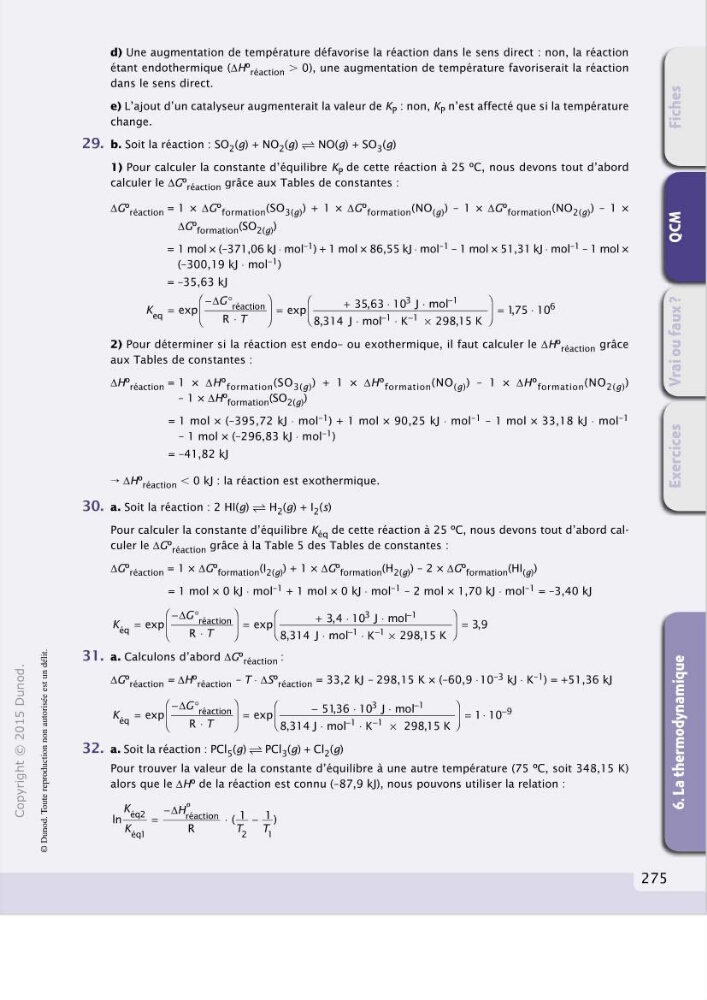
d) Une augmentation de température défavorise la réaction dans le sens direct : non, la réaction
étant endothermique (t:.h'°réaction > 0), une augmentation de température favoriserait la réaction
dans le se ns direct.
e) L'ajout d ' un catalyseur augmenterait la valeur de Kp: non , Kp n'est affecté que si la température
change .
29. b. Soit la réaction : S0 2 (g) + N0 2 (g) ~ NO(g) + S0 3 (g)
1) Pour calculer la constante d'équilibre Kp de cette réaction à 25 °C, nous devons tout d'abord
calculer le t:.C°réaction grâce aux Tables de constantes :
t:.C°réaction = 1 X t:.C°formation(S03(gi} + 1 X t:.C°formation( NO(gi} - 1 X t:.C°formation( N0 2(g)) - 1 X
t:. C° formation(SOz(gi}
=1 mol x(-37 1,06kJ - mol- 1 )+ 1 molx86,55kJ - mol- 1 - 1 molx51 ,3 1 kJ - mol- 1 - 1 molx
(- 300,19 kJ. mo1- 1)
= - 35,63 kJ
K = exp [ -t:.G
0
réaction J = exp [
+ 35,63 · 10
3
J · mo11
J = 1 , 75 . 10 6
eq
R · T
8,314 J · mol- 1 · K- 1 x 298,15 K
2) Pour déterminer si la réaction est endo- ou exothermique, il faut calculer le t:.h'°réaction grâce
aux Tables de constantes :
t:.h'°réaction = 1 X t:. H
0 formation(S03(g)) + 1 X t:. H
0 formation( NO(g)) - 1 X t:.H
0 formation( N0 z(g))
- 1 X ô h'°formation(SOz(g))
= 1 mol x (- 395,72 kJ. mo1 - 1) + 1 mol x 90,25 kJ . mo1- 1 - 1 mol x 33, 18 kJ. mo1- 1
- 1 mol x (-296,83 kJ . mol- 1 )
= - 41,82 kJ
___, ôh'°réaction < 0 kJ : la réaction est exothermiqu e.
30. a. Soit la réaction : 2 Hl(g) ~ H 2 (g) + 1 2 (s)
Pour calculer la constante d'équilibre Kéq de cette réaction à 25 °C, nou s devons tout d'abord calculer le t:.C°réaction grâce à la Tabl e 5 des Tab les de constantes :
t:.C°réaction = 1 X t:.C°formation(l 2(g)) + 1 X t:. C°formation(Hz(g)) - 2 X t:.C°formation(Hl(g))
= 1 mol x 0 kJ. mo1- 1 + 1 mol x 0 kJ. mo1- 1 - 2 mol x 1, 70 kJ. mo1- 1 = - 3,40 kJ
K
[
-t:.G
0
réaction J
[
+ 3, 4 · 10
3 J · mol1
J 3 9
. = exp
= exp
= ,
eq
R · T
8,314 J · mol- 1 · K- 1 x 298, 15 K
31. a. Calculon s d'abord t:.C°réaction :
t:.C°réaction = ô h'°réaction - T. t:.S°réaction = 33 ,2 kJ - 298, 1 5 K X (-60,9 . 10- 3 kJ . K- 1 ) = +5 1,36 kJ
K. = exp [ - t:.G
0
réactionJ = exp[
- 51,36 · 10
3 J · mol
1
J = 1 . 10 -9
eq
R · T
8,3 14J . mol- 1 · K- 1 x 298, 15 K
32. a. Soit la réaction : PCl 5 (g) ~ PCl 3 (g) + Cl 2 (g)
Pour trouver la valeur de la constante d 'équilibre à une autre température (75 °C, soit 348, 15 K)
alors que le t:. h'° de la réaction est connu (-8 7,9 kJ), nous pouvons utiliser la relation :
K . 2
-t:. Ho
ln ~ =
réaction . (..l - ..l)
~~
R
~ ~
275
:;;
"O
"'O
c:
0
::l
c
"'
::i
" "
0
~
lJ)
·;::
.9
T"-i
::l
0
"' c:
N
0
c:
@
c:
.!2
.......
ü
..c
.g
0\
2
ï:::
Q.
>~
a. .!l
0
"
u
<2
-0
0
c:
::l
Cl
@
d) Une augmentation de température défavorise la réaction dans le sens direct : non, la réaction
étant endothermique (t:.h'°réaction > 0), une augmentation de température favoriserait la réaction
dans le se ns direct.
e) L'ajout d ' un catalyseur augmenterait la valeur de Kp: non , Kp n'est affecté que si la température
change .
29. b. Soit la réaction : S0 2 (g) + N0 2 (g) ~ NO(g) + S0 3 (g)
1) Pour calculer la constante d'équilibre Kp de cette réaction à 25 °C, nous devons tout d'abord
calculer le t:.C°réaction grâce aux Tables de constantes :
t:.C°réaction = 1 X t:.C°formation(S03(gi} + 1 X t:.C°formation( NO(gi} - 1 X t:.C°formation( N0 2(g)) - 1 X
t:. C° formation(SOz(gi}
=1 mol x(-37 1,06kJ - mol- 1 )+ 1 molx86,55kJ - mol- 1 - 1 molx51 ,3 1 kJ - mol- 1 - 1 molx
(- 300,19 kJ. mo1- 1)
= - 35,63 kJ
K = exp [ -t:.G
0
réaction J = exp [
+ 35,63 · 10
3
J · mo11
J = 1 , 75 . 10 6
eq
R · T
8,314 J · mol- 1 · K- 1 x 298,15 K
2) Pour déterminer si la réaction est endo- ou exothermique, il faut calculer le t:.h'°réaction grâce
aux Tables de constantes :
t:.h'°réaction = 1 X t:. H
0 formation(S03(g)) + 1 X t:. H
0 formation( NO(g)) - 1 X t:.H
0 formation( N0 z(g))
- 1 X ô h'°formation(SOz(g))
= 1 mol x (- 395,72 kJ. mo1 - 1) + 1 mol x 90,25 kJ . mo1- 1 - 1 mol x 33, 18 kJ. mo1- 1
- 1 mol x (-296,83 kJ . mol- 1 )
= - 41,82 kJ
___, ôh'°réaction < 0 kJ : la réaction est exothermiqu e.
30. a. Soit la réaction : 2 Hl(g) ~ H 2 (g) + 1 2 (s)
Pour calculer la constante d'équilibre Kéq de cette réaction à 25 °C, nou s devons tout d'abord calculer le t:.C°réaction grâce à la Tabl e 5 des Tab les de constantes :
t:.C°réaction = 1 X t:.C°formation(l 2(g)) + 1 X t:. C°formation(Hz(g)) - 2 X t:.C°formation(Hl(g))
= 1 mol x 0 kJ. mo1- 1 + 1 mol x 0 kJ. mo1- 1 - 2 mol x 1, 70 kJ. mo1- 1 = - 3,40 kJ
K
[
-t:.G
0
réaction J
[
+ 3, 4 · 10
3 J · mol1
J 3 9
. = exp
= exp
= ,
eq
R · T
8,314 J · mol- 1 · K- 1 x 298, 15 K
31. a. Calculon s d'abord t:.C°réaction :
t:.C°réaction = ô h'°réaction - T. t:.S°réaction = 33 ,2 kJ - 298, 1 5 K X (-60,9 . 10- 3 kJ . K- 1 ) = +5 1,36 kJ
K. = exp [ - t:.G
0
réactionJ = exp[
- 51,36 · 10
3 J · mol
1
J = 1 . 10 -9
eq
R · T
8,3 14J . mol- 1 · K- 1 x 298, 15 K
32. a. Soit la réaction : PCl 5 (g) ~ PCl 3 (g) + Cl 2 (g)
Pour trouver la valeur de la constante d 'équilibre à une autre température (75 °C, soit 348, 15 K)
alors que le t:. h'° de la réaction est connu (-8 7,9 kJ), nous pouvons utiliser la relation :
K . 2
-t:. Ho
ln ~ =
réaction . (..l - ..l)
~~
R
~ ~
275