

The TRUTH TABLE of the conditional is motivated
by intuition. Consider, for example, the statement:
If Peter watches a horror movie, then he eats
popcorn.
The statement is certainly true if we observe Peter
watching a horror movie and eating popcorn at the
same time (that is, if the antecedent and consequent are
both true), but false if antecedent is true but the consequent is false (that is, Peter is watching a horror movie
but not eating popcorn). This justifies the first two
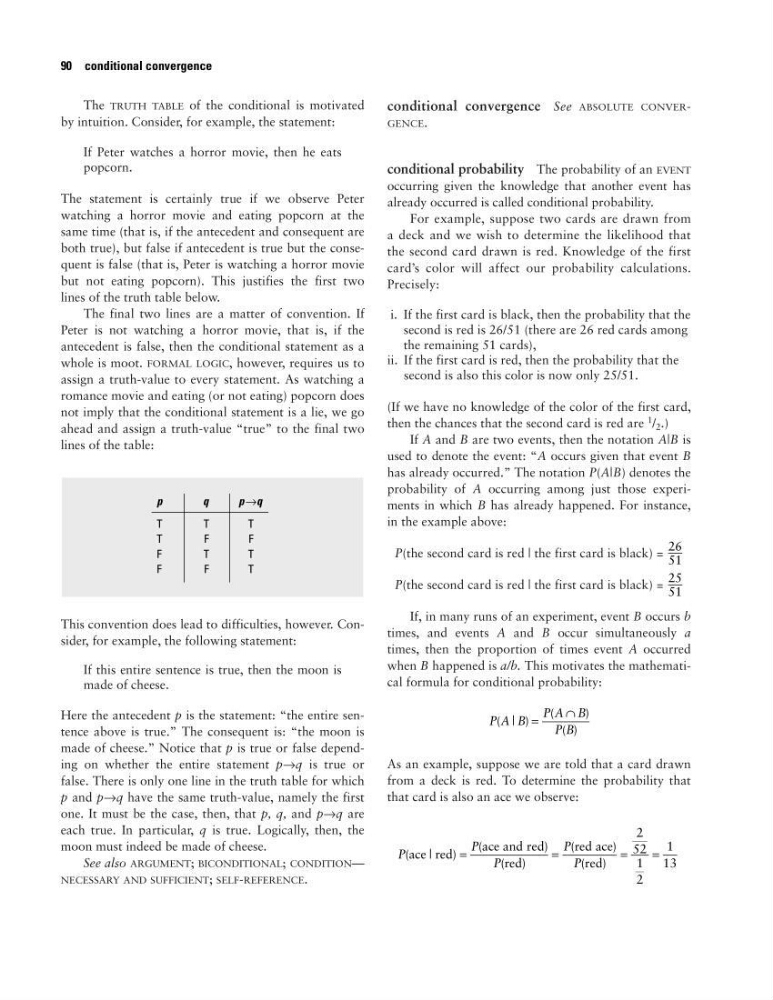
lines of the truth table below.
The final two lines are a matter of convention. If
Peter is not watching a horror movie, that is, if the
antecedent is false, then the conditional statement as a
whole is moot. FORMAL LOGIC, however, requires us to
assign a truth-value to every statement. As watching a
romance movie and eating (or not eating) popcorn does
not imply that the conditional statement is a lie, we go
ahead and assign a truth-value “true” to the final two
lines of the table:
This convention does lead to difficulties, however. Consider, for example, the following statement:
If this entire sentence is true, then the moon is
made of cheese.
Here the antecedent p is the statement: “the entire sentence above is true.” The consequent is: “the moon is
made of cheese.” Notice that p is true or false depending on whether the entire statement p→q is true or
false. There is only one line in the truth table for which
p and p→q have the same truth-value, namely the first
one. It must be the case, then, that p, q, and p→q are
each true. In particular, q is true. Logically, then, the
moon must indeed be made of cheese.
See also ARGUMENT; BICONDITIONAL; CONDITION—
NECESSARY AND SUFFICIENT; SELF-REFERENCE.
conditional convergence See ABSOLUTE CONVERGENCE.
conditional probability The probability of an EVENT
occurring given the knowledge that another event has
already occurred is called conditional probability.
For example, suppose two cards are drawn from
a deck and we wish to determine the likelihood that
the second card drawn is red. Knowledge of the first
card’s color will affect our probability calculations.
Precisely:
i. If the first card is black, then the probability that the
second is red is 26/51 (there are 26 red cards among
the remaining 51 cards),
ii. If the first card is red, then the probability that the
second is also this color is now only 25/51.
(If we have no knowledge of the color of the first card,
then the chances that the second card is red are
1
/ 2 .)
If A and B are two events, then the notation A|B is
used to denote the event: “A occurs given that event B
has already occurred.” The notation P(A|B) denotes the
probability of A occurring among just those experiments in which B has already happened. For instance,
in the example above:
P(the second card is red | the first card is black) =
P(the second card is red | the first card is black) =
If, in many runs of an experiment, event B occurs b
times, and events A and B occur simultaneously a
times, then the proportion of times event A occurred
when B happened is a/b. This motivates the mathematical formula for conditional probability:
As an example, suppose we are told that a card drawn
from a deck is red. To determine the probability that
that card is also an ace we observe:
P
P
P
P
P
(
|
)
(
)
( )
(
)
( )
ace red
ace
red
red
red ace
red
=
=
=
=
and
2
52
1
2
1
13
P A B
P A B
P B
( | )
(
)
( )
=
∩
25
51
26
51
p
q
p→q
T
T
T
T
F
F
F
T
T
F
F
T
90 conditional convergence
by intuition. Consider, for example, the statement:
If Peter watches a horror movie, then he eats
popcorn.
The statement is certainly true if we observe Peter
watching a horror movie and eating popcorn at the
same time (that is, if the antecedent and consequent are
both true), but false if antecedent is true but the consequent is false (that is, Peter is watching a horror movie
but not eating popcorn). This justifies the first two
lines of the truth table below.
The final two lines are a matter of convention. If
Peter is not watching a horror movie, that is, if the
antecedent is false, then the conditional statement as a
whole is moot. FORMAL LOGIC, however, requires us to
assign a truth-value to every statement. As watching a
romance movie and eating (or not eating) popcorn does
not imply that the conditional statement is a lie, we go
ahead and assign a truth-value “true” to the final two
lines of the table:
This convention does lead to difficulties, however. Consider, for example, the following statement:
If this entire sentence is true, then the moon is
made of cheese.
Here the antecedent p is the statement: “the entire sentence above is true.” The consequent is: “the moon is
made of cheese.” Notice that p is true or false depending on whether the entire statement p→q is true or
false. There is only one line in the truth table for which
p and p→q have the same truth-value, namely the first
one. It must be the case, then, that p, q, and p→q are
each true. In particular, q is true. Logically, then, the
moon must indeed be made of cheese.
See also ARGUMENT; BICONDITIONAL; CONDITION—
NECESSARY AND SUFFICIENT; SELF-REFERENCE.
conditional convergence See ABSOLUTE CONVERGENCE.
conditional probability The probability of an EVENT
occurring given the knowledge that another event has
already occurred is called conditional probability.
For example, suppose two cards are drawn from
a deck and we wish to determine the likelihood that
the second card drawn is red. Knowledge of the first
card’s color will affect our probability calculations.
Precisely:
i. If the first card is black, then the probability that the
second is red is 26/51 (there are 26 red cards among
the remaining 51 cards),
ii. If the first card is red, then the probability that the
second is also this color is now only 25/51.
(If we have no knowledge of the color of the first card,
then the chances that the second card is red are
1
/ 2 .)
If A and B are two events, then the notation A|B is
used to denote the event: “A occurs given that event B
has already occurred.” The notation P(A|B) denotes the
probability of A occurring among just those experiments in which B has already happened. For instance,
in the example above:
P(the second card is red | the first card is black) =
P(the second card is red | the first card is black) =
If, in many runs of an experiment, event B occurs b
times, and events A and B occur simultaneously a
times, then the proportion of times event A occurred
when B happened is a/b. This motivates the mathematical formula for conditional probability:
As an example, suppose we are told that a card drawn
from a deck is red. To determine the probability that
that card is also an ace we observe:
P
P
P
P
P
(
|
)
(
)
( )
(
)
( )
ace red
ace
red
red
red ace
red
=
=
=
=
and
2
52
1
2
1
13
P A B
P A B
P B
( | )
(
)
( )
=
∩
25
51
26
51
p
q
p→q
T
T
T
T
F
F
F
T
T
F
F
T
90 conditional convergence