

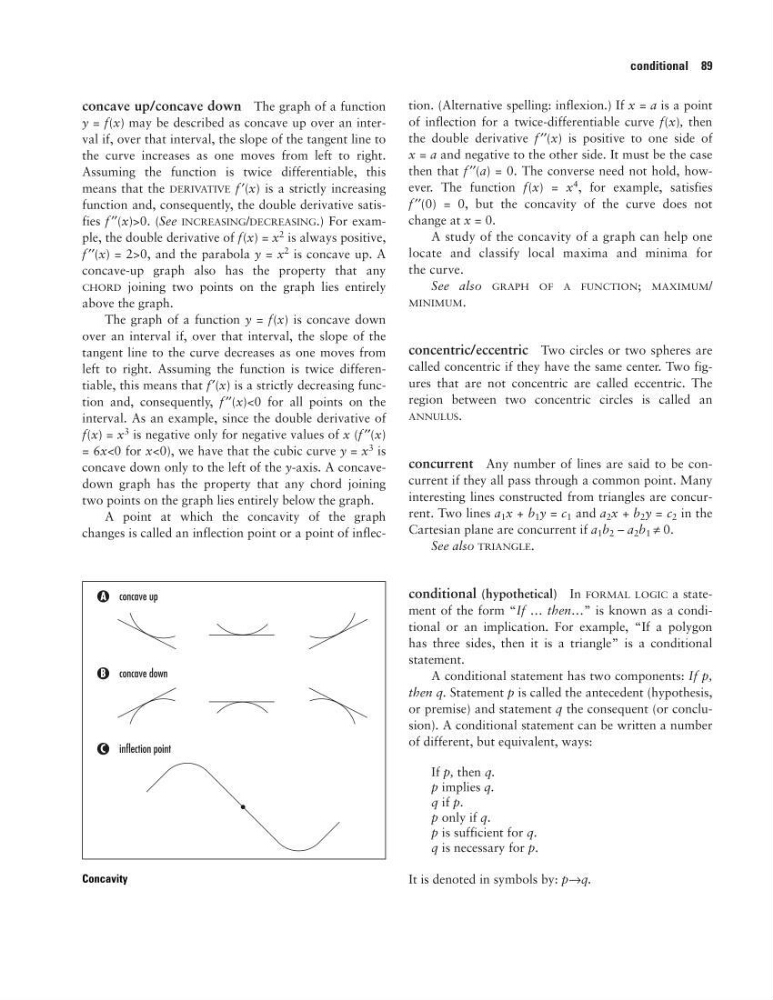
concave up/concave down The graph of a function
y = f(x) may be described as concave up over an interval if, over that interval, the slope of the tangent line to
the curve increases as one moves from left to right.
Assuming the function is twice differentiable, this
means that the DERIVATIVE f ′(x) is a strictly increasing
function and, consequently, the double derivative satisfies f ′′(x)>0. (See INCREASING/DECREASING.) For example, the double derivative of f(x) = x
2 is always positive,
f ′′(x) = 2>0, and the parabola y = x
2 is concave up. A
concave-up graph also has the property that any
CHORD joining two points on the graph lies entirely
above the graph.
The graph of a function y = f(x) is concave down
over an interval if, over that interval, the slope of the
tangent line to the curve decreases as one moves from
left to right. Assuming the function is twice differentiable, this means that f′(x) is a strictly decreasing function and, consequently, f ′′(x)<0 for all points on the
interval. As an example, since the double derivative of
f(x) = x
3 is negative only for negative values of x (f ′′(x)
= 6x<0 for x<0), we have that the cubic curve y = x
3 is
concave down only to the left of the y-axis. A concavedown graph has the property that any chord joining
two points on the graph lies entirely below the graph.
A point at which the concavity of the graph
changes is called an inflection point or a point of inflection. (Alternative spelling: inflexion.) If x = a is a point
of inflection for a twice-differentiable curve f(x), then
the double derivative f ′′(x) is positive to one side of
x = a and negative to the other side. It must be the case
then that f ′′(a) = 0. The converse need not hold, however. The function f(x) = x
4
, for example, satisfies
f ′′(0) = 0, but the concavity of the curve does not
change at x = 0.
A study of the concavity of a graph can help one
locate and classify local maxima and minima for
the curve.
See also GRAPH OF A FUNCTION; MAXIMUM/
MINIMUM.
concentric/eccentric Two circles or two spheres are
called concentric if they have the same center. Two figures that are not concentric are called eccentric. The
region between two concentric circles is called an
ANNULUS.
concurrent Any number of lines are said to be concurrent if they all pass through a common point. Many
interesting lines constructed from triangles are concurrent. Two lines a 1 x + b 1 y = c 1 and a 2 x + b 2 y = c 2 in the
Cartesian plane are concurrent if a 1 b 2 – a 2 b 1 ≠ 0.
See also TRIANGLE.
conditional (hypothetical) In FORMAL LOGIC a statement of the form “If … then…” is known as a conditional or an implication. For example, “If a polygon
has three sides, then it is a triangle” is a conditional
statement.
A conditional statement has two components: If p,
then q. Statement p is called the antecedent (hypothesis,
or premise) and statement q the consequent (or conclusion). A conditional statement can be written a number
of different, but equivalent, ways:
If p, then q.
p implies q.
q if p.
p only if q.
p is sufficient for q.
q is necessary for p.
It is denoted in symbols by: p→q.
conditional 89
Concavity
y = f(x) may be described as concave up over an interval if, over that interval, the slope of the tangent line to
the curve increases as one moves from left to right.
Assuming the function is twice differentiable, this
means that the DERIVATIVE f ′(x) is a strictly increasing
function and, consequently, the double derivative satisfies f ′′(x)>0. (See INCREASING/DECREASING.) For example, the double derivative of f(x) = x
2 is always positive,
f ′′(x) = 2>0, and the parabola y = x
2 is concave up. A
concave-up graph also has the property that any
CHORD joining two points on the graph lies entirely
above the graph.
The graph of a function y = f(x) is concave down
over an interval if, over that interval, the slope of the
tangent line to the curve decreases as one moves from
left to right. Assuming the function is twice differentiable, this means that f′(x) is a strictly decreasing function and, consequently, f ′′(x)<0 for all points on the
interval. As an example, since the double derivative of
f(x) = x
3 is negative only for negative values of x (f ′′(x)
= 6x<0 for x<0), we have that the cubic curve y = x
3 is
concave down only to the left of the y-axis. A concavedown graph has the property that any chord joining
two points on the graph lies entirely below the graph.
A point at which the concavity of the graph
changes is called an inflection point or a point of inflection. (Alternative spelling: inflexion.) If x = a is a point
of inflection for a twice-differentiable curve f(x), then
the double derivative f ′′(x) is positive to one side of
x = a and negative to the other side. It must be the case
then that f ′′(a) = 0. The converse need not hold, however. The function f(x) = x
4
, for example, satisfies
f ′′(0) = 0, but the concavity of the curve does not
change at x = 0.
A study of the concavity of a graph can help one
locate and classify local maxima and minima for
the curve.
See also GRAPH OF A FUNCTION; MAXIMUM/
MINIMUM.
concentric/eccentric Two circles or two spheres are
called concentric if they have the same center. Two figures that are not concentric are called eccentric. The
region between two concentric circles is called an
ANNULUS.
concurrent Any number of lines are said to be concurrent if they all pass through a common point. Many
interesting lines constructed from triangles are concurrent. Two lines a 1 x + b 1 y = c 1 and a 2 x + b 2 y = c 2 in the
Cartesian plane are concurrent if a 1 b 2 – a 2 b 1 ≠ 0.
See also TRIANGLE.
conditional (hypothetical) In FORMAL LOGIC a statement of the form “If … then…” is known as a conditional or an implication. For example, “If a polygon
has three sides, then it is a triangle” is a conditional
statement.
A conditional statement has two components: If p,
then q. Statement p is called the antecedent (hypothesis,
or premise) and statement q the consequent (or conclusion). A conditional statement can be written a number
of different, but equivalent, ways:
If p, then q.
p implies q.
q if p.
p only if q.
p is sufficient for q.
q is necessary for p.
It is denoted in symbols by: p→q.
conditional 89
Concavity