

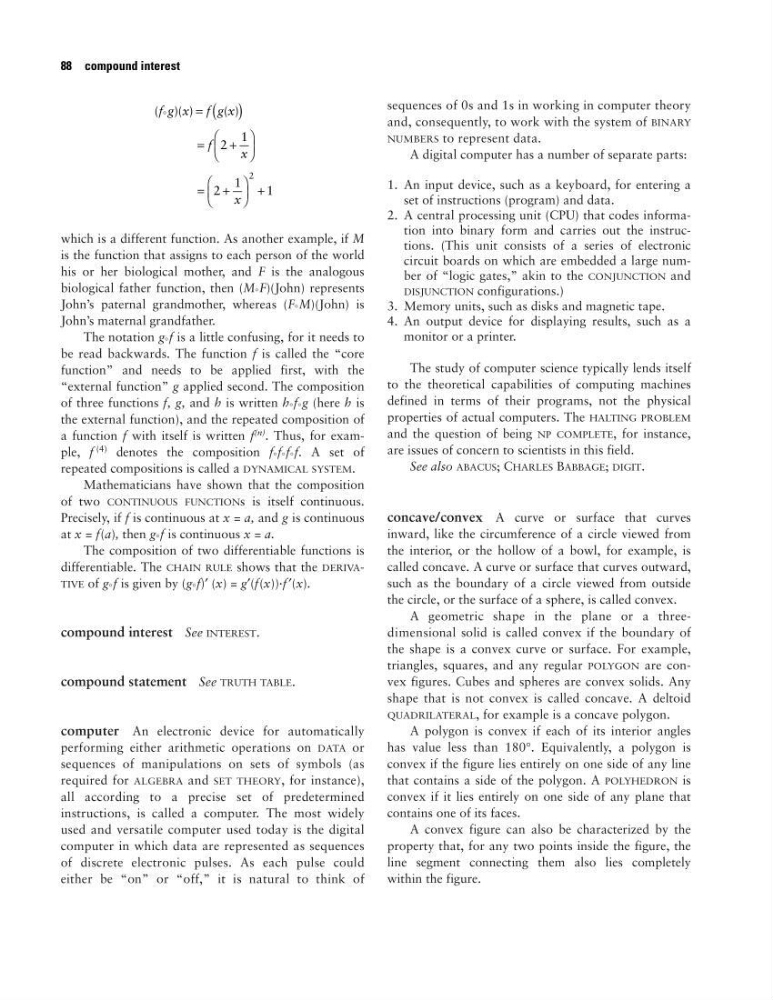
which is a different function. As another example, if M
is the function that assigns to each person of the world
his or her biological mother, and F is the analogous
biological father function, then (M ° F)(John) represents
John’s paternal grandmother, whereas (F ° M)(John) is
John’s maternal grandfather.
The notation g ° f is a little confusing, for it needs to
be read backwards. The function f is called the “core
function” and needs to be applied first, with the
“external function” g applied second. The composition
of three functions f, g, and h is written h ° f ° g (here h is
the external function), and the repeated composition of
a function f with itself is written f
(n) . Thus, for example, f
(4) denotes the composition f ° f ° f ° f. A set of
repeated compositions is called a DYNAMICAL SYSTEM.
Mathematicians have shown that the composition
of two CONTINUOUS FUNCTIONs is itself continuous.
Precisely, if f is continuous at x = a, and g is continuous
at x = f(a), then g ° f is continuous x = a.
The composition of two differentiable functions is
differentiable. The CHAIN RULE shows that the DERIVATIVE of g ° f is given by (g ° f)′ (x) = g′(f(x))·f ′(x).
compound interest See INTEREST.
compound statement See TRUTH TABLE.
computer An electronic device for automatically
performing either arithmetic operations on DATA or
sequences of manipulations on sets of symbols (as
required for ALGEBRA and SET THEORY, for instance),
all according to a precise set of predetermined
instructions, is called a computer. The most widely
used and versatile computer used today is the digital
computer in which data are represented as sequences
of discrete electronic pulses. As each pulse could
either be “on” or “off,” it is natural to think of
sequences of 0s and 1s in working in computer theory
and, consequently, to work with the system of BINARY
NUMBERS to represent data.
A digital computer has a number of separate parts:
1. An input device, such as a keyboard, for entering a
set of instructions (program) and data.
2. A central processing unit (CPU) that codes information into binary form and carries out the instructions. (This unit consists of a series of electronic
circuit boards on which are embedded a large number of “logic gates,” akin to the CONJUNCTION and
DISJUNCTION configurations.)
3. Memory units, such as disks and magnetic tape.
4. An output device for displaying results, such as a
monitor or a printer.
The study of computer science typically lends itself
to the theoretical capabilities of computing machines
defined in terms of their programs, not the physical
properties of actual computers. The HALTING PROBLEM
and the question of being NP COMPLETE, for instance,
are issues of concern to scientists in this field.
See also ABACUS; CHARLES BABBAGE; DIGIT.
concave/convex A curve or surface that curves
inward, like the circumference of a circle viewed from
the interior, or the hollow of a bowl, for example, is
called concave. A curve or surface that curves outward,
such as the boundary of a circle viewed from outside
the circle, or the surface of a sphere, is called convex.
A geometric shape in the plane or a threedimensional solid is called convex if the boundary of
the shape is a convex curve or surface. For example,
triangles, squares, and any regular POLYGON are convex figures. Cubes and spheres are convex solids. Any
shape that is not convex is called concave. A deltoid
QUADRILATERAL, for example is a concave polygon.
A polygon is convex if each of its interior angles
has value less than 180°. Equivalently, a polygon is
convex if the figure lies entirely on one side of any line
that contains a side of the polygon. A POLYHEDRON is
convex if it lies entirely on one side of any plane that
contains one of its faces.
A convex figure can also be characterized by the
property that, for any two points inside the figure, the
line segment connecting them also lies completely
within the figure.
( )( )
( )
f g x f g x
f
x
x
°
= ( )
=
+
⎛
⎝
⎜
⎞
⎠
⎟
= +
⎛
⎝
⎜
⎞
⎠
⎟ +
2
1
2
1
1
2
88 compound interest
is the function that assigns to each person of the world
his or her biological mother, and F is the analogous
biological father function, then (M ° F)(John) represents
John’s paternal grandmother, whereas (F ° M)(John) is
John’s maternal grandfather.
The notation g ° f is a little confusing, for it needs to
be read backwards. The function f is called the “core
function” and needs to be applied first, with the
“external function” g applied second. The composition
of three functions f, g, and h is written h ° f ° g (here h is
the external function), and the repeated composition of
a function f with itself is written f
(n) . Thus, for example, f
(4) denotes the composition f ° f ° f ° f. A set of
repeated compositions is called a DYNAMICAL SYSTEM.
Mathematicians have shown that the composition
of two CONTINUOUS FUNCTIONs is itself continuous.
Precisely, if f is continuous at x = a, and g is continuous
at x = f(a), then g ° f is continuous x = a.
The composition of two differentiable functions is
differentiable. The CHAIN RULE shows that the DERIVATIVE of g ° f is given by (g ° f)′ (x) = g′(f(x))·f ′(x).
compound interest See INTEREST.
compound statement See TRUTH TABLE.
computer An electronic device for automatically
performing either arithmetic operations on DATA or
sequences of manipulations on sets of symbols (as
required for ALGEBRA and SET THEORY, for instance),
all according to a precise set of predetermined
instructions, is called a computer. The most widely
used and versatile computer used today is the digital
computer in which data are represented as sequences
of discrete electronic pulses. As each pulse could
either be “on” or “off,” it is natural to think of
sequences of 0s and 1s in working in computer theory
and, consequently, to work with the system of BINARY
NUMBERS to represent data.
A digital computer has a number of separate parts:
1. An input device, such as a keyboard, for entering a
set of instructions (program) and data.
2. A central processing unit (CPU) that codes information into binary form and carries out the instructions. (This unit consists of a series of electronic
circuit boards on which are embedded a large number of “logic gates,” akin to the CONJUNCTION and
DISJUNCTION configurations.)
3. Memory units, such as disks and magnetic tape.
4. An output device for displaying results, such as a
monitor or a printer.
The study of computer science typically lends itself
to the theoretical capabilities of computing machines
defined in terms of their programs, not the physical
properties of actual computers. The HALTING PROBLEM
and the question of being NP COMPLETE, for instance,
are issues of concern to scientists in this field.
See also ABACUS; CHARLES BABBAGE; DIGIT.
concave/convex A curve or surface that curves
inward, like the circumference of a circle viewed from
the interior, or the hollow of a bowl, for example, is
called concave. A curve or surface that curves outward,
such as the boundary of a circle viewed from outside
the circle, or the surface of a sphere, is called convex.
A geometric shape in the plane or a threedimensional solid is called convex if the boundary of
the shape is a convex curve or surface. For example,
triangles, squares, and any regular POLYGON are convex figures. Cubes and spheres are convex solids. Any
shape that is not convex is called concave. A deltoid
QUADRILATERAL, for example is a concave polygon.
A polygon is convex if each of its interior angles
has value less than 180°. Equivalently, a polygon is
convex if the figure lies entirely on one side of any line
that contains a side of the polygon. A POLYHEDRON is
convex if it lies entirely on one side of any plane that
contains one of its faces.
A convex figure can also be characterized by the
property that, for any two points inside the figure, the
line segment connecting them also lies completely
within the figure.
( )( )
( )
f g x f g x
f
x
x
°
= ( )
=
+
⎛
⎝
⎜
⎞
⎠
⎟
= +
⎛
⎝
⎜
⎞
⎠
⎟ +
2
1
2
1
1
2
88 compound interest