

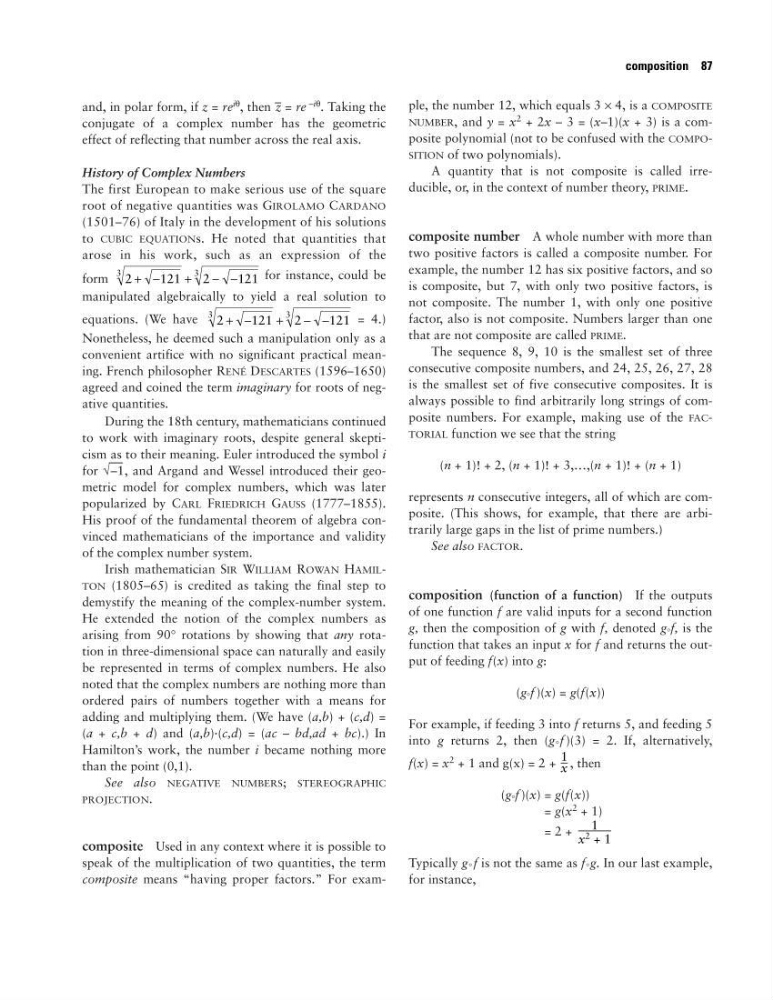
and, in polar form, if z = re
iθ , then – z = re
–iθ . Taking the
conjugate of a complex number has the geometric
effect of reflecting that number across the real axis.
History of Complex Numbers
The first European to make serious use of the square
root of negative quantities was GIROLAMO CARDANO
(1501–76) of Italy in the development of his solutions
to CUBIC EQUATIONs. He noted that quantities that
arose in his work, such as an expression of the
form
for instance, could be
manipulated algebraically to yield a real solution to
equations. (We have
= 4.)
Nonetheless, he deemed such a manipulation only as a
convenient artifice with no significant practical meaning. French philosopher RENÉ DESCARTES (1596–1650)
agreed and coined the term imaginary for roots of negative quantities.
During the 18th century, mathematicians continued
to work with imaginary roots, despite general skepticism as to their meaning. Euler introduced the symbol i
for √
–
–1, and Argand and Wessel introduced their geometric model for complex numbers, which was later
popularized by CARL FRIEDRICH GAUSS (1777–1855).
His proof of the fundamental theorem of algebra convinced mathematicians of the importance and validity
of the complex number system.
Irish mathematician SIR WILLIAM ROWAN HAMILTON (1805–65) is credited as taking the final step to
demystify the meaning of the complex-number system.
He extended the notion of the complex numbers as
arising from 90° rotations by showing that any rotation in three-dimensional space can naturally and easily
be represented in terms of complex numbers. He also
noted that the complex numbers are nothing more than
ordered pairs of numbers together with a means for
adding and multiplying them. (We have (a,b) + (c,d) =
(a + c,b + d) and (a,b)·(c,d) = (ac – bd,ad + bc).) In
Hamilton’s work, the number i became nothing more
than the point (0,1).
See also NEGATIVE NUMBERS; STEREOGRAPHIC
PROJECTION.
composite Used in any context where it is possible to
speak of the multiplication of two quantities, the term
composite means “having proper factors.” For example, the number 12, which equals 3 × 4, is a COMPOSITE
NUMBER, and y = x
2 + 2x – 3 = (x–1)(x + 3) is a composite polynomial (not to be confused with the COMPOSITION of two polynomials).
A quantity that is not composite is called irreducible, or, in the context of number theory, PRIME.
composite number A whole number with more than
two positive factors is called a composite number. For
example, the number 12 has six positive factors, and so
is composite, but 7, with only two positive factors, is
not composite. The number 1, with only one positive
factor, also is not composite. Numbers larger than one
that are not composite are called PRIME.
The sequence 8, 9, 10 is the smallest set of three
consecutive composite numbers, and 24, 25, 26, 27, 28
is the smallest set of five consecutive composites. It is
always possible to find arbitrarily long strings of composite numbers. For example, making use of the FACTORIAL function we see that the string
(n + 1)! + 2, (n + 1)! + 3,…,(n + 1)! + (n + 1)
represents n consecutive integers, all of which are composite. (This shows, for example, that there are arbitrarily large gaps in the list of prime numbers.)
See also FACTOR.
composition (function of a function) If the outputs
of one function f are valid inputs for a second function
g, then the composition of g with f, denoted g ° f, is the
function that takes an input x for f and returns the output of feeding f(x) into g:
(g ° f )(x) = g(f(x))
For example, if feeding 3 into f returns 5, and feeding 5
into g returns 2, then (g ° f )(3) = 2. If, alternatively,
f(x) = x
2 + 1 and g(x) = 2 + , then
(g ° f )(x) = g(f(x))
= g(x
2 + 1)
= 2 +
Typically g ° f is not the same as f ° g. In our last example,
for instance,
1
x
2 + 1
1
x
2
121
2
121
3
3
+ −
+
− −
2
121
2
121
3
3
+ −
+
− −
composition 87
iθ , then – z = re
–iθ . Taking the
conjugate of a complex number has the geometric
effect of reflecting that number across the real axis.
History of Complex Numbers
The first European to make serious use of the square
root of negative quantities was GIROLAMO CARDANO
(1501–76) of Italy in the development of his solutions
to CUBIC EQUATIONs. He noted that quantities that
arose in his work, such as an expression of the
form
for instance, could be
manipulated algebraically to yield a real solution to
equations. (We have
= 4.)
Nonetheless, he deemed such a manipulation only as a
convenient artifice with no significant practical meaning. French philosopher RENÉ DESCARTES (1596–1650)
agreed and coined the term imaginary for roots of negative quantities.
During the 18th century, mathematicians continued
to work with imaginary roots, despite general skepticism as to their meaning. Euler introduced the symbol i
for √
–
–1, and Argand and Wessel introduced their geometric model for complex numbers, which was later
popularized by CARL FRIEDRICH GAUSS (1777–1855).
His proof of the fundamental theorem of algebra convinced mathematicians of the importance and validity
of the complex number system.
Irish mathematician SIR WILLIAM ROWAN HAMILTON (1805–65) is credited as taking the final step to
demystify the meaning of the complex-number system.
He extended the notion of the complex numbers as
arising from 90° rotations by showing that any rotation in three-dimensional space can naturally and easily
be represented in terms of complex numbers. He also
noted that the complex numbers are nothing more than
ordered pairs of numbers together with a means for
adding and multiplying them. (We have (a,b) + (c,d) =
(a + c,b + d) and (a,b)·(c,d) = (ac – bd,ad + bc).) In
Hamilton’s work, the number i became nothing more
than the point (0,1).
See also NEGATIVE NUMBERS; STEREOGRAPHIC
PROJECTION.
composite Used in any context where it is possible to
speak of the multiplication of two quantities, the term
composite means “having proper factors.” For example, the number 12, which equals 3 × 4, is a COMPOSITE
NUMBER, and y = x
2 + 2x – 3 = (x–1)(x + 3) is a composite polynomial (not to be confused with the COMPOSITION of two polynomials).
A quantity that is not composite is called irreducible, or, in the context of number theory, PRIME.
composite number A whole number with more than
two positive factors is called a composite number. For
example, the number 12 has six positive factors, and so
is composite, but 7, with only two positive factors, is
not composite. The number 1, with only one positive
factor, also is not composite. Numbers larger than one
that are not composite are called PRIME.
The sequence 8, 9, 10 is the smallest set of three
consecutive composite numbers, and 24, 25, 26, 27, 28
is the smallest set of five consecutive composites. It is
always possible to find arbitrarily long strings of composite numbers. For example, making use of the FACTORIAL function we see that the string
(n + 1)! + 2, (n + 1)! + 3,…,(n + 1)! + (n + 1)
represents n consecutive integers, all of which are composite. (This shows, for example, that there are arbitrarily large gaps in the list of prime numbers.)
See also FACTOR.
composition (function of a function) If the outputs
of one function f are valid inputs for a second function
g, then the composition of g with f, denoted g ° f, is the
function that takes an input x for f and returns the output of feeding f(x) into g:
(g ° f )(x) = g(f(x))
For example, if feeding 3 into f returns 5, and feeding 5
into g returns 2, then (g ° f )(3) = 2. If, alternatively,
f(x) = x
2 + 1 and g(x) = 2 + , then
(g ° f )(x) = g(f(x))
= g(x
2 + 1)
= 2 +
Typically g ° f is not the same as f ° g. In our last example,
for instance,
1
x
2 + 1
1
x
2
121
2
121
3
3
+ −
+
− −
2
121
2
121
3
3
+ −
+
− −
composition 87