

Also, noting that
, we see that
it is also possible to raise a complex number to a complex power to obtain a real result:
(Technically, since i can also be expressed as
for any whole number k, there are infinitely different
(real) values for the quantity i
i
.)
The Geometry of Complex Numbers
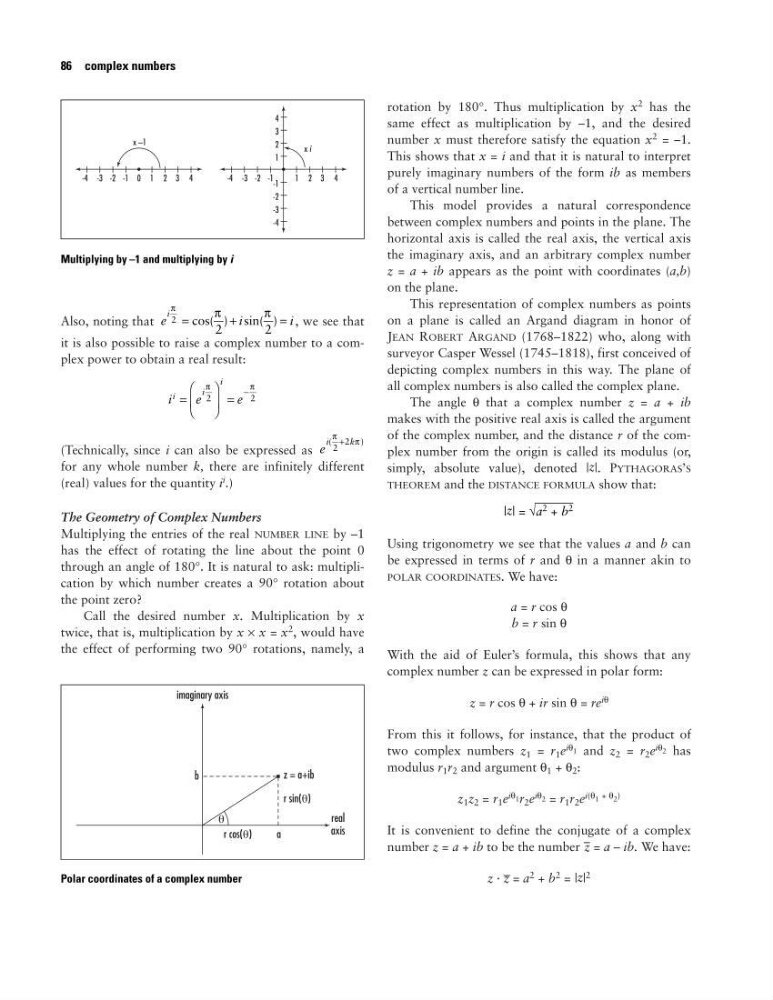
Multiplying the entries of the real NUMBER LINE by –1
has the effect of rotating the line about the point 0
through an angle of 180°. It is natural to ask: multiplication by which number creates a 90° rotation about
the point zero?
Call the desired number x. Multiplication by x
twice, that is, multiplication by x × x = x
2
, would have
the effect of performing two 90° rotations, namely, a
rotation by 180°. Thus multiplication by x
2 has the
same effect as multiplication by –1, and the desired
number x must therefore satisfy the equation x
2 = –1.
This shows that x = i and that it is natural to interpret
purely imaginary numbers of the form ib as members
of a vertical number line.
This model provides a natural correspondence
between complex numbers and points in the plane. The
horizontal axis is called the real axis, the vertical axis
the imaginary axis, and an arbitrary complex number
z = a + ib appears as the point with coordinates (a,b)
on the plane.
This representation of complex numbers as points
on a plane is called an Argand diagram in honor of
JEAN ROBERT ARGAND (1768–1822) who, along with
surveyor Casper Wessel (1745–1818), first conceived of
depicting complex numbers in this way. The plane of
all complex numbers is also called the complex plane.
The angle θ that a complex number z = a + ib
makes with the positive real axis is called the argument
of the complex number, and the distance r of the complex number from the origin is called its modulus (or,
simply, absolute value), denoted |z|. PYTHAGORAS’S
THEOREM and the DISTANCE FORMULA show that:
Using trigonometry we see that the values a and b can
be expressed in terms of r and θ in a manner akin to
POLAR COORDINATES. We have:
a = r cos θ
b = r sin θ
With the aid of Euler’s formula, this shows that any
complex number z can be expressed in polar form:
z = r cos θ + ir sin θ = re iθ
From this it follows, for instance, that the product of
two complex numbers z 1 = r 1 e
iθ 1 and z 2 = r 2 e
iθ 2 has
modulus r 1 r 2 and argument θ 1 + θ 2 :
z 1 z 2 = r 1 e
iθ 1 r 2 e
iθ 2 = r 1 r 2 e
i(θ 1 + θ 2 )
It is convenient to define the conjugate of a complex
number z = a + ib to be the number – z = a – ib. We have:
z · – z = a
2 + b
2 = |z|
2
|z| = √a
2 + b
2
e
i
k
(
)
π
π
2
2
+
i
e
e
i
i
i
=
=
−
π
π
2
2
e
i
i
i
π
π
π
2
2
2
=
+
=
cos( ) sin( )
86 complex numbers
Multiplying by –1 and multiplying by i
Polar coordinates of a complex number
, we see that
it is also possible to raise a complex number to a complex power to obtain a real result:
(Technically, since i can also be expressed as
for any whole number k, there are infinitely different
(real) values for the quantity i
i
.)
The Geometry of Complex Numbers
Multiplying the entries of the real NUMBER LINE by –1
has the effect of rotating the line about the point 0
through an angle of 180°. It is natural to ask: multiplication by which number creates a 90° rotation about
the point zero?
Call the desired number x. Multiplication by x
twice, that is, multiplication by x × x = x
2
, would have
the effect of performing two 90° rotations, namely, a
rotation by 180°. Thus multiplication by x
2 has the
same effect as multiplication by –1, and the desired
number x must therefore satisfy the equation x
2 = –1.
This shows that x = i and that it is natural to interpret
purely imaginary numbers of the form ib as members
of a vertical number line.
This model provides a natural correspondence
between complex numbers and points in the plane. The
horizontal axis is called the real axis, the vertical axis
the imaginary axis, and an arbitrary complex number
z = a + ib appears as the point with coordinates (a,b)
on the plane.
This representation of complex numbers as points
on a plane is called an Argand diagram in honor of
JEAN ROBERT ARGAND (1768–1822) who, along with
surveyor Casper Wessel (1745–1818), first conceived of
depicting complex numbers in this way. The plane of
all complex numbers is also called the complex plane.
The angle θ that a complex number z = a + ib
makes with the positive real axis is called the argument
of the complex number, and the distance r of the complex number from the origin is called its modulus (or,
simply, absolute value), denoted |z|. PYTHAGORAS’S
THEOREM and the DISTANCE FORMULA show that:
Using trigonometry we see that the values a and b can
be expressed in terms of r and θ in a manner akin to
POLAR COORDINATES. We have:
a = r cos θ
b = r sin θ
With the aid of Euler’s formula, this shows that any
complex number z can be expressed in polar form:
z = r cos θ + ir sin θ = re iθ
From this it follows, for instance, that the product of
two complex numbers z 1 = r 1 e
iθ 1 and z 2 = r 2 e
iθ 2 has
modulus r 1 r 2 and argument θ 1 + θ 2 :
z 1 z 2 = r 1 e
iθ 1 r 2 e
iθ 2 = r 1 r 2 e
i(θ 1 + θ 2 )
It is convenient to define the conjugate of a complex
number z = a + ib to be the number – z = a – ib. We have:
z · – z = a
2 + b
2 = |z|
2
|z| = √a
2 + b
2
e
i
k
(
)
π
π
2
2
+
i
e
e
i
i
i
=
=
−
π
π
2
2
e
i
i
i
π
π
π
2
2
2
=
+
=
cos( ) sin( )
86 complex numbers
Multiplying by –1 and multiplying by i
Polar coordinates of a complex number