

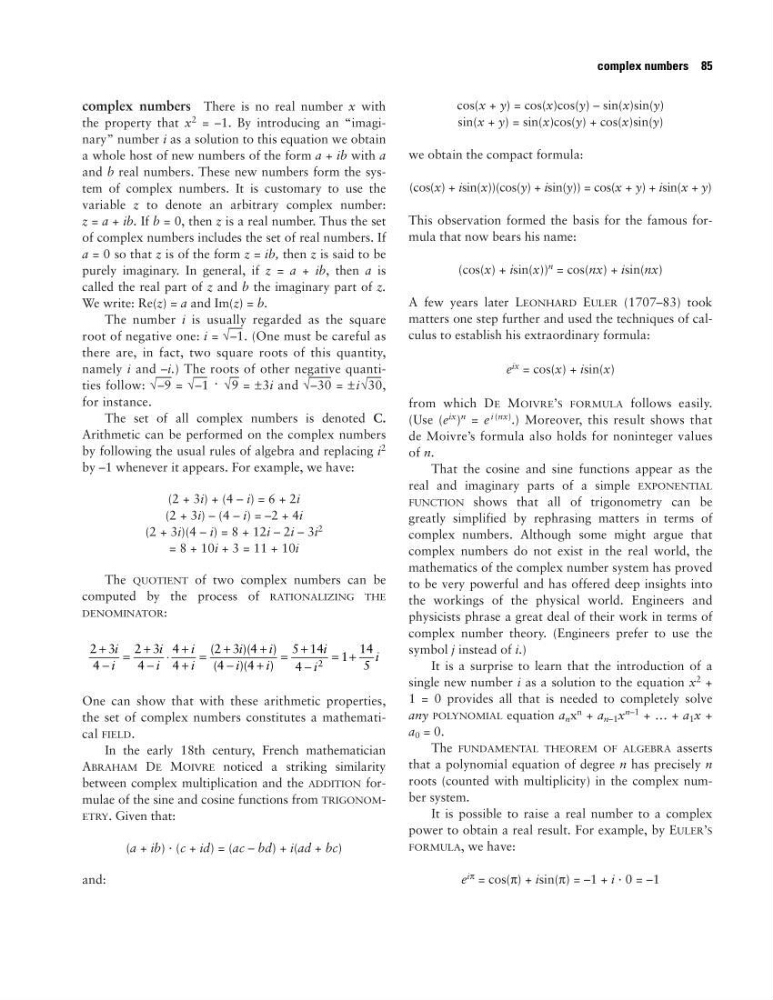
complex numbers There is no real number x with
the property that x
2 = –1. By introducing an “imaginary” number i as a solution to this equation we obtain
a whole host of new numbers of the form a + ib with a
and b real numbers. These new numbers form the system of complex numbers. It is customary to use the
variable z to denote an arbitrary complex number:
z = a + ib. If b = 0, then z is a real number. Thus the set
of complex numbers includes the set of real numbers. If
a = 0 so that z is of the form z = ib, then z is said to be
purely imaginary. In general, if z = a + ib, then a is
called the real part of z and b the imaginary part of z.
We write: Re(z) = a and Im(z) = b.
The number i is usually regarded as the square
root of negative one: i = √
–
–1. (One must be careful as
there are, in fact, two square roots of this quantity,
namely i and –i.) The roots of other negative quantities follow: √
–
–9 = √
–
–1 . √
–
9 = ±3i and √
–
–30 = ± i √
–
30,
for instance.
The set of all complex numbers is denoted C.
Arithmetic can be performed on the complex numbers
by following the usual rules of algebra and replacing i
2
by –1 whenever it appears. For example, we have:
(2 + 3i) + (4 – i) = 6 + 2i
(2 + 3i) – (4 – i) = –2 + 4i
(2 + 3i)(4 – i) = 8 + 12i – 2i – 3i
2
= 8 + 10i + 3 = 11 + 10i
The QUOTIENT of two complex numbers can be
computed by the process of RATIONALIZING THE
DENOMINATOR:
One can show that with these arithmetic properties,
the set of complex numbers constitutes a mathematical FIELD.
In the early 18th century, French mathematician
ABRAHAM DE MOIVRE noticed a striking similarity
between complex multiplication and the ADDITION formulae of the sine and cosine functions from TRIGONOMETRY. Given that:
(a + ib) · (c + id) = (ac – bd) + i(ad + bc)
and:
cos(x + y) = cos(x)cos(y) – sin(x)sin(y)
sin(x + y) = sin(x)cos(y) + cos(x)sin(y)
we obtain the compact formula:
(cos(x) + isin(x))(cos(y) + isin(y)) = cos(x + y) + isin(x + y)
This observation formed the basis for the famous formula that now bears his name:
(cos(x) + isin(x))
n = cos(nx) + isin(nx)
A few years later LEONHARD EULER (1707–83) took
matters one step further and used the techniques of calculus to establish his extraordinary formula:
e
ix = cos(x) + isin(x)
from which DE MOIVRE’S FORMULA follows easily.
(Use (e
ix )
n = e
i (nx) .) Moreover, this result shows that
de Moivre’s formula also holds for noninteger values
of n.
That the cosine and sine functions appear as the
real and imaginary parts of a simple EXPONENTIAL
FUNCTION shows that all of trigonometry can be
greatly simplified by rephrasing matters in terms of
complex numbers. Although some might argue that
complex numbers do not exist in the real world, the
mathematics of the complex number system has proved
to be very powerful and has offered deep insights into
the workings of the physical world. Engineers and
physicists phrase a great deal of their work in terms of
complex number theory. (Engineers prefer to use the
symbol j instead of i.)
It is a surprise to learn that the introduction of a
single new number i as a solution to the equation x
2 +
1 = 0 provides all that is needed to completely solve
any POLYNOMIAL equation a n x
n + a n–1 x
n–1 + … + a 1 x +
a 0 = 0.
The FUNDAMENTAL THEOREM OF ALGEBRA asserts
that a polynomial equation of degree n has precisely n
roots (counted with multiplicity) in the complex number system.
It is possible to raise a real number to a complex
power to obtain a real result. For example, by EULER’S
FORMULA, we have:
e
iπ = cos(π) + isin(π) = –1 + i · 0 = –1
2 3
4
2 3
4
4
4
2 3 4
4
4
5 14
4
1
14
5
2
+
−
=
+
−
⋅
+
+
=
+
+
−
+
=
+
−
= +
i
i
i
i
i
i
i
i
i
i
i
i
i
(
)(
)
(
)(
)
complex numbers 85
the property that x
2 = –1. By introducing an “imaginary” number i as a solution to this equation we obtain
a whole host of new numbers of the form a + ib with a
and b real numbers. These new numbers form the system of complex numbers. It is customary to use the
variable z to denote an arbitrary complex number:
z = a + ib. If b = 0, then z is a real number. Thus the set
of complex numbers includes the set of real numbers. If
a = 0 so that z is of the form z = ib, then z is said to be
purely imaginary. In general, if z = a + ib, then a is
called the real part of z and b the imaginary part of z.
We write: Re(z) = a and Im(z) = b.
The number i is usually regarded as the square
root of negative one: i = √
–
–1. (One must be careful as
there are, in fact, two square roots of this quantity,
namely i and –i.) The roots of other negative quantities follow: √
–
–9 = √
–
–1 . √
–
9 = ±3i and √
–
–30 = ± i √
–
30,
for instance.
The set of all complex numbers is denoted C.
Arithmetic can be performed on the complex numbers
by following the usual rules of algebra and replacing i
2
by –1 whenever it appears. For example, we have:
(2 + 3i) + (4 – i) = 6 + 2i
(2 + 3i) – (4 – i) = –2 + 4i
(2 + 3i)(4 – i) = 8 + 12i – 2i – 3i
2
= 8 + 10i + 3 = 11 + 10i
The QUOTIENT of two complex numbers can be
computed by the process of RATIONALIZING THE
DENOMINATOR:
One can show that with these arithmetic properties,
the set of complex numbers constitutes a mathematical FIELD.
In the early 18th century, French mathematician
ABRAHAM DE MOIVRE noticed a striking similarity
between complex multiplication and the ADDITION formulae of the sine and cosine functions from TRIGONOMETRY. Given that:
(a + ib) · (c + id) = (ac – bd) + i(ad + bc)
and:
cos(x + y) = cos(x)cos(y) – sin(x)sin(y)
sin(x + y) = sin(x)cos(y) + cos(x)sin(y)
we obtain the compact formula:
(cos(x) + isin(x))(cos(y) + isin(y)) = cos(x + y) + isin(x + y)
This observation formed the basis for the famous formula that now bears his name:
(cos(x) + isin(x))
n = cos(nx) + isin(nx)
A few years later LEONHARD EULER (1707–83) took
matters one step further and used the techniques of calculus to establish his extraordinary formula:
e
ix = cos(x) + isin(x)
from which DE MOIVRE’S FORMULA follows easily.
(Use (e
ix )
n = e
i (nx) .) Moreover, this result shows that
de Moivre’s formula also holds for noninteger values
of n.
That the cosine and sine functions appear as the
real and imaginary parts of a simple EXPONENTIAL
FUNCTION shows that all of trigonometry can be
greatly simplified by rephrasing matters in terms of
complex numbers. Although some might argue that
complex numbers do not exist in the real world, the
mathematics of the complex number system has proved
to be very powerful and has offered deep insights into
the workings of the physical world. Engineers and
physicists phrase a great deal of their work in terms of
complex number theory. (Engineers prefer to use the
symbol j instead of i.)
It is a surprise to learn that the introduction of a
single new number i as a solution to the equation x
2 +
1 = 0 provides all that is needed to completely solve
any POLYNOMIAL equation a n x
n + a n–1 x
n–1 + … + a 1 x +
a 0 = 0.
The FUNDAMENTAL THEOREM OF ALGEBRA asserts
that a polynomial equation of degree n has precisely n
roots (counted with multiplicity) in the complex number system.
It is possible to raise a real number to a complex
power to obtain a real result. For example, by EULER’S
FORMULA, we have:
e
iπ = cos(π) + isin(π) = –1 + i · 0 = –1
2 3
4
2 3
4
4
4
2 3 4
4
4
5 14
4
1
14
5
2
+
−
=
+
−
⋅
+
+
=
+
+
−
+
=
+
−
= +
i
i
i
i
i
i
i
i
i
i
i
i
i
(
)(
)
(
)(
)
complex numbers 85