

That is, the probability that a red card is an ace is
1/13. Of course, counting the number of times “ace”
occurs among the red cards also yields P(ace | red) =
2/26 = 1/13.
Conditional probability is useful in analyzing
more complex problems such as the famous TWOCARD PUZZLE.
If two events A and B are INDEPENDENT EVENTS,
then the probabilities satisfy the relation P(A∩B) =
P(A) × P(B). This shows P(A | B) = P(A), that is, the
probability of event A occurring indeed is not altered
by information of whether or not B has occurred.
See also BAYES’S THEOREM.
condition—necessary and sufficient In logic, a
condition is a proposition or statement p required to be
true in order that another proposition q be true. If q
cannot be true without p, then we call p a necessary
condition. If the validity of p ensures that q is true,
then we call p a sufficient condition. For example, for a
quadrilateral to be a rectangle it is necessary for it to
possess two parallel sides, but this condition is not sufficient. (A trapezoid, for example, has two parallel
sides but is not a rectangle.) For a number to be even it
is sufficient that the number end with a four, but this
condition is not necessary.
If p is a sufficient condition for q, then the CONDITIONAL (implication) p→q holds. Mathematicians usually write: q is true if p is true. If p is a necessary
condition for q, then the implication q→p holds. Mathematicians usually write: q is true only if p is true.
If the BICONDITIONAL holds: p↔q, then p is necessary and sufficient for q. For example, for a number to
be divisible by 10 it is necessary and sufficient that the
number end with a zero. Such a statement is usually
written: p if, and only if, q or, compactly, as “p iff q.”
See also FORMAL LOGIC; TRUTH TABLE.
cone In three-dimensional space, a cone is the surface
formed by an infinite collection of straight lines drawn
the following way: each line passes through one point
of a fixed closed curve inscribed in a plane, called the
directrix of the cone, and through a fixed given point
above the plane, called the vertex of the cone. The lines
drawn are called the generators of the cone.
In elementary work, the directrix is usually taken
to be a circle so that the cones produced are circular
cones. A circular cone is “right” if its vertex lies
directly above the center of the circle, and “oblique”
otherwise. Points on the surface of a right circular cone
satisfy an equation of the form x
2 + y
2 = a
2
z
2
, for some
constant a.
Technically, the generators of a cone are assumed
to extend indefinitely in both directions. Thus an arbitrary cone consists of two identical surfaces meeting
at the vertex. Each surface is called nappe (French for
“sheet”) or a half-cone. However, if the context is
clear, the word cone often refers to just one nappe, or
just the part of a nappe between the vertex and the
plane of the directrix. The object in this latter case is
sometimes called a finite cone. It is bounded and
encloses a finite volume.
For a finite cone, the planar region bounded by the
directrix is called the base of the cone, and the vertex is
called the APEX of the cone. The vertical distance of the
apex from the base is called the height of the cone, and
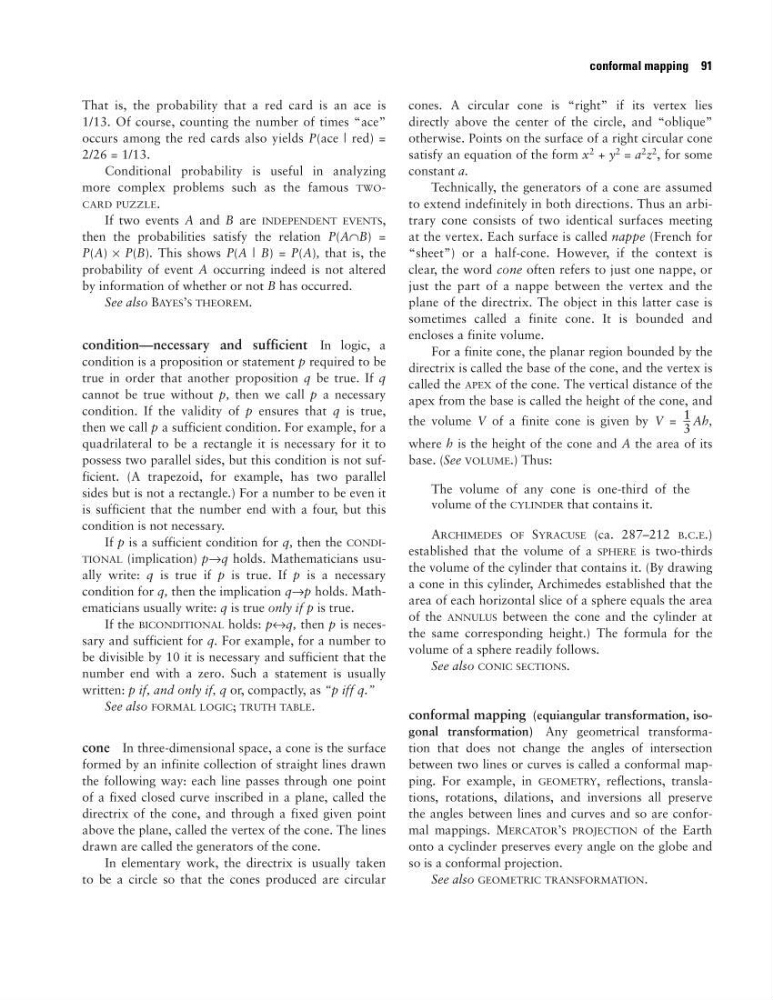
the volume V of a finite cone is given by V = Ah,
where h is the height of the cone and A the area of its
base. (See VOLUME.) Thus:
The volume of any cone is one-third of the
volume of the CYLINDER that contains it.
ARCHIMEDES OF SYRACUSE (ca. 287–212 B.C.E.)
established that the volume of a SPHERE is two-thirds
the volume of the cylinder that contains it. (By drawing
a cone in this cylinder, Archimedes established that the
area of each horizontal slice of a sphere equals the area
of the ANNULUS between the cone and the cylinder at
the same corresponding height.) The formula for the
volume of a sphere readily follows.
See also CONIC SECTIONS.
conformal mapping (equiangular transformation, isogonal transformation) Any geometrical transformation that does not change the angles of intersection
between two lines or curves is called a conformal mapping. For example, in GEOMETRY, reflections, translations, rotations, dilations, and inversions all preserve
the angles between lines and curves and so are conformal mappings. MERCATOR’S PROJECTION of the Earth
onto a cyclinder preserves every angle on the globe and
so is a conformal projection.
See also GEOMETRIC TRANSFORMATION.
1
3
conformal mapping 91
1/13. Of course, counting the number of times “ace”
occurs among the red cards also yields P(ace | red) =
2/26 = 1/13.
Conditional probability is useful in analyzing
more complex problems such as the famous TWOCARD PUZZLE.
If two events A and B are INDEPENDENT EVENTS,
then the probabilities satisfy the relation P(A∩B) =
P(A) × P(B). This shows P(A | B) = P(A), that is, the
probability of event A occurring indeed is not altered
by information of whether or not B has occurred.
See also BAYES’S THEOREM.
condition—necessary and sufficient In logic, a
condition is a proposition or statement p required to be
true in order that another proposition q be true. If q
cannot be true without p, then we call p a necessary
condition. If the validity of p ensures that q is true,
then we call p a sufficient condition. For example, for a
quadrilateral to be a rectangle it is necessary for it to
possess two parallel sides, but this condition is not sufficient. (A trapezoid, for example, has two parallel
sides but is not a rectangle.) For a number to be even it
is sufficient that the number end with a four, but this
condition is not necessary.
If p is a sufficient condition for q, then the CONDITIONAL (implication) p→q holds. Mathematicians usually write: q is true if p is true. If p is a necessary
condition for q, then the implication q→p holds. Mathematicians usually write: q is true only if p is true.
If the BICONDITIONAL holds: p↔q, then p is necessary and sufficient for q. For example, for a number to
be divisible by 10 it is necessary and sufficient that the
number end with a zero. Such a statement is usually
written: p if, and only if, q or, compactly, as “p iff q.”
See also FORMAL LOGIC; TRUTH TABLE.
cone In three-dimensional space, a cone is the surface
formed by an infinite collection of straight lines drawn
the following way: each line passes through one point
of a fixed closed curve inscribed in a plane, called the
directrix of the cone, and through a fixed given point
above the plane, called the vertex of the cone. The lines
drawn are called the generators of the cone.
In elementary work, the directrix is usually taken
to be a circle so that the cones produced are circular
cones. A circular cone is “right” if its vertex lies
directly above the center of the circle, and “oblique”
otherwise. Points on the surface of a right circular cone
satisfy an equation of the form x
2 + y
2 = a
2
z
2
, for some
constant a.
Technically, the generators of a cone are assumed
to extend indefinitely in both directions. Thus an arbitrary cone consists of two identical surfaces meeting
at the vertex. Each surface is called nappe (French for
“sheet”) or a half-cone. However, if the context is
clear, the word cone often refers to just one nappe, or
just the part of a nappe between the vertex and the
plane of the directrix. The object in this latter case is
sometimes called a finite cone. It is bounded and
encloses a finite volume.
For a finite cone, the planar region bounded by the
directrix is called the base of the cone, and the vertex is
called the APEX of the cone. The vertical distance of the
apex from the base is called the height of the cone, and
the volume V of a finite cone is given by V = Ah,
where h is the height of the cone and A the area of its
base. (See VOLUME.) Thus:
The volume of any cone is one-third of the
volume of the CYLINDER that contains it.
ARCHIMEDES OF SYRACUSE (ca. 287–212 B.C.E.)
established that the volume of a SPHERE is two-thirds
the volume of the cylinder that contains it. (By drawing
a cone in this cylinder, Archimedes established that the
area of each horizontal slice of a sphere equals the area
of the ANNULUS between the cone and the cylinder at
the same corresponding height.) The formula for the
volume of a sphere readily follows.
See also CONIC SECTIONS.
conformal mapping (equiangular transformation, isogonal transformation) Any geometrical transformation that does not change the angles of intersection
between two lines or curves is called a conformal mapping. For example, in GEOMETRY, reflections, translations, rotations, dilations, and inversions all preserve
the angles between lines and curves and so are conformal mappings. MERCATOR’S PROJECTION of the Earth
onto a cyclinder preserves every angle on the globe and
so is a conformal projection.
See also GEOMETRIC TRANSFORMATION.
1
3
conformal mapping 91