

and was one of the first scholars to permit
negative and complex solutions to equations. He
argued that the number i, representing the square
root of –1, does have a place in real-world applications of mathematics. Wallis also introduced the symbol ∞ for infinity.
In addition to working as a research mathematician, Wallis also made significant contributions as a
mathematical historian. He restored several ancient
Greek texts and presented a comprehensive survey of
the history of algebra in his 1685 work Treatise on
Algebra. He died in Oxford, England, on November
8, 1703.
Wallis helped shape the entire course of mathematical work in England for the latter part of the 17th century and paved the way for Newton to develop his
ideas. As a result, Britain became the center of mathematical research in the late 1600s and remained so
until the influence of LEONHARD EULER (1707–83) and
members of the BERNOULLI FAMILY moved the focus
back to continental Europe in the mid 1700s.
See also WALLIS’S PRODUCT.
Wallis’s product In 1656 English mathematician
JOHN WALLIS discovered the following remarkable
expression for the number
as an INFINITE PRODUCT:
He discovered this result while attempting to compute
INTEGRALs of the form
with n not necessarily an integer. (For example, when
n =
, four times this integral equals the area of a
circle.) The work of LEONHARD EULER (1707–83) on
the ZETA FUNCTION also leads to a proof of Wallis’s
product, one that is relatively straightforward to follow.
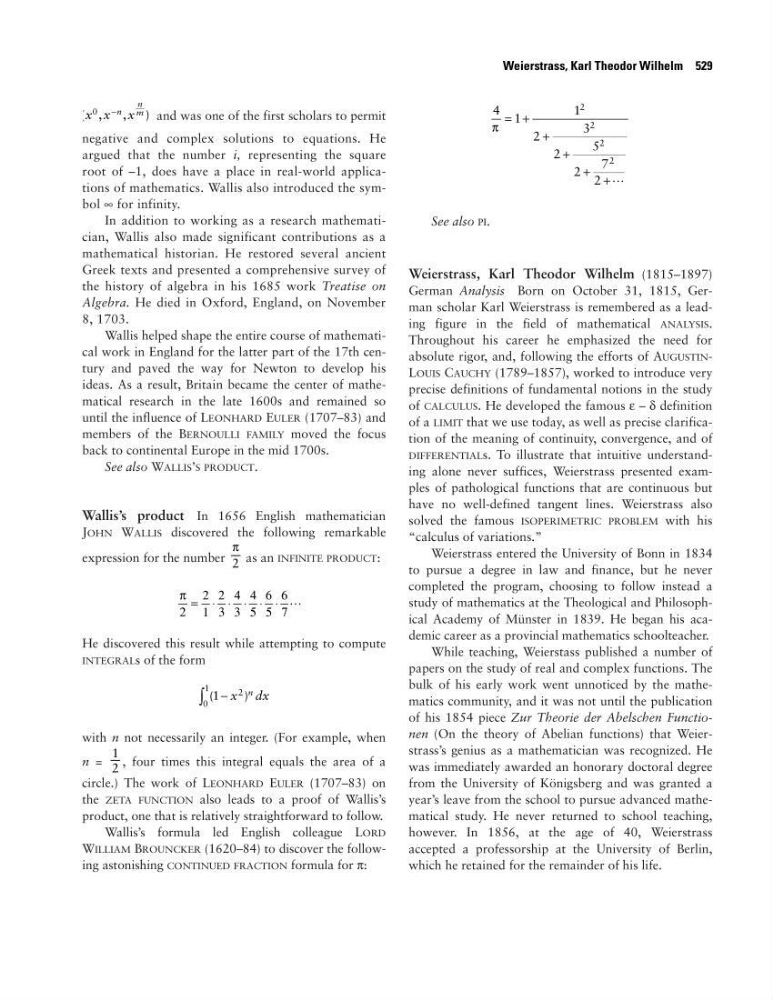
Wallis’s formula led English colleague LORD
WILLIAM BROUNCKER (1620–84) to discover the following astonishing CONTINUED FRACTION formula for π:
See also PI.
Weierstrass, Karl Theodor Wilhelm (1815–1897)
German Analysis Born on October 31, 1815, German scholar Karl Weierstrass is remembered as a leading figure in the field of mathematical ANALYSIS.
Throughout his career he emphasized the need for
absolute rigor, and, following the efforts of AUGUSTINLOUIS CAUCHY (1789–1857), worked to introduce very
precise definitions of fundamental notions in the study
of CALCULUS. He developed the famous ε – δ definition
of a LIMIT that we use today, as well as precise clarification of the meaning of continuity, convergence, and of
DIFFERENTIALs. To illustrate that intuitive understanding alone never suffices, Weierstrass presented examples of pathological functions that are continuous but
have no well-defined tangent lines. Weierstrass also
solved the famous ISOPERIMETRIC PROBLEM with his
“calculus of variations.”
Weierstrass entered the University of Bonn in 1834
to pursue a degree in law and finance, but he never
completed the program, choosing to follow instead a
study of mathematics at the Theological and Philosophical Academy of Münster in 1839. He began his academic career as a provincial mathematics schoolteacher.
While teaching, Weierstass published a number of
papers on the study of real and complex functions. The
bulk of his early work went unnoticed by the mathematics community, and it was not until the publication
of his 1854 piece Zur Theorie der Abelschen Functionen (On the theory of Abelian functions) that Weierstrass’s genius as a mathematician was recognized. He
was immediately awarded an honorary doctoral degree
from the University of Königsberg and was granted a
year’s leave from the school to pursue advanced mathematical study. He never returned to school teaching,
however. In 1856, at the age of 40, Weierstrass
accepted a professorship at the University of Berlin,
which he retained for the remainder of his life.
4 1
1
2
3
2
5
2
7
2
2
2
2
2
π
= +
+
+
+ + L
1
–
2
(
)
1
2
0
1 −
∫
x dx
n
π
2
2
1
2
3
4
3
4
5
6
5
6
7
= ⋅ ⋅ ⋅ ⋅ ⋅ L
π
–
2
( ,
,
)
x x x
n
n
m
0
−
Weierstrass, Karl Theodor Wilhelm 529
negative and complex solutions to equations. He
argued that the number i, representing the square
root of –1, does have a place in real-world applications of mathematics. Wallis also introduced the symbol ∞ for infinity.
In addition to working as a research mathematician, Wallis also made significant contributions as a
mathematical historian. He restored several ancient
Greek texts and presented a comprehensive survey of
the history of algebra in his 1685 work Treatise on
Algebra. He died in Oxford, England, on November
8, 1703.
Wallis helped shape the entire course of mathematical work in England for the latter part of the 17th century and paved the way for Newton to develop his
ideas. As a result, Britain became the center of mathematical research in the late 1600s and remained so
until the influence of LEONHARD EULER (1707–83) and
members of the BERNOULLI FAMILY moved the focus
back to continental Europe in the mid 1700s.
See also WALLIS’S PRODUCT.
Wallis’s product In 1656 English mathematician
JOHN WALLIS discovered the following remarkable
expression for the number
as an INFINITE PRODUCT:
He discovered this result while attempting to compute
INTEGRALs of the form
with n not necessarily an integer. (For example, when
n =
, four times this integral equals the area of a
circle.) The work of LEONHARD EULER (1707–83) on
the ZETA FUNCTION also leads to a proof of Wallis’s
product, one that is relatively straightforward to follow.
Wallis’s formula led English colleague LORD
WILLIAM BROUNCKER (1620–84) to discover the following astonishing CONTINUED FRACTION formula for π:
See also PI.
Weierstrass, Karl Theodor Wilhelm (1815–1897)
German Analysis Born on October 31, 1815, German scholar Karl Weierstrass is remembered as a leading figure in the field of mathematical ANALYSIS.
Throughout his career he emphasized the need for
absolute rigor, and, following the efforts of AUGUSTINLOUIS CAUCHY (1789–1857), worked to introduce very
precise definitions of fundamental notions in the study
of CALCULUS. He developed the famous ε – δ definition
of a LIMIT that we use today, as well as precise clarification of the meaning of continuity, convergence, and of
DIFFERENTIALs. To illustrate that intuitive understanding alone never suffices, Weierstrass presented examples of pathological functions that are continuous but
have no well-defined tangent lines. Weierstrass also
solved the famous ISOPERIMETRIC PROBLEM with his
“calculus of variations.”
Weierstrass entered the University of Bonn in 1834
to pursue a degree in law and finance, but he never
completed the program, choosing to follow instead a
study of mathematics at the Theological and Philosophical Academy of Münster in 1839. He began his academic career as a provincial mathematics schoolteacher.
While teaching, Weierstass published a number of
papers on the study of real and complex functions. The
bulk of his early work went unnoticed by the mathematics community, and it was not until the publication
of his 1854 piece Zur Theorie der Abelschen Functionen (On the theory of Abelian functions) that Weierstrass’s genius as a mathematician was recognized. He
was immediately awarded an honorary doctoral degree
from the University of Königsberg and was granted a
year’s leave from the school to pursue advanced mathematical study. He never returned to school teaching,
however. In 1856, at the age of 40, Weierstrass
accepted a professorship at the University of Berlin,
which he retained for the remainder of his life.
4 1
1
2
3
2
5
2
7
2
2
2
2
2
π
= +
+
+
+ + L
1
–
2
(
)
1
2
0
1 −
∫
x dx
n
π
2
2
1
2
3
4
3
4
5
6
5
6
7
= ⋅ ⋅ ⋅ ⋅ ⋅ L
π
–
2
( ,
,
)
x x x
n
n
m
0
−
Weierstrass, Karl Theodor Wilhelm 529