

Wallis, John (1616–1703) British Calculus Born on
November 23, 1616, in Kent, England, mathematician
John Wallis is remembered for his substantial contributions to the early development of CALCULUS, which laid
the groundwork for SIR ISAAC NEWTON (1642–1727)
to later fully develop the subject. His contributions to
mechanics also helped Newton formulate the laws of
motion. He was considered the leading English mathematician of his time.
Wallis had little exposure to mathematics during
the early part of his life. He received a bachelor of arts
degree in 1637 and a master’s degree in 1640 in theology and was ordained as a minister in 1640.
By happenstance, while working as chaplain during
the time of civil unrest in England, Wallis discovered
that he could easily decipher the coded messages parishioners shared with him. This demonstrated a talent for
mathematical thinking, and Wallis was soon hired by
the Parliamentarians to decode Royalist messages.
During this time Wallis read the works of
JOHANNES KEPLER and BONAVENTURA CAVALIERI and
others, and developed an interest to expand on the
ideas of infinitesimal calculus as developed by these
authors. In 1656 Wallis wrote his influential text Arithmetica infinitorum (Infinite series), which contains,
among many things, his famous product formula for .
Wallis also studied and wrote on the topics of CONIC
SECTIONS and ALGEBRA. He was the first to explain
the meaning of zero, negative, and fractional powers
π
–
2
528
W
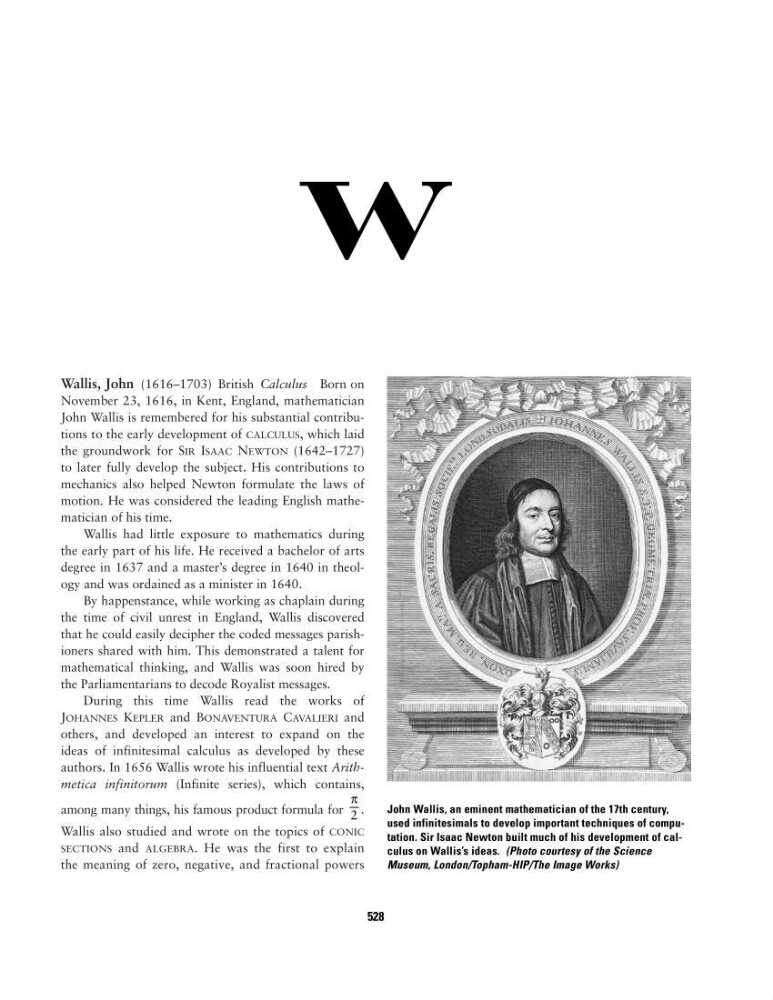
John Wallis, an eminent mathematician of the 17th century,
used infinitesimals to develop important techniques of computation. Sir Isaac Newton built much of his development of calculus on Wallis’s ideas. (Photo courtesy of the Science
Museum, London/Topham-HIP/The Image Works)
November 23, 1616, in Kent, England, mathematician
John Wallis is remembered for his substantial contributions to the early development of CALCULUS, which laid
the groundwork for SIR ISAAC NEWTON (1642–1727)
to later fully develop the subject. His contributions to
mechanics also helped Newton formulate the laws of
motion. He was considered the leading English mathematician of his time.
Wallis had little exposure to mathematics during
the early part of his life. He received a bachelor of arts
degree in 1637 and a master’s degree in 1640 in theology and was ordained as a minister in 1640.
By happenstance, while working as chaplain during
the time of civil unrest in England, Wallis discovered
that he could easily decipher the coded messages parishioners shared with him. This demonstrated a talent for
mathematical thinking, and Wallis was soon hired by
the Parliamentarians to decode Royalist messages.
During this time Wallis read the works of
JOHANNES KEPLER and BONAVENTURA CAVALIERI and
others, and developed an interest to expand on the
ideas of infinitesimal calculus as developed by these
authors. In 1656 Wallis wrote his influential text Arithmetica infinitorum (Infinite series), which contains,
among many things, his famous product formula for .
Wallis also studied and wrote on the topics of CONIC
SECTIONS and ALGEBRA. He was the first to explain
the meaning of zero, negative, and fractional powers
π
–
2
528
W
John Wallis, an eminent mathematician of the 17th century,
used infinitesimals to develop important techniques of computation. Sir Isaac Newton built much of his development of calculus on Wallis’s ideas. (Photo courtesy of the Science
Museum, London/Topham-HIP/The Image Works)