

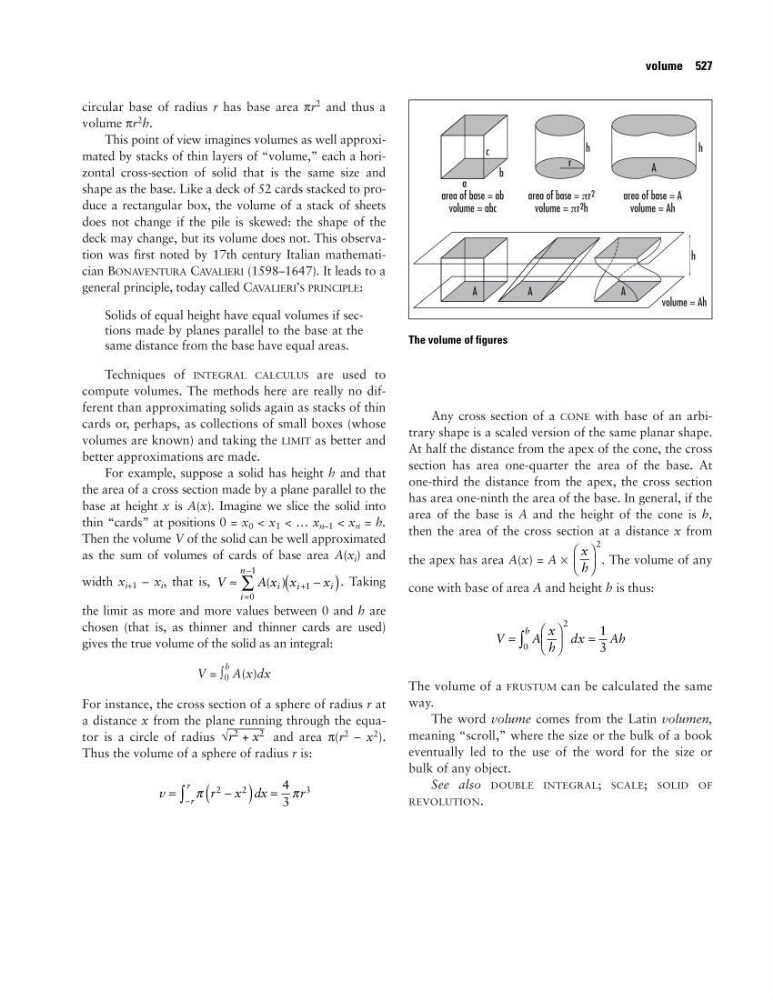
circular base of radius r has base area πr
2 and thus a
volume πr
2 h.
This point of view imagines volumes as well approximated by stacks of thin layers of “volume,” each a horizontal cross-section of solid that is the same size and
shape as the base. Like a deck of 52 cards stacked to produce a rectangular box, the volume of a stack of sheets
does not change if the pile is skewed: the shape of the
deck may change, but its volume does not. This observation was first noted by 17th century Italian mathematician BONAVENTURA CAVALIERI (1598–1647). It leads to a
general principle, today called CAVALIERI’S PRINCIPLE:
Solids of equal height have equal volumes if sections made by planes parallel to the base at the
same distance from the base have equal areas.
Techniques of INTEGRAL CALCULUS are used to
compute volumes. The methods here are really no different than approximating solids again as stacks of thin
cards or, perhaps, as collections of small boxes (whose
volumes are known) and taking the LIMIT as better and
better approximations are made.
For example, suppose a solid has height h and that
the area of a cross section made by a plane parallel to the
base at height x is A(x). Imagine we slice the solid into
thin “cards” at positions 0 = x 0 < x 1 < … x n–1 < x n = h.
Then the volume V of the solid can be well approximated
as the sum of volumes of cards of base area A(x i ) and
width x i+1 – x i , that is,
. Taking
the limit as more and more values between 0 and h are
chosen (that is, as thinner and thinner cards are used)
gives the true volume of the solid as an integral:
V = ∫
h
0 A(x)dx
For instance, the cross section of a sphere of radius r at
a distance x from the plane running through the equator is a circle of radius
and area π(r
2 – x
2 ).
Thus the volume of a sphere of radius r is:
Any cross section of a CONE with base of an arbitrary shape is a scaled version of the same planar shape.
At half the distance from the apex of the cone, the cross
section has area one-quarter the area of the base. At
one-third the distance from the apex, the cross section
has area one-ninth the area of the base. In general, if the
area of the base is A and the height of the cone is h,
then the area of the cross section at a distance x from
the apex has area A(x) = A ×
. The volume of any
cone with base of area A and height h is thus:
The volume of a FRUSTUM can be calculated the same
way.
The word volume comes from the Latin volumen,
meaning “scroll,” where the size or the bulk of a book
eventually led to the use of the word for the size or
bulk of any object.
See also DOUBLE INTEGRAL; SCALE; SOLID OF
REVOLUTION.
V
A
x
h
dx
Ah
h
=
⎛
⎝
⎜
⎞
⎠
⎟
=
∫
2
0
1
3
x
h
⎛
⎝
⎜
⎞
⎠
⎟
2
v
r
x d x
r
r
r
=
−
(
) =
−
∫ π
π
2
2
3
4
3
√r
2 + x
2
V
Ax x
x
i
i
i
i
n
≈
−
(
)
+
=
−
∑ ( ) 1
0
1
volume 527
The volume of figures
2 and thus a
volume πr
2 h.
This point of view imagines volumes as well approximated by stacks of thin layers of “volume,” each a horizontal cross-section of solid that is the same size and
shape as the base. Like a deck of 52 cards stacked to produce a rectangular box, the volume of a stack of sheets
does not change if the pile is skewed: the shape of the
deck may change, but its volume does not. This observation was first noted by 17th century Italian mathematician BONAVENTURA CAVALIERI (1598–1647). It leads to a
general principle, today called CAVALIERI’S PRINCIPLE:
Solids of equal height have equal volumes if sections made by planes parallel to the base at the
same distance from the base have equal areas.
Techniques of INTEGRAL CALCULUS are used to
compute volumes. The methods here are really no different than approximating solids again as stacks of thin
cards or, perhaps, as collections of small boxes (whose
volumes are known) and taking the LIMIT as better and
better approximations are made.
For example, suppose a solid has height h and that
the area of a cross section made by a plane parallel to the
base at height x is A(x). Imagine we slice the solid into
thin “cards” at positions 0 = x 0 < x 1 < … x n–1 < x n = h.
Then the volume V of the solid can be well approximated
as the sum of volumes of cards of base area A(x i ) and
width x i+1 – x i , that is,
. Taking
the limit as more and more values between 0 and h are
chosen (that is, as thinner and thinner cards are used)
gives the true volume of the solid as an integral:
V = ∫
h
0 A(x)dx
For instance, the cross section of a sphere of radius r at
a distance x from the plane running through the equator is a circle of radius
and area π(r
2 – x
2 ).
Thus the volume of a sphere of radius r is:
Any cross section of a CONE with base of an arbitrary shape is a scaled version of the same planar shape.
At half the distance from the apex of the cone, the cross
section has area one-quarter the area of the base. At
one-third the distance from the apex, the cross section
has area one-ninth the area of the base. In general, if the
area of the base is A and the height of the cone is h,
then the area of the cross section at a distance x from
the apex has area A(x) = A ×
. The volume of any
cone with base of area A and height h is thus:
The volume of a FRUSTUM can be calculated the same
way.
The word volume comes from the Latin volumen,
meaning “scroll,” where the size or the bulk of a book
eventually led to the use of the word for the size or
bulk of any object.
See also DOUBLE INTEGRAL; SCALE; SOLID OF
REVOLUTION.
V
A
x
h
dx
Ah
h
=
⎛
⎝
⎜
⎞
⎠
⎟
=
∫
2
0
1
3
x
h
⎛
⎝
⎜
⎞
⎠
⎟
2
v
r
x d x
r
r
r
=
−
(
) =
−
∫ π
π
2
2
3
4
3
√r
2 + x
2
V
Ax x
x
i
i
i
i
n
≈
−
(
)
+
=
−
∑ ( ) 1
0
1
volume 527
The volume of figures