

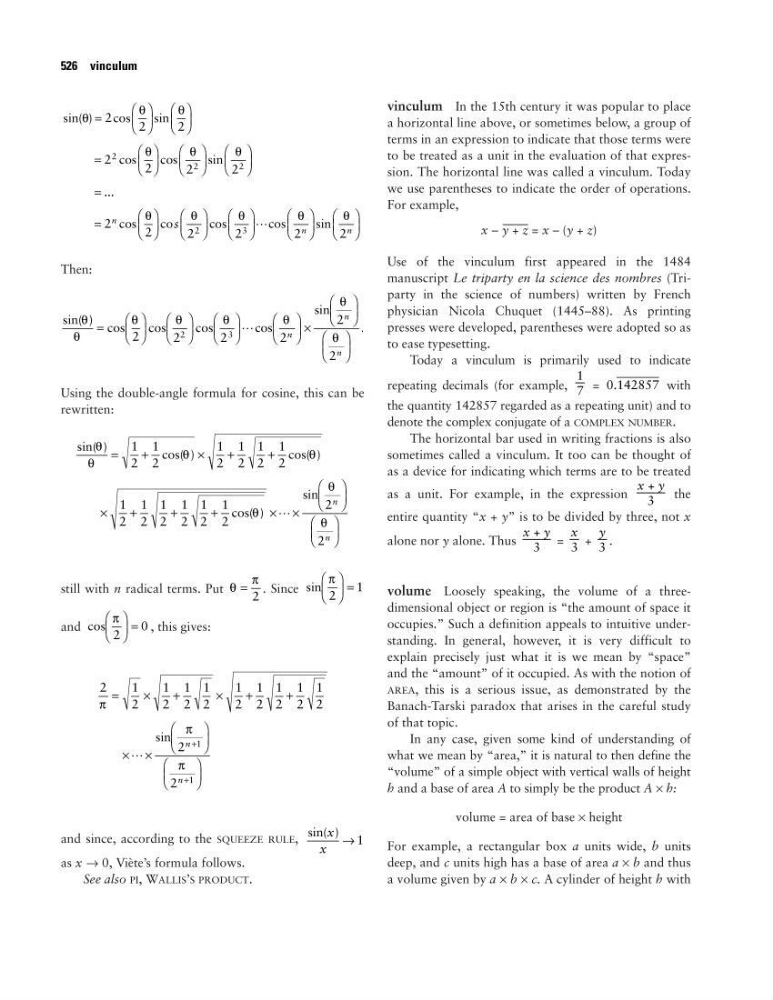
Then:
Using the double-angle formula for cosine, this can be
rewritten:
still with n radical terms. Put
. Since
and
, this gives:
and since, according to the SQUEEZE RULE,
as x → 0, Viète’s formula follows.
See also PI, WALLIS’S PRODUCT.
vinculum In the 15th century it was popular to place
a horizontal line above, or sometimes below, a group of
terms in an expression to indicate that those terms were
to be treated as a unit in the evaluation of that expression. The horizontal line was called a vinculum. Today
we use parentheses to indicate the order of operations.
For example,
x –
——
y + z = x – (y + z)
Use of the vinculum first appeared in the 1484
manuscript Le triparty en la science des nombres (Triparty in the science of numbers) written by French
physician Nicola Chuquet (1445–88). As printing
presses were developed, parentheses were adopted so as
to ease typesetting.
Today a vinculum is primarily used to indicate
repeating decimals (for example,
=
with
the quantity 142857 regarded as a repeating unit) and to
denote the complex conjugate of a COMPLEX NUMBER.
The horizontal bar used in writing fractions is also
sometimes called a vinculum. It too can be thought of
as a device for indicating which terms are to be treated
as a unit. For example, in the expression
the
entire quantity “x + y” is to be divided by three, not x
alone nor y alone. Thus
=
+ .
volume Loosely speaking, the volume of a threedimensional object or region is “the amount of space it
occupies.” Such a definition appeals to intuitive understanding. In general, however, it is very difficult to
explain precisely just what it is we mean by “space”
and the “amount” of it occupied. As with the notion of
AREA, this is a serious issue, as demonstrated by the
Banach-Tarski paradox that arises in the careful study
of that topic.
In any case, given some kind of understanding of
what we mean by “area,” it is natural to then define the
“volume” of a simple object with vertical walls of height
h and a base of area A to simply be the product A × h:
volume = area of base × height
For example, a rectangular box a units wide, b units
deep, and c units high has a base of area a × b and thus
a volume given by a × b × c. A cylinder of height h with
y
–
3
x
–
3
x + y
–––
3
x + y
–––
3
0.142857
1
–
7
sin( )
x
x
→ 1
2
1
2
1
2
1
2
1
2
1
2
1
2
1
2
1
2
1
2
2
2
1
1
π
π
π
=
×
+
×
+
+
× ×
+
+
L
sin n
n
cos
π
2
0
=
sin
π
2
1
=
θ
π
= 2
sin( )
cos( )
cos( )
cos( )
sin
θ
θ
θ
θ
θ
θ
θ
=
+
×
+
+
×
+
+
+
× ×
1
2
1
2
1
2
1
2
1
2
1
2
1
2
1
2
1
2
1
2
1
2
1
2
2
2
L
n
n
sin( ) cos
cos
cos
cos
sin
.
θ
θ
θ
θ
θ
θ
θ
θ
=
×
2
2
2
2
2
2
2
3
L
n
n
n
sin( )
cos
sin
cos
cos
sin
...
cos
co
cos
cos
sin
θ
θ
θ
θ
θ
θ
θ
θ
θ
θ
θ
=
=
=
=
2
2
2
2
2
2
2
2
2
2
2
2
2
2
2
2
2
3
n
n
n
s
L
526 vinculum
Using the double-angle formula for cosine, this can be
rewritten:
still with n radical terms. Put
. Since
and
, this gives:
and since, according to the SQUEEZE RULE,
as x → 0, Viète’s formula follows.
See also PI, WALLIS’S PRODUCT.
vinculum In the 15th century it was popular to place
a horizontal line above, or sometimes below, a group of
terms in an expression to indicate that those terms were
to be treated as a unit in the evaluation of that expression. The horizontal line was called a vinculum. Today
we use parentheses to indicate the order of operations.
For example,
x –
——
y + z = x – (y + z)
Use of the vinculum first appeared in the 1484
manuscript Le triparty en la science des nombres (Triparty in the science of numbers) written by French
physician Nicola Chuquet (1445–88). As printing
presses were developed, parentheses were adopted so as
to ease typesetting.
Today a vinculum is primarily used to indicate
repeating decimals (for example,
=
with
the quantity 142857 regarded as a repeating unit) and to
denote the complex conjugate of a COMPLEX NUMBER.
The horizontal bar used in writing fractions is also
sometimes called a vinculum. It too can be thought of
as a device for indicating which terms are to be treated
as a unit. For example, in the expression
the
entire quantity “x + y” is to be divided by three, not x
alone nor y alone. Thus
=
+ .
volume Loosely speaking, the volume of a threedimensional object or region is “the amount of space it
occupies.” Such a definition appeals to intuitive understanding. In general, however, it is very difficult to
explain precisely just what it is we mean by “space”
and the “amount” of it occupied. As with the notion of
AREA, this is a serious issue, as demonstrated by the
Banach-Tarski paradox that arises in the careful study
of that topic.
In any case, given some kind of understanding of
what we mean by “area,” it is natural to then define the
“volume” of a simple object with vertical walls of height
h and a base of area A to simply be the product A × h:
volume = area of base × height
For example, a rectangular box a units wide, b units
deep, and c units high has a base of area a × b and thus
a volume given by a × b × c. A cylinder of height h with
y
–
3
x
–
3
x + y
–––
3
x + y
–––
3
0.142857
1
–
7
sin( )
x
x
→ 1
2
1
2
1
2
1
2
1
2
1
2
1
2
1
2
1
2
1
2
2
2
1
1
π
π
π
=
×
+
×
+
+
× ×
+
+
L
sin n
n
cos
π
2
0
=
sin
π
2
1
=
θ
π
= 2
sin( )
cos( )
cos( )
cos( )
sin
θ
θ
θ
θ
θ
θ
θ
=
+
×
+
+
×
+
+
+
× ×
1
2
1
2
1
2
1
2
1
2
1
2
1
2
1
2
1
2
1
2
1
2
1
2
2
2
L
n
n
sin( ) cos
cos
cos
cos
sin
.
θ
θ
θ
θ
θ
θ
θ
θ
=
×
2
2
2
2
2
2
2
3
L
n
n
n
sin( )
cos
sin
cos
cos
sin
...
cos
co
cos
cos
sin
θ
θ
θ
θ
θ
θ
θ
θ
θ
θ
θ
=
=
=
=
2
2
2
2
2
2
2
2
2
2
2
2
2
2
2
2
2
3
n
n
n
s
L
526 vinculum