

WILHELM LEIBNIZ (1646–1716) and the great LEONHARD EULER (1707–83) each used diagrams similar
to these to analyze arguments. In the context of FORMAL LOGIC Venn diagrams are often called EULER
DIAGRAMS.
A single set A divides the universal set into two
disjoint pieces, A and its complement A′. Two subsets
A and B generally divide the universal set into four
disjoint pieces: A ∩ B, A′ ∩ B, A ∩ B′, and A′ ∩ B′.
(This is not the case, however, if A is a subset of B, B
is a subset of A, or if A and B do not intersect.) Three
subsets A, B, and C, in their most general arrangement, divide the universal set into eight disjoint
pieces. (The diagram produced can be used to illustrate DE MORGAN’S LAWS.)
It is not possible to draw a diagram of four overlapping circles to represent four general subsets A, B,
C, and D in such a way as to make the 16 disjoint
pieces of the universal set apparent. For this reason,
Venn diagrams are usually only used to illustrate relations between just two or three sets.
See also SET THEORY; JOHN VENN.
Viète, François (Franciscus Vieta) (1540–1603) French
Algebra Born in Fontenay-le-Comte, France, in 1540
(his exact birth date is not known), scholar François
Viète is often referred to as “the father of algebra.” His
influential 1591 work In artem analyticam isagoge
(Introduction to the analytic arts) is noted as one of the
earliest Western texts on the topic. His practice of using
letters as symbols for unknowns represented a first step
toward the development of modern algebraic notation
and allowed him to make significant advances in the
subject. Viète also made important contributions to the
field of TRIGONOMETRY.
Viète was never employed as a professional mathematician. After graduating from the University of
Poitiers in 1560, he began a career in legal practice, but
soon decided to change occupations by accepting a
position as a private tutor in 1564. Within this role he
pursued an interest in mathematics and soon developed
a reputation as a capable scholar. Viète occasionally
gave mathematical lectures at institutes of higher learning, and in 1589 was employed by King Henry IV of
France to decode secret messages being sent to the
enemy of the state, Philip II of Spain.
His first published work, Canon mathematicus
seu ad triangula (The mathematical canon applied to
triangles), appeared in 1579 and was intended as an
introduction to mathematical astronomy. In it Viète
used the six main trigonometric functions to solve
problems relating to plane and spherical triangles,
listed tables of values for these functions, and
explained the mathematics behind the construction of
those tables. Later, in 1593, Viète wrote two other
texts on the topic of trigonometry, Zeteticorum libri
quinque (Algebra volume five), mimicking the fifth
book in DIOPHANTUS’s Arithmetica, and Variorum de
rebus mathematicis responsorum (Various mathematical problems), which contains his famous formula for
π as an infinite product of radicals. He also lectured
on the classical problems of DUPLICATING THE CUBE
and TRISECTING AN ANGLE.
Today Viète is best remembered for his advances in
algebra as presented in his famous 1591 text Isagoge,
which clearly demonstrated the value of manipulating
letters as symbols for both known and unknown quantities as a means to solve algebraic problems. Viète also
introduced improved notation for squares, cubes, and
other powers, as well as coined the term coefficient.
With his new approach to algebra, Viète successfully
tackled a number of problems that classical scholars
had been unable to solve. Viète died in Paris, France,
on February 23, 1603.
See also COEFFICIENT; VIÈTE’S FORMULA.
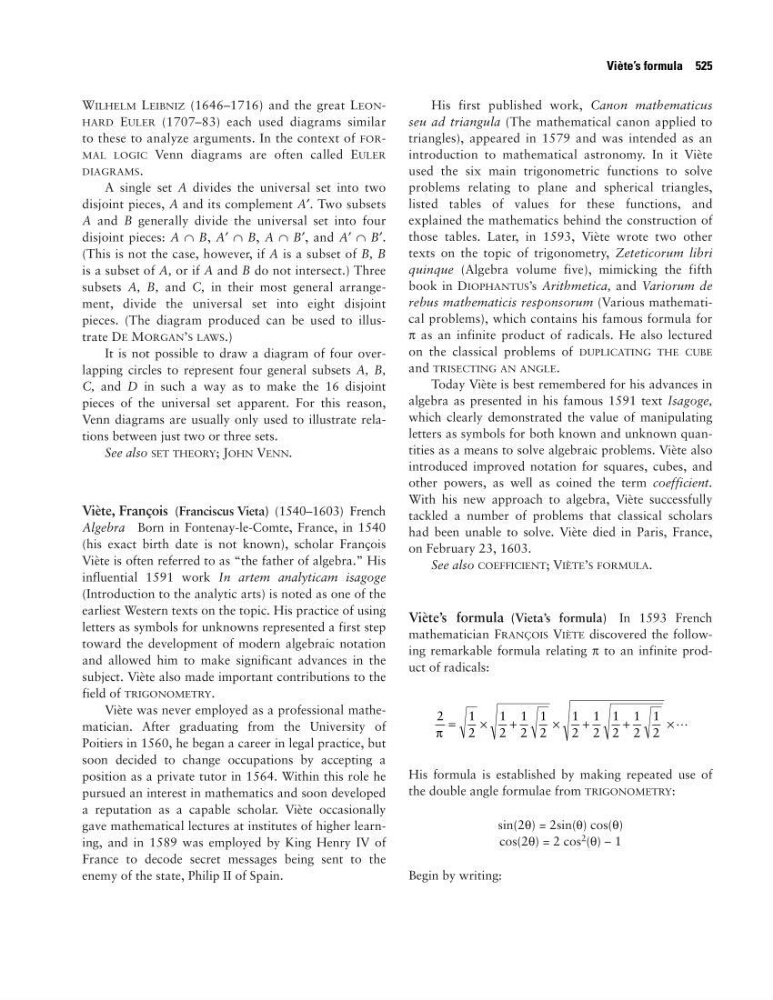
Viète’s formula (Vieta’s formula) In 1593 French
mathematician FRANÇOIS VIÈTE discovered the following remarkable formula relating π to an infinite product of radicals:
His formula is established by making repeated use of
the double angle formulae from TRIGONOMETRY:
sin(2θ) = 2sin(θ) cos(θ)
cos(2θ) = 2 cos
2
(θ) – 1
Begin by writing:
2
1
2
1
2
1
2
1
2
1
2
1
2
1
2
1
2
1
2
π
=
×
+
×
+
+
×L
Viète’s formula 525
to these to analyze arguments. In the context of FORMAL LOGIC Venn diagrams are often called EULER
DIAGRAMS.
A single set A divides the universal set into two
disjoint pieces, A and its complement A′. Two subsets
A and B generally divide the universal set into four
disjoint pieces: A ∩ B, A′ ∩ B, A ∩ B′, and A′ ∩ B′.
(This is not the case, however, if A is a subset of B, B
is a subset of A, or if A and B do not intersect.) Three
subsets A, B, and C, in their most general arrangement, divide the universal set into eight disjoint
pieces. (The diagram produced can be used to illustrate DE MORGAN’S LAWS.)
It is not possible to draw a diagram of four overlapping circles to represent four general subsets A, B,
C, and D in such a way as to make the 16 disjoint
pieces of the universal set apparent. For this reason,
Venn diagrams are usually only used to illustrate relations between just two or three sets.
See also SET THEORY; JOHN VENN.
Viète, François (Franciscus Vieta) (1540–1603) French
Algebra Born in Fontenay-le-Comte, France, in 1540
(his exact birth date is not known), scholar François
Viète is often referred to as “the father of algebra.” His
influential 1591 work In artem analyticam isagoge
(Introduction to the analytic arts) is noted as one of the
earliest Western texts on the topic. His practice of using
letters as symbols for unknowns represented a first step
toward the development of modern algebraic notation
and allowed him to make significant advances in the
subject. Viète also made important contributions to the
field of TRIGONOMETRY.
Viète was never employed as a professional mathematician. After graduating from the University of
Poitiers in 1560, he began a career in legal practice, but
soon decided to change occupations by accepting a
position as a private tutor in 1564. Within this role he
pursued an interest in mathematics and soon developed
a reputation as a capable scholar. Viète occasionally
gave mathematical lectures at institutes of higher learning, and in 1589 was employed by King Henry IV of
France to decode secret messages being sent to the
enemy of the state, Philip II of Spain.
His first published work, Canon mathematicus
seu ad triangula (The mathematical canon applied to
triangles), appeared in 1579 and was intended as an
introduction to mathematical astronomy. In it Viète
used the six main trigonometric functions to solve
problems relating to plane and spherical triangles,
listed tables of values for these functions, and
explained the mathematics behind the construction of
those tables. Later, in 1593, Viète wrote two other
texts on the topic of trigonometry, Zeteticorum libri
quinque (Algebra volume five), mimicking the fifth
book in DIOPHANTUS’s Arithmetica, and Variorum de
rebus mathematicis responsorum (Various mathematical problems), which contains his famous formula for
π as an infinite product of radicals. He also lectured
on the classical problems of DUPLICATING THE CUBE
and TRISECTING AN ANGLE.
Today Viète is best remembered for his advances in
algebra as presented in his famous 1591 text Isagoge,
which clearly demonstrated the value of manipulating
letters as symbols for both known and unknown quantities as a means to solve algebraic problems. Viète also
introduced improved notation for squares, cubes, and
other powers, as well as coined the term coefficient.
With his new approach to algebra, Viète successfully
tackled a number of problems that classical scholars
had been unable to solve. Viète died in Paris, France,
on February 23, 1603.
See also COEFFICIENT; VIÈTE’S FORMULA.
Viète’s formula (Vieta’s formula) In 1593 French
mathematician FRANÇOIS VIÈTE discovered the following remarkable formula relating π to an infinite product of radicals:
His formula is established by making repeated use of
the double angle formulae from TRIGONOMETRY:
sin(2θ) = 2sin(θ) cos(θ)
cos(2θ) = 2 cos
2
(θ) – 1
Begin by writing:
2
1
2
1
2
1
2
1
2
1
2
1
2
1
2
1
2
1
2
π
=
×
+
×
+
+
×L
Viète’s formula 525