

Weierstrass made significant contributions to the
study of POWER SERIES and their convergence, and to
FOURIER SERIES and their applications to problems in
geometry and mechanics. In providing a precise definition of a limit, Weierstrass completely revolutionized
mathematical understanding of the founding principles
of CALCULUS and modern analysis. In a very real sense,
Weierstrass set the standards of rigor that all mathematicians still follow today.
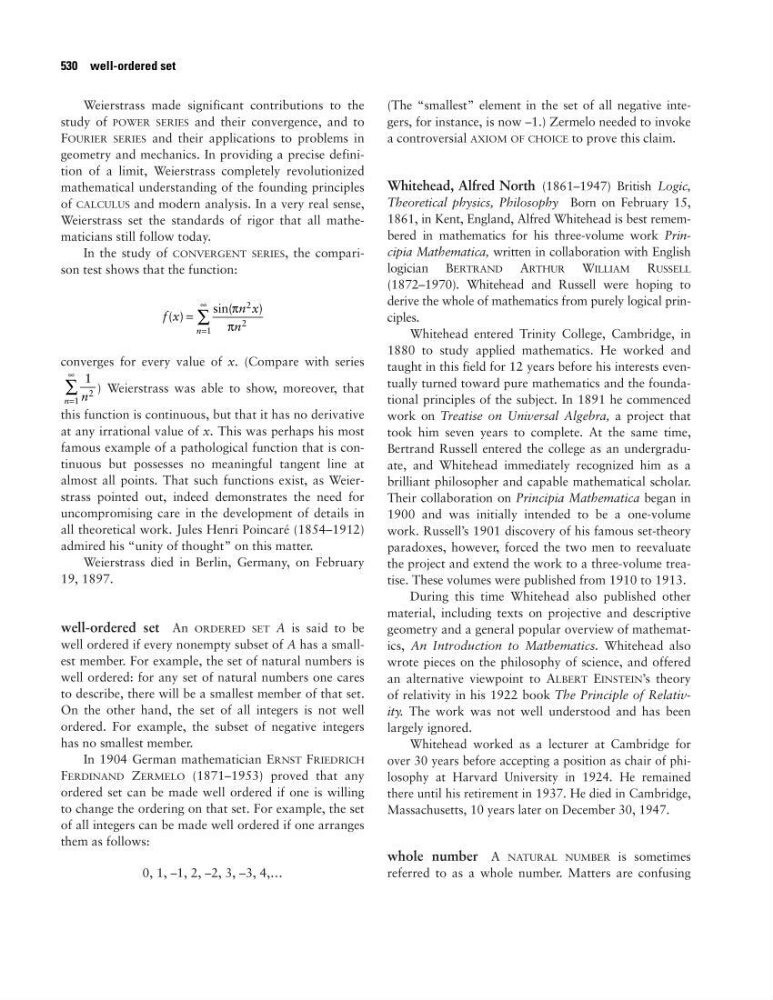
In the study of CONVERGENT SERIES, the comparison test shows that the function:
converges for every value of x. (Compare with series
) Weierstrass was able to show, moreover, that
this function is continuous, but that it has no derivative
at any irrational value of x. This was perhaps his most
famous example of a pathological function that is continuous but possesses no meaningful tangent line at
almost all points. That such functions exist, as Weierstrass pointed out, indeed demonstrates the need for
uncompromising care in the development of details in
all theoretical work. Jules Henri Poincaré (1854–1912)
admired his “unity of thought” on this matter.
Weierstrass died in Berlin, Germany, on February
19, 1897.
well-ordered set An ORDERED SET A is said to be
well ordered if every nonempty subset of A has a smallest member. For example, the set of natural numbers is
well ordered: for any set of natural numbers one cares
to describe, there will be a smallest member of that set.
On the other hand, the set of all integers is not well
ordered. For example, the subset of negative integers
has no smallest member.
In 1904 German mathematician ERNST FRIEDRICH
FERDINAND ZERMELO (1871–1953) proved that any
ordered set can be made well ordered if one is willing
to change the ordering on that set. For example, the set
of all integers can be made well ordered if one arranges
them as follows:
0, 1, –1, 2, –2, 3, –3, 4,…
(The “smallest” element in the set of all negative integers, for instance, is now –1.) Zermelo needed to invoke
a controversial AXIOM OF CHOICE to prove this claim.
Whitehead, Alfred North (1861–1947) British Logic,
Theoretical physics, Philosophy Born on February 15,
1861, in Kent, England, Alfred Whitehead is best remembered in mathematics for his three-volume work Principia Mathematica, written in collaboration with English
logician BERTRAND ARTHUR WILLIAM RUSSELL
(1872–1970). Whitehead and Russell were hoping to
derive the whole of mathematics from purely logical principles.
Whitehead entered Trinity College, Cambridge, in
1880 to study applied mathematics. He worked and
taught in this field for 12 years before his interests eventually turned toward pure mathematics and the foundational principles of the subject. In 1891 he commenced
work on Treatise on Universal Algebra, a project that
took him seven years to complete. At the same time,
Bertrand Russell entered the college as an undergraduate, and Whitehead immediately recognized him as a
brilliant philosopher and capable mathematical scholar.
Their collaboration on Principia Mathematica began in
1900 and was initially intended to be a one-volume
work. Russell’s 1901 discovery of his famous set-theory
paradoxes, however, forced the two men to reevaluate
the project and extend the work to a three-volume treatise. These volumes were published from 1910 to 1913.
During this time Whitehead also published other
material, including texts on projective and descriptive
geometry and a general popular overview of mathematics, An Introduction to Mathematics. Whitehead also
wrote pieces on the philosophy of science, and offered
an alternative viewpoint to ALBERT EINSTEIN’s theory
of relativity in his 1922 book The Principle of Relativity. The work was not well understood and has been
largely ignored.
Whitehead worked as a lecturer at Cambridge for
over 30 years before accepting a position as chair of philosophy at Harvard University in 1924. He remained
there until his retirement in 1937. He died in Cambridge,
Massachusetts, 10 years later on December 30, 1947.
whole number A NATURAL NUMBER is sometimes
referred to as a whole number. Matters are confusing
1
2
1 n
n=
∞
∑
f x
n x
n
n
( )
sin(
)
=
=
∞
∑
π
π
2
2
1
530 well-ordered set
study of POWER SERIES and their convergence, and to
FOURIER SERIES and their applications to problems in
geometry and mechanics. In providing a precise definition of a limit, Weierstrass completely revolutionized
mathematical understanding of the founding principles
of CALCULUS and modern analysis. In a very real sense,
Weierstrass set the standards of rigor that all mathematicians still follow today.
In the study of CONVERGENT SERIES, the comparison test shows that the function:
converges for every value of x. (Compare with series
) Weierstrass was able to show, moreover, that
this function is continuous, but that it has no derivative
at any irrational value of x. This was perhaps his most
famous example of a pathological function that is continuous but possesses no meaningful tangent line at
almost all points. That such functions exist, as Weierstrass pointed out, indeed demonstrates the need for
uncompromising care in the development of details in
all theoretical work. Jules Henri Poincaré (1854–1912)
admired his “unity of thought” on this matter.
Weierstrass died in Berlin, Germany, on February
19, 1897.
well-ordered set An ORDERED SET A is said to be
well ordered if every nonempty subset of A has a smallest member. For example, the set of natural numbers is
well ordered: for any set of natural numbers one cares
to describe, there will be a smallest member of that set.
On the other hand, the set of all integers is not well
ordered. For example, the subset of negative integers
has no smallest member.
In 1904 German mathematician ERNST FRIEDRICH
FERDINAND ZERMELO (1871–1953) proved that any
ordered set can be made well ordered if one is willing
to change the ordering on that set. For example, the set
of all integers can be made well ordered if one arranges
them as follows:
0, 1, –1, 2, –2, 3, –3, 4,…
(The “smallest” element in the set of all negative integers, for instance, is now –1.) Zermelo needed to invoke
a controversial AXIOM OF CHOICE to prove this claim.
Whitehead, Alfred North (1861–1947) British Logic,
Theoretical physics, Philosophy Born on February 15,
1861, in Kent, England, Alfred Whitehead is best remembered in mathematics for his three-volume work Principia Mathematica, written in collaboration with English
logician BERTRAND ARTHUR WILLIAM RUSSELL
(1872–1970). Whitehead and Russell were hoping to
derive the whole of mathematics from purely logical principles.
Whitehead entered Trinity College, Cambridge, in
1880 to study applied mathematics. He worked and
taught in this field for 12 years before his interests eventually turned toward pure mathematics and the foundational principles of the subject. In 1891 he commenced
work on Treatise on Universal Algebra, a project that
took him seven years to complete. At the same time,
Bertrand Russell entered the college as an undergraduate, and Whitehead immediately recognized him as a
brilliant philosopher and capable mathematical scholar.
Their collaboration on Principia Mathematica began in
1900 and was initially intended to be a one-volume
work. Russell’s 1901 discovery of his famous set-theory
paradoxes, however, forced the two men to reevaluate
the project and extend the work to a three-volume treatise. These volumes were published from 1910 to 1913.
During this time Whitehead also published other
material, including texts on projective and descriptive
geometry and a general popular overview of mathematics, An Introduction to Mathematics. Whitehead also
wrote pieces on the philosophy of science, and offered
an alternative viewpoint to ALBERT EINSTEIN’s theory
of relativity in his 1922 book The Principle of Relativity. The work was not well understood and has been
largely ignored.
Whitehead worked as a lecturer at Cambridge for
over 30 years before accepting a position as chair of philosophy at Harvard University in 1924. He remained
there until his retirement in 1937. He died in Cambridge,
Massachusetts, 10 years later on December 30, 1947.
whole number A NATURAL NUMBER is sometimes
referred to as a whole number. Matters are confusing
1
2
1 n
n=
∞
∑
f x
n x
n
n
( )
sin(
)
=
=
∞
∑
π
π
2
2
1
530 well-ordered set