

according to the GEOMETRIC SERIES formula, is the
fraction .
Any DYADIC fraction has a finite binary decimal
expansion. As the study of those fractions shows, the
binary code of a dyadic can be cleverly interpreted as
instructions for folding a strip of paper to produce a
crease mark at the location of that dyadic fraction. The
process of RUSSIAN MULTIPLICATION also uses binary
numbers in an ingenious manner.
Binary numbers are used in computers because the
two digits 0 and 1 can be represented by two alternative states of a component (for example, “on” or “off,”
or the presence or absence of a magnetized region).
It is appropriate to mention that the powers of 2
solve the famous “five stone problem”:
A woman possesses five stones and a simple
two-arm balance. She claims that, with a combination of her stones, she can match the
weight of any rock you hand her and thereby
determine its weight. She does this under the
proviso that your rock weighs an integral number of pounds and no more than 31 pounds.
What are the weights of her five stones?
As every number from 1 through 31 can be represented
as a sum of the numbers 1, 2, 4, 8, and 16, the woman
has stones of weights corresponding to these first five
powers of 2.
binary operation A rule that assigns to each pair of
elements of a set another element of that same set is
called a binary operation. For example, the addition
of two numbers is a binary operation on the set of
real numbers, as is the product of the two numbers
and the sum of the two numbers squared. “Union” is
a binary operation on sets, as is “intersection,” and
CROSS PRODUCT is a binary operation on the set of
vectors in three-space. However, the operation of DOT
PRODUCT is not a binary operation on the set of vectors; the results of this operation are numbers, not
other vectors.
If the set under consideration is denoted S, then a
binary operation on S can be thought of as a FUNCTION
f from the set of pairs of elements of the set, denoted S
× S, to the set S: f : S × S → S.
See also OPERATION; UNARY OPERATION.
binomial Any algebraic expression consisting of two
terms, such as 2x + y or a + 1, is called a binomial.
See also MONOMIAL; POLYNOMIAL; TRINOMIAL.
binomial coefficient See BINOMIAL THEOREM.
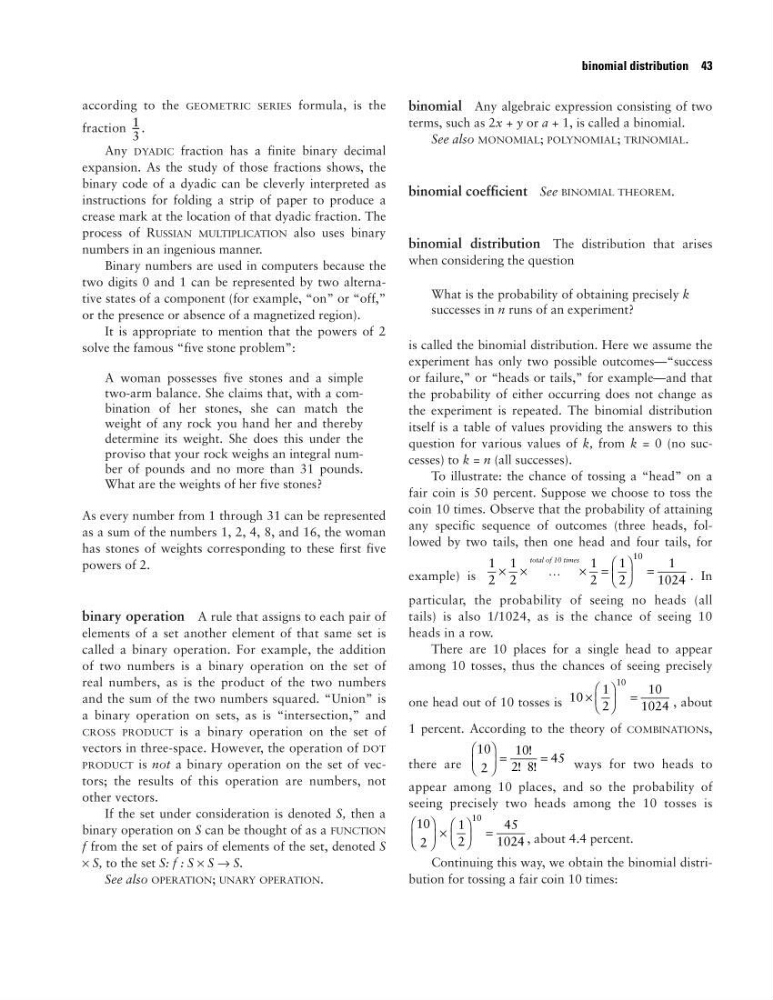
binomial distribution The distribution that arises
when considering the question
What is the probability of obtaining precisely k
successes in n runs of an experiment?
is called the binomial distribution. Here we assume the
experiment has only two possible outcomes—“success
or failure,” or “heads or tails,” for example—and that
the probability of either occurring does not change as
the experiment is repeated. The binomial distribution
itself is a table of values providing the answers to this
question for various values of k, from k = 0 (no successes) to k = n (all successes).
To illustrate: the chance of tossing a “head” on a
fair coin is 50 percent. Suppose we choose to toss the
coin 10 times. Observe that the probability of attaining
any specific sequence of outcomes (three heads, followed by two tails, then one head and four tails, for
example) is
. In
particular, the probability of seeing no heads (all
tails) is also 1/1024, as is the chance of seeing 10
heads in a row.
There are 10 places for a single head to appear
among 10 tosses, thus the chances of seeing precisely
one head out of 10 tosses is
, about
1 percent. According to the theory of COMBINATIONs,
there are
ways for two heads to
appear among 10 places, and so the probability of
seeing precisely two heads among the 10 tosses is
, about 4.4 percent.
Continuing this way, we obtain the binomial distribution for tossing a fair coin 10 times:
10
2
1
2
45
1024
10
⎛
⎝
⎜
⎞
⎠
⎟ ×
⎛
⎝
⎜
⎞
⎠
⎟ =
10
2
10
2 8
45
⎛
⎝
⎜
⎞
⎠
⎟ =
=
!
! !
10
1
2
10
1024
10
×
⎛
⎝
⎜
⎞
⎠
⎟ =
1
2
1
2
1
2
1
2
1
1024
10
× ×
… × =
⎛
⎝
⎜
⎞
⎠
⎟ =
total of 10 times
1
3
binomial distribution 43
fraction .
Any DYADIC fraction has a finite binary decimal
expansion. As the study of those fractions shows, the
binary code of a dyadic can be cleverly interpreted as
instructions for folding a strip of paper to produce a
crease mark at the location of that dyadic fraction. The
process of RUSSIAN MULTIPLICATION also uses binary
numbers in an ingenious manner.
Binary numbers are used in computers because the
two digits 0 and 1 can be represented by two alternative states of a component (for example, “on” or “off,”
or the presence or absence of a magnetized region).
It is appropriate to mention that the powers of 2
solve the famous “five stone problem”:
A woman possesses five stones and a simple
two-arm balance. She claims that, with a combination of her stones, she can match the
weight of any rock you hand her and thereby
determine its weight. She does this under the
proviso that your rock weighs an integral number of pounds and no more than 31 pounds.
What are the weights of her five stones?
As every number from 1 through 31 can be represented
as a sum of the numbers 1, 2, 4, 8, and 16, the woman
has stones of weights corresponding to these first five
powers of 2.
binary operation A rule that assigns to each pair of
elements of a set another element of that same set is
called a binary operation. For example, the addition
of two numbers is a binary operation on the set of
real numbers, as is the product of the two numbers
and the sum of the two numbers squared. “Union” is
a binary operation on sets, as is “intersection,” and
CROSS PRODUCT is a binary operation on the set of
vectors in three-space. However, the operation of DOT
PRODUCT is not a binary operation on the set of vectors; the results of this operation are numbers, not
other vectors.
If the set under consideration is denoted S, then a
binary operation on S can be thought of as a FUNCTION
f from the set of pairs of elements of the set, denoted S
× S, to the set S: f : S × S → S.
See also OPERATION; UNARY OPERATION.
binomial Any algebraic expression consisting of two
terms, such as 2x + y or a + 1, is called a binomial.
See also MONOMIAL; POLYNOMIAL; TRINOMIAL.
binomial coefficient See BINOMIAL THEOREM.
binomial distribution The distribution that arises
when considering the question
What is the probability of obtaining precisely k
successes in n runs of an experiment?
is called the binomial distribution. Here we assume the
experiment has only two possible outcomes—“success
or failure,” or “heads or tails,” for example—and that
the probability of either occurring does not change as
the experiment is repeated. The binomial distribution
itself is a table of values providing the answers to this
question for various values of k, from k = 0 (no successes) to k = n (all successes).
To illustrate: the chance of tossing a “head” on a
fair coin is 50 percent. Suppose we choose to toss the
coin 10 times. Observe that the probability of attaining
any specific sequence of outcomes (three heads, followed by two tails, then one head and four tails, for
example) is
. In
particular, the probability of seeing no heads (all
tails) is also 1/1024, as is the chance of seeing 10
heads in a row.
There are 10 places for a single head to appear
among 10 tosses, thus the chances of seeing precisely
one head out of 10 tosses is
, about
1 percent. According to the theory of COMBINATIONs,
there are
ways for two heads to
appear among 10 places, and so the probability of
seeing precisely two heads among the 10 tosses is
, about 4.4 percent.
Continuing this way, we obtain the binomial distribution for tossing a fair coin 10 times:
10
2
1
2
45
1024
10
⎛
⎝
⎜
⎞
⎠
⎟ ×
⎛
⎝
⎜
⎞
⎠
⎟ =
10
2
10
2 8
45
⎛
⎝
⎜
⎞
⎠
⎟ =
=
!
! !
10
1
2
10
1024
10
×
⎛
⎝
⎜
⎞
⎠
⎟ =
1
2
1
2
1
2
1
2
1
1024
10
× ×
… × =
⎛
⎝
⎜
⎞
⎠
⎟ =
total of 10 times
1
3
binomial distribution 43