

However, as was the tradition at the time, Bh – askara did
not explain how he derived his results. It is conjectured
that Indian astronomers and mathematicians felt it necessary to conceal their methods regarding proofs and
derivations as “trade secrets” of the art.
Bh – askara’s accomplishments were revered for
many centuries. In 1817, H. J. Colebrook provided
English translations of both Lilavati and Bijaganita in
his text Algebra with Arithmetic and Mensuration.
bias A systematic error in a statistical study is called a
bias. If the sample in the study is large, errors produced
by chance tend to cancel each other out, but those from a
bias do not. For example, a survey on the shopping
habits of the general population conducted at a shopping
mall is likely to be biased toward people who shop primarily at malls, omitting results from people who shop
from home through catalogs and on-line services. This is
similar to a loaded die, which is biased to produce a particular outcome with greater than one-sixth probability.
Surprisingly, American pennies are biased. If you
delicately balance 30 pennies on edge and bump the surface on which they stand, most will fall over heads up.
If, on the other hand, you spin 30 pennies and let them
all naturally come to rest, then most will land tails.
See also POPULATION AND SAMPLE.
biconditional In FORMAL LOGIC, a statement of the
form “p if, and only if, q” is called a biconditional
statement. For example, “A triangle is equilateral if,
and only if, it is equiangular” is a biconditional statement. A biconditional statement is often abbreviated as
p iff q and is written in symbols as p ↔ q. It is equivalent to the compound statement “p implies q, and q
implies p” composed of two CONDITIONAL statements.
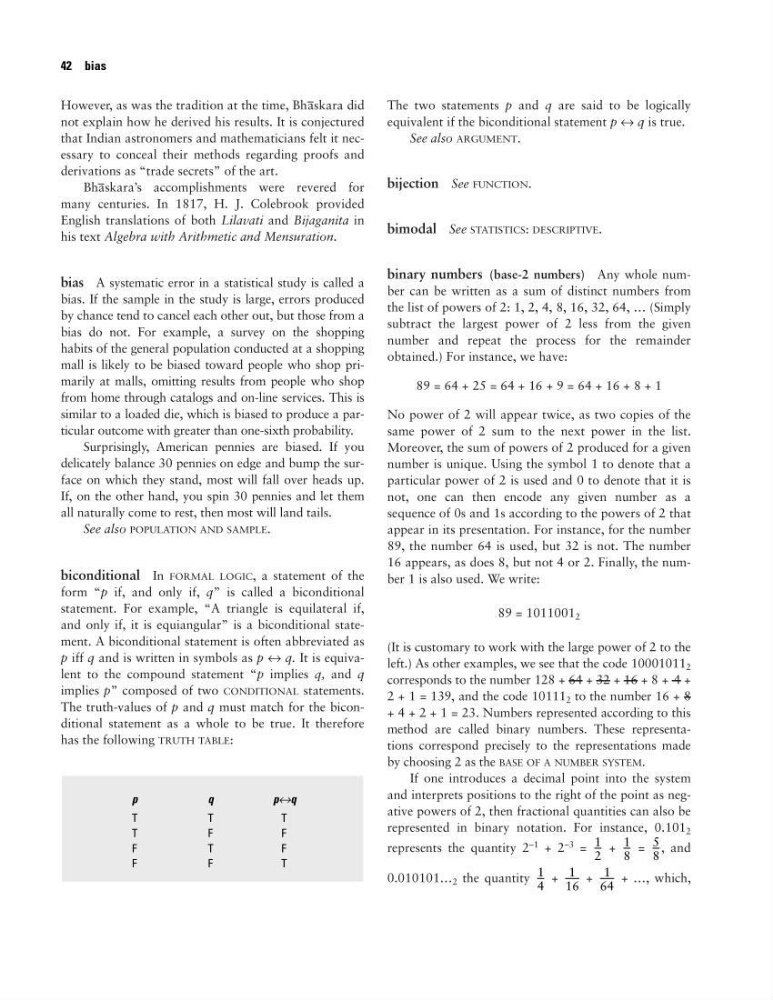
The truth-values of p and q must match for the biconditional statement as a whole to be true. It therefore
has the following TRUTH TABLE:
The two statements p and q are said to be logically
equivalent if the biconditional statement p ↔ q is true.
See also ARGUMENT.
bijection See FUNCTION.
bimodal See STATISTICS: DESCRIPTIVE.
binary numbers (base-2 numbers) Any whole number can be written as a sum of distinct numbers from
the list of powers of 2: 1, 2, 4, 8, 16, 32, 64, … (Simply
subtract the largest power of 2 less from the given
number and repeat the process for the remainder
obtained.) For instance, we have:
89 = 64 + 25 = 64 + 16 + 9 = 64 + 16 + 8 + 1
No power of 2 will appear twice, as two copies of the
same power of 2 sum to the next power in the list.
Moreover, the sum of powers of 2 produced for a given
number is unique. Using the symbol 1 to denote that a
particular power of 2 is used and 0 to denote that it is
not, one can then encode any given number as a
sequence of 0s and 1s according to the powers of 2 that
appear in its presentation. For instance, for the number
89, the number 64 is used, but 32 is not. The number
16 appears, as does 8, but not 4 or 2. Finally, the number 1 is also used. We write:
89 = 1011001 2
(It is customary to work with the large power of 2 to the
left.) As other examples, we see that the code 10001011 2
corresponds to the number 128 + 64 + 32 + 16 + 8 + – 4 +
2 + 1 = 139, and the code 10111 2 to the number 16 + 8
+ 4 + 2 + 1 = 23. Numbers represented according to this
method are called binary numbers. These representations correspond precisely to the representations made
by choosing 2 as the BASE OF A NUMBER SYSTEM.
If one introduces a decimal point into the system
and interprets positions to the right of the point as negative powers of 2, then fractional quantities can also be
represented in binary notation. For instance, 0.101 2
represents the quantity 2
–1 + 2
–3 =
+
= , and
0.010101… 2 the quantity
+
+
+ …, which,
1
64
1
16
1
4
5
8
1
8
1
2
p
q
p ↔q
T
T
T
T
F
F
F
T
F
F
F
T
42 bias
not explain how he derived his results. It is conjectured
that Indian astronomers and mathematicians felt it necessary to conceal their methods regarding proofs and
derivations as “trade secrets” of the art.
Bh – askara’s accomplishments were revered for
many centuries. In 1817, H. J. Colebrook provided
English translations of both Lilavati and Bijaganita in
his text Algebra with Arithmetic and Mensuration.
bias A systematic error in a statistical study is called a
bias. If the sample in the study is large, errors produced
by chance tend to cancel each other out, but those from a
bias do not. For example, a survey on the shopping
habits of the general population conducted at a shopping
mall is likely to be biased toward people who shop primarily at malls, omitting results from people who shop
from home through catalogs and on-line services. This is
similar to a loaded die, which is biased to produce a particular outcome with greater than one-sixth probability.
Surprisingly, American pennies are biased. If you
delicately balance 30 pennies on edge and bump the surface on which they stand, most will fall over heads up.
If, on the other hand, you spin 30 pennies and let them
all naturally come to rest, then most will land tails.
See also POPULATION AND SAMPLE.
biconditional In FORMAL LOGIC, a statement of the
form “p if, and only if, q” is called a biconditional
statement. For example, “A triangle is equilateral if,
and only if, it is equiangular” is a biconditional statement. A biconditional statement is often abbreviated as
p iff q and is written in symbols as p ↔ q. It is equivalent to the compound statement “p implies q, and q
implies p” composed of two CONDITIONAL statements.
The truth-values of p and q must match for the biconditional statement as a whole to be true. It therefore
has the following TRUTH TABLE:
The two statements p and q are said to be logically
equivalent if the biconditional statement p ↔ q is true.
See also ARGUMENT.
bijection See FUNCTION.
bimodal See STATISTICS: DESCRIPTIVE.
binary numbers (base-2 numbers) Any whole number can be written as a sum of distinct numbers from
the list of powers of 2: 1, 2, 4, 8, 16, 32, 64, … (Simply
subtract the largest power of 2 less from the given
number and repeat the process for the remainder
obtained.) For instance, we have:
89 = 64 + 25 = 64 + 16 + 9 = 64 + 16 + 8 + 1
No power of 2 will appear twice, as two copies of the
same power of 2 sum to the next power in the list.
Moreover, the sum of powers of 2 produced for a given
number is unique. Using the symbol 1 to denote that a
particular power of 2 is used and 0 to denote that it is
not, one can then encode any given number as a
sequence of 0s and 1s according to the powers of 2 that
appear in its presentation. For instance, for the number
89, the number 64 is used, but 32 is not. The number
16 appears, as does 8, but not 4 or 2. Finally, the number 1 is also used. We write:
89 = 1011001 2
(It is customary to work with the large power of 2 to the
left.) As other examples, we see that the code 10001011 2
corresponds to the number 128 + 64 + 32 + 16 + 8 + – 4 +
2 + 1 = 139, and the code 10111 2 to the number 16 + 8
+ 4 + 2 + 1 = 23. Numbers represented according to this
method are called binary numbers. These representations correspond precisely to the representations made
by choosing 2 as the BASE OF A NUMBER SYSTEM.
If one introduces a decimal point into the system
and interprets positions to the right of the point as negative powers of 2, then fractional quantities can also be
represented in binary notation. For instance, 0.101 2
represents the quantity 2
–1 + 2
–3 =
+
= , and
0.010101… 2 the quantity
+
+
+ …, which,
1
64
1
16
1
4
5
8
1
8
1
2
p
q
p ↔q
T
T
T
T
F
F
F
T
F
F
F
T
42 bias