

circle at the point M = (1,0). Extend the radius
OP further until it meets the tangent line at Q.
Then tan θ is the length of the tangent linesegment MQ and sec θ is the length of the
secant to the circle OQ.
Dividing the Pythagorean identity sin
2
θ + cos
2
θ = 1
through by cos
2
θ and by sin
2
θ yields the identities:
1 + tan
2
θ = sec
2
θ
1 + cot
2
θ = csc
2
θ
The Addition and Subtraction Formulae
The diagram on the following page shows that two
congruent copies of a right triangle containing an angle
A and two copies of a second right triangle containing
an angle B can be arranged in the same large rectangle
in two different ways.
The AREA of the region surrounding the four triangles, which must be the same for each diagram, can be
computed as the sum of areas of two rectangles or as
the area of a PARALLELOGRAM of base of length 1, and
height of length cos(A – B). This yields the difference
formula for cosines:
cos(A – B) = cos A cos B + sin A sin B
Substituting in –B for B, yields the addition formula for
cosines:
cos(A + B) = cos A cos(–B) + sin A sin(–B)
= cos A cos B – sin A sin B
trigonometry 511
translate the Sanskrit word jy –
a, into their texts and simply
wrote jiba as a close approximation.
In the 12th century, European scholars began translating the Arabic works and soon became acquainted with the
extensive theory of trigonometry. Misinterpreting jiba as the
Arabic word jaib for “cove” or “bay,” translators wrote the
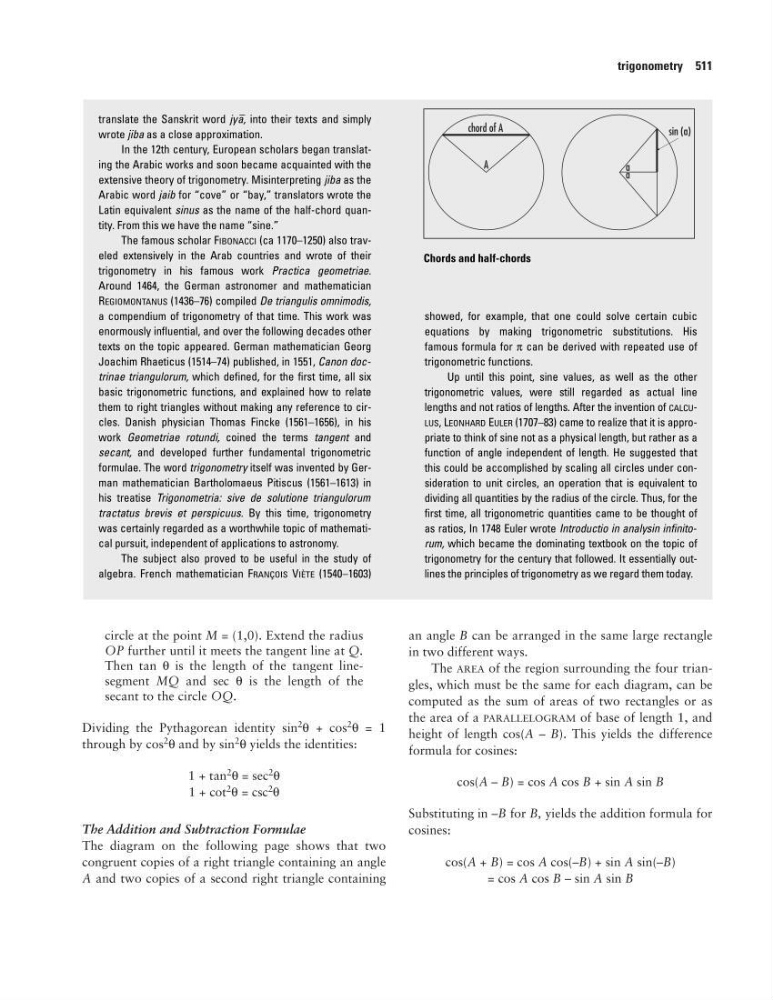
Latin equivalent sinus as the name of the half-chord quantity. From this we have the name “sine.”
The famous scholar FIBONACCI (ca 1170–1250) also traveled extensively in the Arab countries and wrote of their
trigonometry in his famous work Practica geometriae.
Around 1464, the German astronomer and mathematician
REGIOMONTANUS (1436–76) compiled De triangulis omnimodis,
a compendium of trigonometry of that time. This work was
enormously influential, and over the following decades other
texts on the topic appeared. German mathematician Georg
Joachim Rhaeticus (1514–74) published, in 1551, Canon doctrinae triangulorum, which defined, for the first time, all six
basic trigonometric functions, and explained how to relate
them to right triangles without making any reference to circles. Danish physician Thomas Fincke (1561–1656), in his
work Geometriae rotundi, coined the terms tangent and
secant, and developed further fundamental trigonometric
formulae. The word trigonometry itself was invented by German mathematician Bartholomaeus Pitiscus (1561–1613) in
his treatise Trigonometria: sive de solutione triangulorum
tractatus brevis et perspicuus. By this time, trigonometry
was certainly regarded as a worthwhile topic of mathematical pursuit, independent of applications to astronomy.
The subject also proved to be useful in the study of
algebra. French mathematician FRANÇOIS VIÈTE (1540–1603)
showed, for example, that one could solve certain cubic
equations by making trigonometric substitutions. His
famous formula for π can be derived with repeated use of
trigonometric functions.
Up until this point, sine values, as well as the other
trigonometric values, were still regarded as actual line
lengths and not ratios of lengths. After the invention of CALCULUS, LEONHARD EULER (1707–83) came to realize that it is appropriate to think of sine not as a physical length, but rather as a
function of angle independent of length. He suggested that
this could be accomplished by scaling all circles under consideration to unit circles, an operation that is equivalent to
dividing all quantities by the radius of the circle. Thus, for the
first time, all trigonometric quantities came to be thought of
as ratios, In 1748 Euler wrote Introductio in analysin infinitorum, which became the dominating textbook on the topic of
trigonometry for the century that followed. It essentially outlines the principles of trigonometry as we regard them today.
Chords and half-chords
OP further until it meets the tangent line at Q.
Then tan θ is the length of the tangent linesegment MQ and sec θ is the length of the
secant to the circle OQ.
Dividing the Pythagorean identity sin
2
θ + cos
2
θ = 1
through by cos
2
θ and by sin
2
θ yields the identities:
1 + tan
2
θ = sec
2
θ
1 + cot
2
θ = csc
2
θ
The Addition and Subtraction Formulae
The diagram on the following page shows that two
congruent copies of a right triangle containing an angle
A and two copies of a second right triangle containing
an angle B can be arranged in the same large rectangle
in two different ways.
The AREA of the region surrounding the four triangles, which must be the same for each diagram, can be
computed as the sum of areas of two rectangles or as
the area of a PARALLELOGRAM of base of length 1, and
height of length cos(A – B). This yields the difference
formula for cosines:
cos(A – B) = cos A cos B + sin A sin B
Substituting in –B for B, yields the addition formula for
cosines:
cos(A + B) = cos A cos(–B) + sin A sin(–B)
= cos A cos B – sin A sin B
trigonometry 511
translate the Sanskrit word jy –
a, into their texts and simply
wrote jiba as a close approximation.
In the 12th century, European scholars began translating the Arabic works and soon became acquainted with the
extensive theory of trigonometry. Misinterpreting jiba as the
Arabic word jaib for “cove” or “bay,” translators wrote the
Latin equivalent sinus as the name of the half-chord quantity. From this we have the name “sine.”
The famous scholar FIBONACCI (ca 1170–1250) also traveled extensively in the Arab countries and wrote of their
trigonometry in his famous work Practica geometriae.
Around 1464, the German astronomer and mathematician
REGIOMONTANUS (1436–76) compiled De triangulis omnimodis,
a compendium of trigonometry of that time. This work was
enormously influential, and over the following decades other
texts on the topic appeared. German mathematician Georg
Joachim Rhaeticus (1514–74) published, in 1551, Canon doctrinae triangulorum, which defined, for the first time, all six
basic trigonometric functions, and explained how to relate
them to right triangles without making any reference to circles. Danish physician Thomas Fincke (1561–1656), in his
work Geometriae rotundi, coined the terms tangent and
secant, and developed further fundamental trigonometric
formulae. The word trigonometry itself was invented by German mathematician Bartholomaeus Pitiscus (1561–1613) in
his treatise Trigonometria: sive de solutione triangulorum
tractatus brevis et perspicuus. By this time, trigonometry
was certainly regarded as a worthwhile topic of mathematical pursuit, independent of applications to astronomy.
The subject also proved to be useful in the study of
algebra. French mathematician FRANÇOIS VIÈTE (1540–1603)
showed, for example, that one could solve certain cubic
equations by making trigonometric substitutions. His
famous formula for π can be derived with repeated use of
trigonometric functions.
Up until this point, sine values, as well as the other
trigonometric values, were still regarded as actual line
lengths and not ratios of lengths. After the invention of CALCULUS, LEONHARD EULER (1707–83) came to realize that it is appropriate to think of sine not as a physical length, but rather as a
function of angle independent of length. He suggested that
this could be accomplished by scaling all circles under consideration to unit circles, an operation that is equivalent to
dividing all quantities by the radius of the circle. Thus, for the
first time, all trigonometric quantities came to be thought of
as ratios, In 1748 Euler wrote Introductio in analysin infinitorum, which became the dominating textbook on the topic of
trigonometry for the century that followed. It essentially outlines the principles of trigonometry as we regard them today.
Chords and half-chords